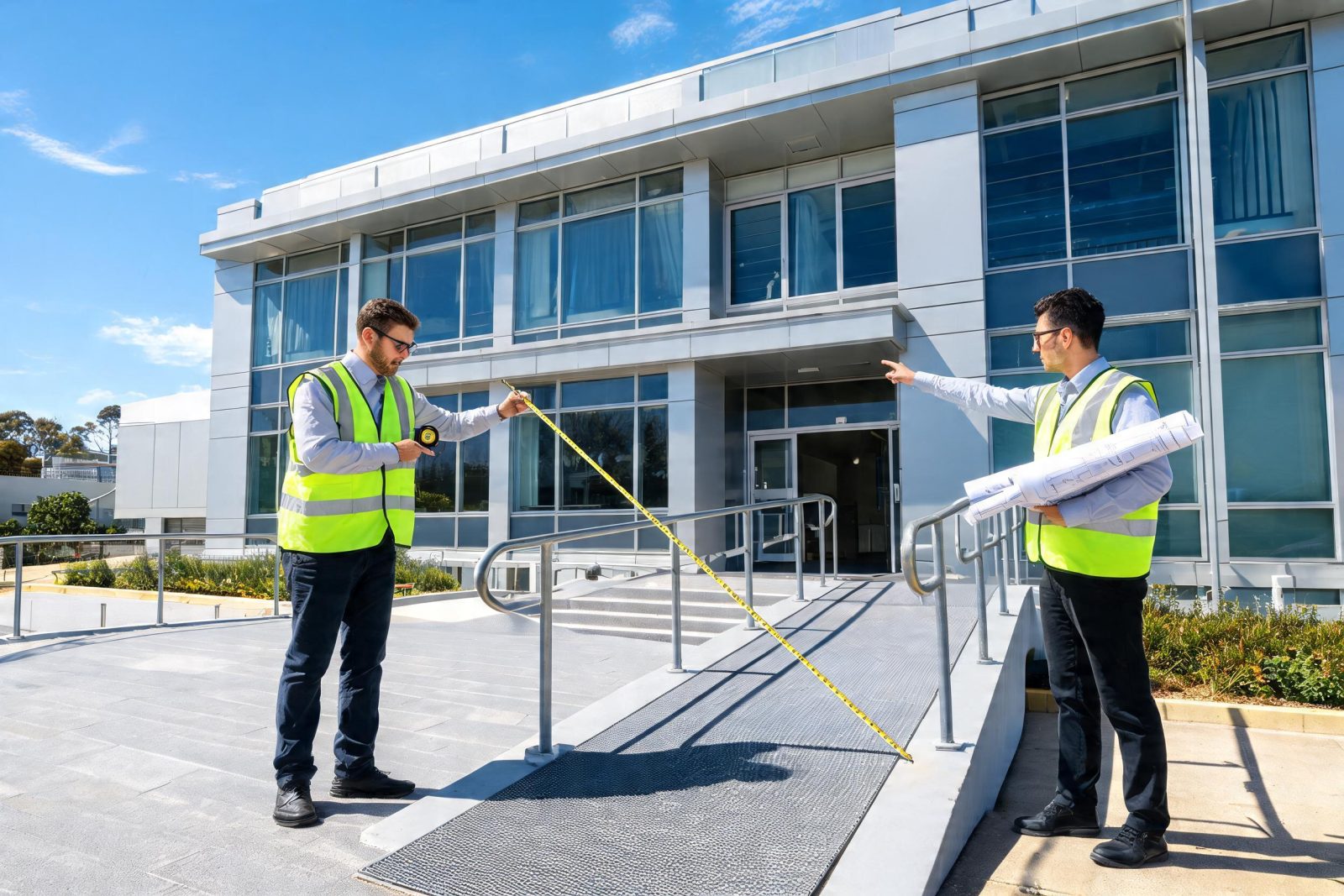
Access Requirements for Class 5, 7b and 8 Buildings training
All courses

Access Requirements for Class 5, 7b and 8 Buildings

Access matters because Australian law makes it unlawful to discriminate against a person with disability, and because buildings that are hard to…

CPD accredited 20 questions · 9-page handbook Recommended renewal: 1 year Accredited by Assured CPD

Enrol and start straight away · assessment & instant e-certificate included

OVERVIEW

About this course.

Access matters because Australian law makes it unlawful to discriminate against a person with disability, and because buildings that are hard to enter, move through or use exclude workers, visitors and customers from ordinary participation in work and public life. Three instruments work together. The Disability Discrimination Act 1992 (Cth) — the DDA — sets the overarching prohibition on disability discrimination, including in access to premises. The Disability (Access to Premises — Buildings) Standards 2010 — the Premises Standards — translate that broad duty into specified building requirements. The National Construction Code (NCC), developed by the ABCB, carries the technical access provisions that are checked at approval. Together they turn a general right into buildable, verifiable requirements.

It helps to understand the DDA first, because it is the foundation on which everything else rests. The DDA is Commonwealth anti-discrimination law, administered in relation to complaints by the Australian Human Rights Commission. It makes discrimination on the ground of disability unlawful across many areas of public life, including employment and the provision of goods, services, facilities and access to premises. Importantly, the DDA operates whether or not a building happens to comply with any particular technical requirement: a person who is denied dignified access to a workplace or a service can, in principle, bring a complaint under the DDA. This is why access is not merely a code-compliance exercise. A building can satisfy the minimum technical provisions and still generate a complaint if, in practice, a person with disability cannot use it on an equal footing. The DDA also recognises the concept of "unjustifiable hardship", which allows that some adjustments may impose costs or difficulties out of all proportion to the benefit — but this is a defence to be established on the facts, not a general excuse, and it is assessed case by case.

The details
  • PriceA$60
  • FormatOnline · self-paced
  • Assessment20 questions · 80% to pass
  • CertificateInstant · 1-yr renewal
  • Course access12 months
Add to basket

Need more than two? A$149 Annual Pass — every course, for a year

  • Independently accredited — Assured CPD
  • Secure card checkout via Stripe
  • Instant certificate · 1-yr renewal
  • Access guarantee — full refund if a technical fault stops you accessing your course
WHAT'S COVERED

Course syllabus.

Why does access matter, and how do the DDA, the Premises Standards and the National Construction Code work together?
What are Class 5, 7b and 8 buildings, and how does classification affect access duties?
What is a continuous accessible path of travel into and through these workplaces?
How are entrances, doorways, ramps, lifts and circulation made accessible in offices, warehouses and factories?
How are sanitary and other facilities provided, and where are access provisions concessional in storage and production areas?
What are the concepts behind signage, wayfinding, and tactile and luminance-contrast provisions?
How do I apply access requirements in practice and work with an access consultant?
Worked scenario
Practical activity
GOOD TO KNOW

Frequently asked questions.

How much does the Access Requirements for Class 5, 7b and 8 Buildings course cost?

It costs A.00 — a one-off payment with no subscription. The price includes the online course, the assessment, and your certificate.

Is Access Requirements for Class 5, 7b and 8 Buildings CPD accredited?

Yes. It is independently accredited by Assured CPD. Your certificate carries a unique ID and QR code that an employer or inspector can verify online at nexiscpd.com.au/verify.

How is the course assessed and when do I get my certificate?

You study online at your own pace, then take a multiple-choice assessment with an 80% pass mark. As soon as you pass, your Assured CPD certificate is emailed to you and available to download instantly.

Does the Access Requirements for Class 5, 7b and 8 Buildings certificate expire?

This certificate has no legal expiry.

Can I take this course online, and how long do I have access?

Yes — the course is 100% online and works on any device. You get 12 months of access to the course materials from the date of purchase.

READY?

Start Access Requirements for Class 5, 7b and 8 Buildings today.

Enrol and begin straight away. Pass the assessment and your Assured CPD certificate is emailed instantly.