How do nurses build a CPD portfolio? A template and reflection examples
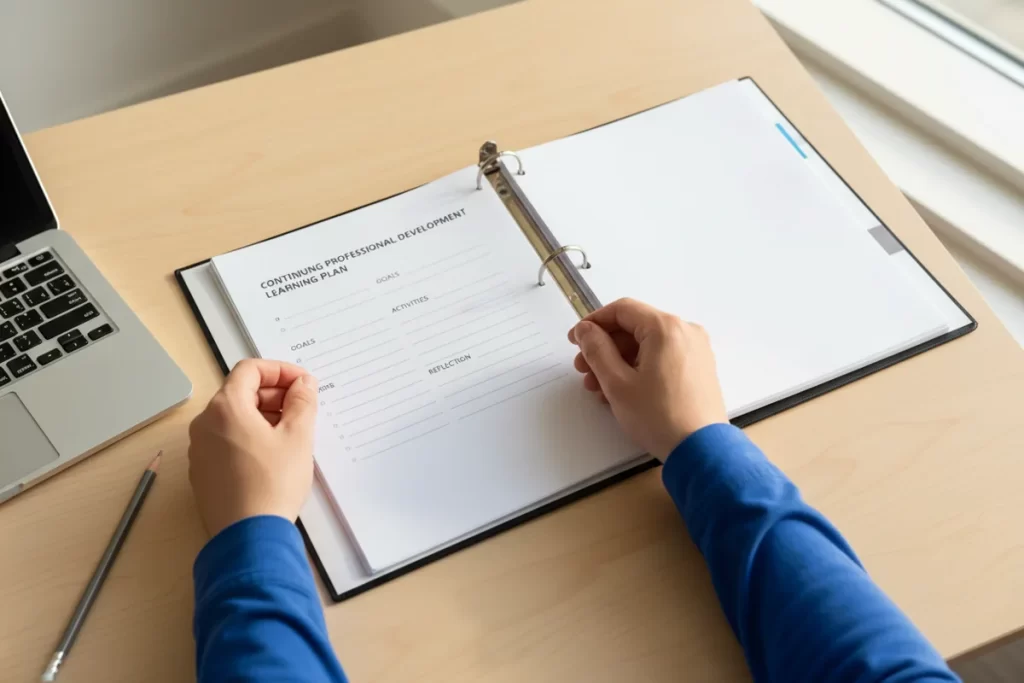
A nursing CPD portfolio brings your learning plan, activity log, reflections and supporting evidence together. For each entry, record what you wanted to learn, what you did, the date and time spent, and how the learning relates to your practice. Save the evidence with the entry so you can find it if the Nursing and Midwifery Board of Australia asks.

On this page
- What should you put in a nursing CPD portfolio?
- How do you write a reflection that shows what changed?
- How do you link a learning plan to your activity log?
- How do you organise your records before an audit?
- What does a complete nursing CPD entry look like?
- How do you record a workshop, a course or independent reading?
- How can you write CPD reflections in different nursing roles?
- How do you turn a vague reflection into something you can follow up?
- What should you do if your CPD evidence is missing?
- How can you maintain your portfolio throughout the year?
- What should you check before sharing your CPD portfolio?
- Frequently asked questions
What should you put in a nursing CPD portfolio?
Start with three items you can retrieve easily. Keep a learning plan that sets out the skills or knowledge you want to develop, a log that connects each activity to those goals, and a folder with its supporting evidence. The NMBA provides a self-directed CPD evidence record you can adapt for this purpose. NMBA self-directed CPD evidence record
Give each learning activity a reference such as CPD-2026-04. Use the same reference in your log and the evidence filename. A clear reference, date and short topic make it easier to find the right document when several activities have similar titles.
Copy these fields into a spreadsheet or notes app. If one activity addresses several goals, explain the links in the same record and enter its duration once in your total.
| Field | What to record |
|---|---|
| Learning goal | The gap you identified and how it relates to your role. |
| Activity | Title, provider or source, date completed and time spent. |
| Reflection | What you learnt and which part of your practice it relates to. |
| Next step | One action you can take or a question you will review with your team. |
| Evidence | A certificate, attendance confirmation or other appropriate supporting record, with its filename. |
How do you write a reflection that shows what changed?
A useful nursing CPD reflection answers three questions. What did you need to improve? What did this activity teach you? What will you do with the learning? Write it soon after the activity, while you can still describe the details. Add a follow-up note later if you have had a chance to test the change in practice.
Example 1. An online course about professional boundaries. A nurse wants to respond more consistently when a patient tries to connect through a personal social media account. After training, they record what they would say and which local policy they will check.
The course example helped me practise redirecting a personal message to an approved service channel. I will check the wording against our social media policy and discuss a fictional scenario with my supervisor at our next check-in.
A course such as Professional Boundaries in Nursing and Midwifery can help you identify situations to reflect on. Record the evidence and learning that actually apply to your role.
Example 2. Self-directed reading about cultural safety. A nurse educator wants feedback on the way they present a teaching scenario. They record what they read, how long the study took and what action followed.
The reading prompted me to check who gets to define whether our teaching scenario feels culturally safe. I will ask our education team how we seek feedback from the people represented in the scenario before using it again.
If you want a structured activity on the same theme, compare the course outline for Cultural Safety in Nursing and Midwifery Practice with the gap in your learning plan.
How do you link a learning plan to your activity log?
Give each goal a short label and carry it into your activity entries. A nurse educator might use “Improve feedback in simulation” for a workshop, a structured reading session and a later discussion with colleagues. At the end of the period, they can see which activities addressed the goal and decide what still needs practice.
How do you organise your records before an audit?
Review your portfolio in the order an auditor would be likely to need it. Start with the relevant registration period, check that every activity has a date and duration, and follow each evidence reference to the supporting file. The NMBA tells practitioners to retain their CPD evidence for at least five years from the date they completed the activity. NMBA CPD guidance
- Match the period in your log to the registration period you are reviewing.
- Open each attachment and check that it relates to the stated activity.
- Check that each reflection explains why the learning matters to your work.
- Record any missing evidence and request it while the provider can still supply it.
- Use a secure location that you can access if you leave your employer. Keep identifiable patient details out of portfolio records.
For a learning goal about better clinical records, Documentation in Nursing and Midwifery is an example of a course you could compare with your own needs. Keep portfolio reflections separate from patient records.
What does a complete nursing CPD entry look like?
A complete entry lets someone follow the connection from your learning need to your evidence. Use a consistent format for a course, discussion or reading activity. Change the supporting material to match what you did. In the fictional example below, a nurse links a course about documentation to a specific handover problem and names a follow-up they can actually do.
| Field | Fictional example |
|---|---|
| Activity reference | CPD-2026-08 |
| Role and practice need | Ward nurse. Make responsibility for follow-up clearer during written handovers. |
| Learning activity | Online module on professional documentation, followed by a fictional handover exercise. |
| Date and time | 12 August 2026. 45 minutes of learning and 15 minutes of structured reflection, recorded separately in the notes. |
| What I learnt | I can separate what I observed, what action was agreed and who will follow up. |
| Next step | Ask an educator to review a fictional handover entry using the ward’s current template. |
| Evidence | Completion certificate, module outline and dated reflection saved under the activity reference. |
| Follow-up | The educator identified that the example still needed a clearer review time. I revised the entry and added that point to my practice checklist. |
The times in this example illustrate recordkeeping. Enter your actual learning time, check what elements your registration standard allows you to count and use the same units throughout the log. If a provider’s certificate lists a course duration and your timed session differs, keep the actual details clear so you can explain the entry later. NMBA CPD registration standard
How do you record a workshop, a course or independent reading?
Use the same basic record for each type of activity. Enter the date, learning goal, time, what you learnt and a reference for the supporting material. For structured independent reading, the source and your notes will often carry more weight than a receipt or calendar entry. Capture those details while you can still find the exact material.
| Activity | Evidence to consider keeping | Reflection prompt |
|---|---|---|
| Online course | Certificate, course outline and any record of an exercise. | Which part of the course addressed the gap you identified? |
| Live workshop or webinar | Attendance confirmation, programme and notes on the relevant session. | What question did you bring and what was your answer afterwards? |
| Independent reading | Author or organisation, title, edition or date, link and notes. | Which idea could you apply and what would you check first? |
| Discussion or supervised learning exercise | Agenda, learning objective and a dated summary of the exercise or feedback. | What did feedback reveal about your own approach? |
| Multi-session programme | Session list, dates and a record of the parts you attended. | Which sessions relate to your role and which learning will you follow up? |
Count a learning activity consistently. If you receive a certificate for a workshop and also have attendance confirmation, attach both to one entry. When a long programme covers several topics, keep one record with dated session notes or use individual entries that add up to the relevant learning time. Reconcile the total before renewal. NMBA guidance on continuing professional development
When reading an online resource, save its publication date and any version number with the link. A bookmark alone may eventually point to a revised page. A short note on what you read and when gives you enough context to identify the material later. Use a document your employer permits you to keep and keep workplace records in authorised systems.
How can you write CPD reflections in different nursing roles?
A reflection can describe a change in education, management or another aspect of practice that matters to your role. Begin with a question you faced, describe how the activity changed your understanding and choose a follow-up. The examples below illustrate how the same structure works for a midwife, a nurse educator and a team leader.
Midwifery example. A midwife attends a teaching session on communication across care settings. They want to be clearer about whom to contact when sharing follow-up information. Their reflection might read:
The session helped me see why the recipient needs a clear action as well as a summary. I will check which handover format our service uses and bring a fictional example to the next team discussion.
Nurse educator example. An educator reads about structuring feedback after simulation. They realise their feedback often lists several issues at once. Their reflection might read:
I will start by asking the learner which part of the scenario they found most difficult. Then I will use one specific observation and agree one thing to rehearse before the next session. I can ask a colleague to observe the debrief and tell me whether the learner can describe the next step.
Team leader example. A team leader attends a workshop on raising workplace concerns. Their aim is to improve how they document agreed follow-up. Their reflection might read:
The workshop made me check whether my notes distinguish a concern someone raised from the action we agreed. I will review the team’s approved meeting template and ask another lead to read a fictional action note for clarity.
Write to the level of detail needed to explain your learning. Keep patient names, record numbers and other details that could identify a person out of the portfolio. If workplace material contains identifiable information, record the learning in your own words and retain any necessary approved evidence through the workplace process.
How do you turn a vague reflection into something you can follow up?
Start with the skill you wanted to improve and describe what you would do differently in one recognisable situation. A vague statement such as “This was useful and I will use it at work” gives you little to revisit. Add enough detail for a colleague to understand the learning and help you assess whether it made a difference.
A nurse might first write, “I improved my documentation.” That sentence leaves the activity and change unclear. A more useful version would be, “The exercise showed me that my fictional handover did not say who would follow up. I rewrote it using the local template and will ask the educator to check whether the responsibility is clear.” The revised version provides a task the educator can assess without needing any patient details.
A reflection can also show that you need more support. If a course raised a question you cannot yet answer, write down what remains unclear and who can help. At your next review, add a dated sentence about the result. Keep the original entry so you can follow the change in your understanding.
What should you do if your CPD evidence is missing?
Check the provider or organiser first and request the appropriate record. If a certificate cannot be found, look for other evidence connected to the activity, such as an attendance email, an agenda or the published resource you studied. Keep a note of what you have and what you requested. Follow any instructions from the NMBA about evidence it asks you to supply.
If you cannot recall how long an activity took, check any entries you made at the time and request the provider’s record. Preserve the uncertainty if the evidence does not establish a duration. Filling in a convenient number makes it harder to explain the record later. If an entry depends on an outstanding document, mark it for follow-up so you can see what remains incomplete at renewal.
Avoid relying on automatic access to a learning portal. Download the records you are allowed to keep after each activity, open the files to make sure they are readable, and use a backup location that meets your organisation’s privacy rules. If your employer uses a training system, find out how you can obtain approved copies before changing roles.
How can you maintain your portfolio throughout the year?
Make an entry when you finish each activity and set a short review in your calendar partway through the registration period. During the review, match your log to your goals, open the supporting files, and check whether activities and learning time fit the current requirements for your registration. Decide what to learn next while there is time to act.
- After the activity: Save the evidence, record the date and time, and add a reflection.
- At a mid-period review: Check whether your learning still matches your role and record any gaps.
- When your role changes: Add a learning goal for the new work and record where it applies.
- Before renewal: Reconcile the total, check evidence and keep the record accessible.
- After renewal: File the completed period and start a new log. Keep supporting evidence for the time specified by the NMBA.
If you hold more than one registration type or an endorsement, check the applicable standard and note which activities relate to each context of practice. A separate column for relevance can make that easier. Keep the evidence with the original entry and follow the Board’s rules for when shared learning may count. NMBA CPD guidance
What should you check before sharing your CPD portfolio?
Check who needs the record and which part they need to see. You may have a complete portfolio for your own use and a smaller set of records for a particular request. Read the instructions, match the evidence to the right registration period and check that each document can be opened. Use the channel specified in the request.
Imagine a nurse wants to share an example with a colleague to help them set up their own log. The nurse can share a blank version of the template and a fictional example rather than forwarding a completed record with personal or workplace details. For a regulator request, follow the stated instructions and keep a copy of what you supplied.
Review exports as well as the original files. A spreadsheet may contain hidden tabs, and a document may include comments that are not visible on the printed page. Make a clean version for sharing when appropriate and keep your original evidence in your own organised record.
Frequently asked questions
Can I use a certificate as my whole nursing CPD record?
A certificate can support proof of completion. Add a log entry showing your learning goal, date, duration, reflection and relevance to your practice. Use the Board’s evidence guidance when checking your record.
How do I record learning that has no certificate?
Record the source, date, learning time and a short reflection. Keep an appropriate supporting item, such as a reference to the reading or the outline for a discussion. Check the NMBA’s guidance on self-directed learning.
Does the NMBA require me to use a particular app?
The NMBA provides an evidence record to help you organise CPD. Use the Board’s current instructions for your registration category, including any directions you receive if selected for an audit.