Working alone in Australia: how to set up a lone-worker safety plan
A lone-worker safety plan sets out which tasks a person can do alone, how they will keep in touch, who will notice if contact is lost and how help will reach them. Start by removing avoidable solo work. For tasks that remain, match the controls to the risks at that location and time, then test both the communications and the emergency response.
On this page
- What counts as working alone or in isolation?
- What does Australian WHS law require for lone workers?
- Which tasks should be moved, paired or paused?
- What should a lone-worker check-in plan include?
- What should happen if a check-in is missed?
- How can you tell whether your lone-worker procedure works?
- Frequently asked questions
By the Nexis CPD editorial team. Australian requirements and guidance checked on 16 November 2026.
What counts as working alone or in isolation?
Remote or isolated work is work where getting help is difficult because of where, when or how the job is done. A person can be isolated in a busy suburb if nobody can see, hear or quickly reach them. Assess whether the worker could summon help and whether someone could reach them promptly if they were unable to make the call themselves. Safe Work Australia
Think about each part of the shift. A maintenance worker may have good support while a community centre is open. After the front doors lock, the same worker might be alone in a service area that can only be reached through a separate gate. That changes both the time it takes to notice a problem and the time it takes to reach the worker.
An outreach worker can be isolated in a client’s home even if the client is present. A field worker travelling between rural properties may face a different problem between appointments if their communication system fails on the road. Mark these changes on the roster or route so the plan reflects the whole job. WorkSafe Victoria guidance on remote and isolated work
What does Australian WHS law require for lone workers?
The model Work Health and Safety (WHS) Regulations require a person conducting a business or undertaking (PCBU) to manage risks associated with remote or isolated work. Regulation 48 requires a system of work that includes effective communication when minimising those risks. Apply the laws and guidance in force at the job location. Victoria uses its own occupational health and safety framework. Safe Work Australia’s WHS duties guidance
In NSW, for example, section 48 of the Work Health and Safety Regulation 2025 sets out the remote and isolated work duty. Section 43 deals with emergency plans, including how the workplace responds and how emergency procedures are tested. A lone-worker process should say how it connects to the wider emergency plan, including who calls for help and how responders can get in. NSW Work Health and Safety Regulation 2025
WorkSafe Victoria advises employers to plan how they will keep in touch with workers and appoint a backup contact when the usual manager is unavailable. If you manage staff or contractors across borders, check the legal duties and applicable codes at each location. The Nexis guide to which WHS laws apply in your state explains where to start. WorkSafe Victoria guidance
Which tasks should be moved, paired or paused?
Decide which tasks can be eliminated, rescheduled or assigned to a team before designing a check-in process. Consider what could go wrong, how quickly the worker would need help, and what task-specific requirements apply. A reliable radio can help a worker report a problem. Where a task requires another person on site or a suitable rescue arrangement, schedule the people and equipment before work begins. Safe Work Australia model code of practice
Walk through the job with the people who do it. Where are there blind spots? When does the public enter? Who can help when the site is locked? Ask about changes that might be invisible on a paper roster, such as one worker regularly finishing late or a task that often takes them out of radio range. The psychosocial hazards at work guide explains how isolation can combine with job demands and poor support.
| Situation | What to check with the team | Possible response to assess |
|---|---|---|
| Closing a public venue after hours | Who remains inside, how the worker exits, and which areas have coverage. | Send a pair for the final sweep or do it while another worker is still on site. |
| Visiting a client at home | Risks flagged before the visit, safe exit, and whether the worker can call discreetly. | Arrange a paired visit or offer a staffed venue when the risk assessment calls for it. |
| Driving to a rural worksite | Dead zones along the route, access roads, weather and realistic response times. | Use a tested alternative communication system, change the route or defer the trip. |
| Carrying out maintenance in a locked area | Hazards from equipment, access restrictions and rescue arrangements. | Restrict solo work to assessed low-risk tasks and schedule higher-risk work with appropriate support. |
Set decision points when the plan is made. A worker who arrives to find a locked exit, unexpectedly poor coverage or a new hazard needs a clear instruction to stand down, move to a safe location and contact the supervisor. Explain who can authorise a different plan, and make sure the roster allows time to stop without having to explain the delay during an emergency.
What should a lone-worker check-in plan include?
Write down who is working, where they will be, what work is approved, how to contact them and who will act if contact is lost. A named monitor should actively confirm each check-in. Choose a backup channel and a backup person, and make the escalation instructions easy for both people to find wherever they are working. Safe Work Australia model code of practice
Use this table to create a shift card that the worker and monitor can both use. For a fixed workplace, a card may cover recurring shifts with a roster showing who is on duty. For mobile work, give the monitor an appropriate record of the planned route or stops and an agreed way to confirm changes.
| Field | What to put on the shift card |
|---|---|
| Worker and job | Name, today’s permitted tasks, planned start and finish, and changes that need supervisor approval. |
| Location and access | Street address or coordinates where appropriate, last planned work zone, and the entry point or access contact for responders. |
| Primary communication | The tested device or channel and the expected form of acknowledgement. |
| Backup communication | A fallback that works when the primary channel is unavailable. State where it has been tested. |
| Person monitoring the shift | The rostered contact, a backup and how they explicitly accept handover. |
| Contact schedule | Start and finish checks, checks at defined stages or times, and how to confirm a revised schedule. |
| Escalation | Who makes the first contact attempt, who takes over, when emergency services are required and who meets responders. |
| Completion | Who records that the worker has signed out safely and what to do if the shift overruns. |
Choose the timing by working backwards from how soon help may be needed. Include the delay before anyone spots a missed check, the time to act and the time for help to arrive. An interval that works in an open office can leave too much time unobserved in a locked service area. A job that cannot be made safe enough with periodic calls needs stronger controls before it goes ahead. Safe Work Australia on managing risks
Test the fallback for the failure you expect. A voice call and an internet message from devices relying on the same local network can both fail at once. A radio only helps if there is coverage and someone listens on the right channel. Include the workers who use the system in choosing the method, especially when noise, hearing, language or protective equipment affects how messages are sent or understood.
How should a monitor handle changes during the shift?
Treat a late appointment, an early departure or a new route as a change that needs acknowledgement. The worker says where they are, what has changed and when they expect to check in again. The monitor repeats the new plan and updates the roster. Until that acknowledgement arrives, both people use the previous plan or the agreed instructions for lost contact.
For example, a cleaner finishes the ground-floor rooms and is asked to visit an isolated storeroom upstairs. The storeroom was outside the original coverage test, and the supervisor is about to hand the duty phone to someone else. The cleaner leaves the extra task pending. The outgoing supervisor gives the incoming monitor the worker’s current location and next contact time. A supervisor can then assess the additional work and decide whether to send a second worker, test coverage or reschedule it.
Busy shifts can make people use different channels every time. Pick one place for the current plan, one convention for acknowledging a change and one person responsible for each active shift. A new monitor should be able to take over from that record without reconstructing the shift from personal messages.
What should happen if a check-in is missed?
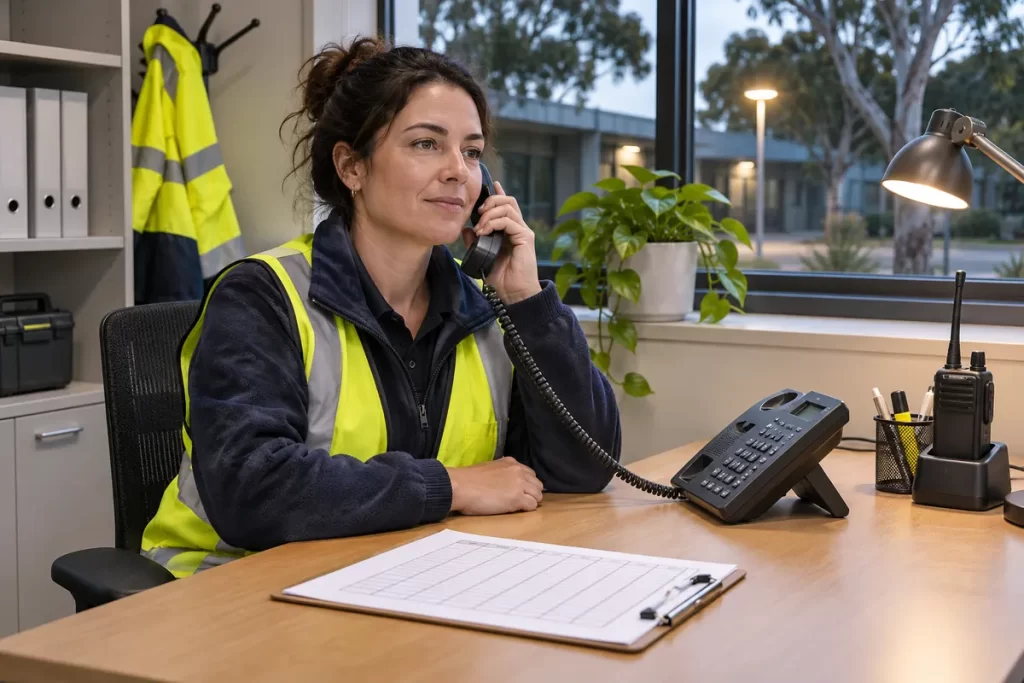
The nominated monitor should start the agreed response when a check-in is missed. For an unexplained delay, try the primary and backup channels, check the last confirmed location and hand over to the backup or duty lead if required. For known or suspected emergencies requiring urgent police, fire or ambulance help, call Triple Zero (000) immediately. Give responders the last known location and any access hazards. Australian Government Triple Zero guidance
Agree on the difference between a missed routine update and an emergency alert when rehearsing the plan. An automatic alarm indicating possible incapacity, a reported threat or the sound of a serious incident may call for urgent action. Record who calls, who stays available to the worker, and who can provide directions or site access to responders. Keep anyone asked to assist out of unsafe areas.
What could missed-check-in escalation look like?
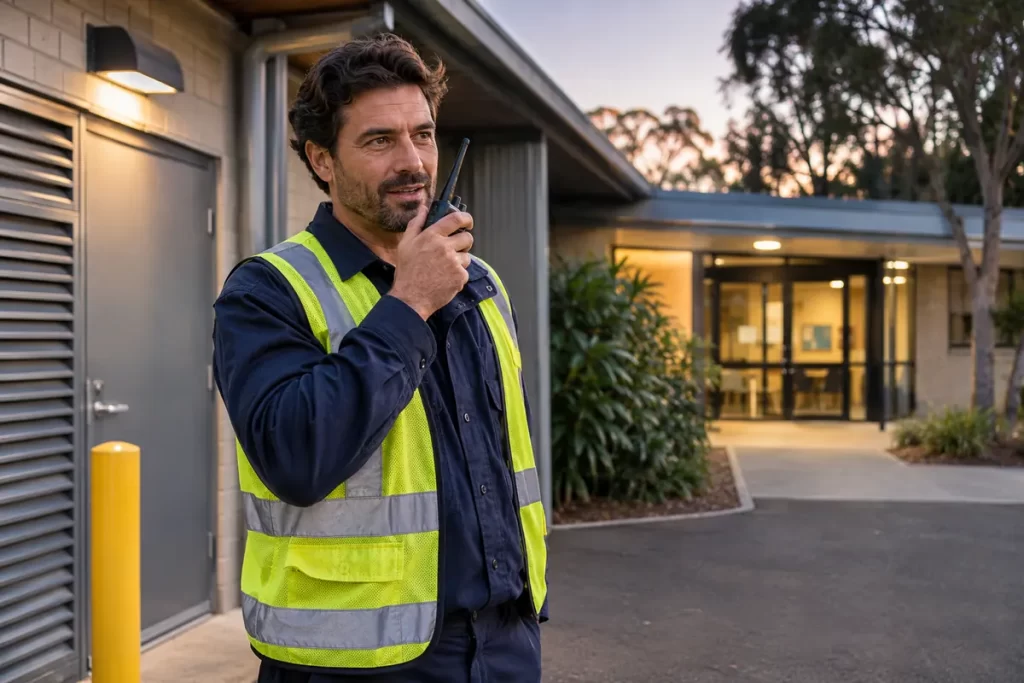
In this fictional example, a facilities attendant carries out an approved visual inspection in a council venue at dusk. Work involving machinery, roofs or locked plant spaces is scheduled separately with the appropriate support. The attendant tests their radio and phone from the inspection corridor, and the duty supervisor confirms they can monitor the round.
| Example time | What the supervisor or attendant does |
|---|---|
| 6:00 pm | The attendant checks in on the radio. The supervisor records that the attendant is starting the agreed route and acknowledges the next contact time. |
| 6:15 pm | The scheduled check does not arrive. The supervisor calls on the radio, then tries the tested backup phone and checks the last confirmed location. |
| 6:17 pm | With no reply, the supervisor hands location and access details to the duty lead under the venue’s example escalation plan. The duty lead takes ownership and uses its emergency arrangements. |
| As soon as an emergency is suspected | The person handling the response calls Triple Zero (000) when urgent emergency help is needed, regardless of where the plan is up to. |
| After direct contact is restored | The lead confirms the worker’s safety, records what occurred and checks whether work can safely continue. |
The example times belong to this scenario. Set your own action points based on the work and the time it could take to get help. If the worker says they had to step outside to get a signal, treat that as a coverage failure. Fix the affected part of the route or work arrangement before using the plan again.
How can you tell whether your lone-worker procedure works?
Run a drill using the people, equipment and locations the plan depends on. Test a missed contact, a device failure and a shift handover. Check whether a rostered person notices the alert and can tell someone where the worker is and how to get there. Feed what you learn back into the work arrangements, and repeat the drill after you address shortfalls. Safe Work Australia guidance on managing remote work risks
- Walk the actual route. Confirm communication from each working area at the usual working time. Include the loading bay, car park, stairwell or travel leg if it forms part of the job.
- Make one channel unavailable. Use a simulation to see whether the worker and monitor can switch to the fallback. Record how long switching took and where it failed.
- Hand over to another person. Check that the next monitor knows who is out, where they were last confirmed, when they are due and what limits apply to the task.
- Rehearse the response safely. Use a simulated emergency call. Check that whoever would call can give the address, access details and hazards without searching for a password or finding an absent colleague.
- Write down fixes and retest. Give each action an owner and deadline. Confirm the change before relying on the affected part of the plan for a live shift.
Review when a worker reports that a method is unreliable, after an incident or near miss, and when tasks, locations or staffing change. Ask whether the check-in process itself is creating problems. For example, a worker should be able to check in from a safe stopping point, and a supervisor with competing duties needs enough capacity to notice and respond to a missed check. WorkSafe Victoria guidance
If you are briefing supervisors, the Keeping Remote and Isolated Workers Safe course covers identifying isolation, choosing controls and consulting workers. Follow the learning with a walkthrough of one actual shift so both the worker and the monitor can practise the local arrangements.
Frequently asked questions
Most lone-worker questions come down to the task, the help available and who will act if contact is lost. A written plan gives everyone a common reference. The risk assessment determines whether working alone can go ahead and what communication and emergency support the business needs to provide.
Is it legal to work alone in Australia?
Working alone can be permitted where the applicable requirements are met and the risks are managed. A task may need additional people, equipment, permits or emergency arrangements under specific rules. Check the duties that apply to the work and speak with your local regulator or a competent WHS adviser if you are unsure. Safe Work Australia’s WHS duties guidance
Is there a minimum check-in frequency?
Regulation 48 of the model WHS Regulations sets an effective communication requirement and leaves the arrangements to the circumstances of the job. Choose a frequency that fits foreseeable harm, location, communication reliability and the time it would take to get help. Check applicable industry or local rules as part of that decision. Safe Work Australia’s WHS duties guidance
Can a mobile phone be the only way to check in?
A mobile phone may be suitable when coverage, battery life and the ability to use it are reliable for the work, and the chosen setup addresses communication failures and emergencies. Test it on the actual route. If a worker could be unable to use the phone, consider how the monitor would detect that and get help. Safe Work Australia model code of practice
Can a family member monitor a lone worker?
Assess whether an informal contact can reliably acknowledge checks, recognise a missed contact, reach the duty supervisor and give responders the right location. The work duty remains with the person or organisation that owes it. A rostered contact who understands the site, has a backup and can activate the emergency plan is easier to verify. Safe Work Australia’s WHS duties guidance
Do you need GPS tracking for lone workers?
Choose a location method that gives responders enough information to reach the worker. An address, zone or an agreed itinerary may be adequate for some jobs. If GPS tracking is appropriate, explain why it is needed, who can view the data, how long it is kept and which parts of the shift it covers. Consult workers before introducing the system. WorkSafe Victoria guidance