Under the WHS regulations, a business must manage psychosocial hazards the same way it manages physical ones: identify them, eliminate the risk so far as is reasonably practicable, minimise what remains, and review the controls. Regulations 55A to 55D of the model WHS Regulations define a psychosocial hazard and list the matters a business must consider when choosing controls, such as job demands, how work is organised and supported, workplace behaviours, and the training and supervision workers receive.
The details vary by state. NSW, Queensland, the ACT and the Commonwealth, for example, require psychosocial risks to be managed under the general risk management rules, including the hierarchy of controls, but the model regulations as first published excluded it — so check your own jurisdiction’s wording. Victoria, which has its own OHS laws, introduced the Occupational Health and Safety (Psychological Health) Regulations 2025 from 1 December 2025.
What is a psychosocial hazard under the WHS regulations?
The WHS laws have always covered mental health. The model WHS Act defines health as both physical and psychological health, so the primary duty to ensure health and safety so far as is reasonably practicable has always included psychological harm. What the regulations added is detail on how to meet that duty.
In the model WHS Regulations, regulation 55A says a psychosocial hazard is a hazard that:
- Arises from or relates to the design or management of work, a work environment, plant at a workplace, or workplace interactions or behaviours.
- May cause psychological harm, whether or not it may also cause physical harm.
Regulation 55B defines psychosocial risk as a risk to the health or safety of a worker or other person from a psychosocial hazard.
The definition is deliberately broad. A program that forces weeks of excessive overtime, or a crew working alone on a remote job with no way to call for help, are psychosocial hazards because they come from how work is designed and managed.
What do regulations 55C and 55D actually require?
Regulation 55C requires a person conducting a business or undertaking (PCBU) to manage psychosocial risks in line with Part 3.1 of the regulations. Part 3.1 is the general risk management process that applies to every hazard: identify reasonably foreseeable hazards, eliminate risks so far as is reasonably practicable, minimise them if they cannot be eliminated, maintain the controls and review them.
Regulation 55D then lists the matters a PCBU must have regard to when deciding which controls to put in place. They include:
- Exposure. The duration, frequency or severity of exposure to psychosocial hazards.
- Combined hazards. How the hazards may interact or combine.
- Work design. The design of work, including job demands and tasks.
- Systems of work. How work is managed, organised and supported.
- The workplace. Its design, layout and environmental conditions, including safe entry and exit and facilities for workers’ welfare.
- Accommodation. The design, layout and conditions of workers’ accommodation, where the PCBU provides it.
- Plant and structures. The plant, substances and structures at the workplace.
- Behaviour. Workplace interactions or behaviours.
- Capability. The information, training, instruction and supervision given to workers.
The list matters because it points at the work, not the worker. A resilience workshop or an employee assistance program can be a useful support, but on its own it does not deal with an unrealistic program, a lack of practical support or a supervisor who shouts at the crew.
Does the hierarchy of controls apply to psychosocial risks?
In most places, yes — but the wording has not always been the same everywhere. The ACT’s explanatory statement for its 2023 amendment records that the model regulation, as first published, required psychosocial risks to be managed under Part 3.1 “other than regulation 36”, the hierarchy of controls. The ACT removed those words so the hierarchy does apply in the ACT.
Queensland’s regulation requires psychosocial risks to be managed under Part 3.1 without that exclusion, and so does the current Commonwealth WHS Regulations 2011, which applies to Commonwealth workplaces. In NSW, the Work Health and Safety Regulation 2025 replaced the 2017 regulation on 22 August 2025, and SafeWork NSW states that PCBUs must use the hierarchy of controls to manage psychosocial risks.
In practice, the difference is smaller than it sounds. Even where regulation 36 is excluded, the PCBU must still eliminate or minimise the risk so far as is reasonably practicable, and a business relying only on policies, posters and training will struggle to show it has done so. Our guide to which WHS laws apply in your state explains how the laws fit together.
When did the psychosocial rules start in each state?
The model regulations were amended by Safe Work Australia in 2022, and each jurisdiction adopted them on its own timetable. Dates confirmed from official sources include:
- NSW. The psychosocial provisions commenced on 1 October 2022, through an amendment to the Work Health and Safety Regulation 2017. They now sit in the Work Health and Safety Regulation 2025, which commenced on 22 August 2025.
- Queensland. The provisions and the Managing the risk of psychosocial hazards at work Code of Practice 2022 took effect on 1 April 2023. From 1 March 2025, Queensland also requires a written prevention plan where a risk of sexual harassment or sex or gender-based harassment has been identified.
- ACT. The ACT amendment commenced on 27 November 2023, with an ACT code of practice.
- Victoria. Victoria does not use the model WHS laws. Its Occupational Health and Safety (Psychological Health) Regulations 2025 commenced on 1 December 2025, supported by a compliance code.
The other jurisdictions that use the model WHS laws have also adopted psychosocial provisions, with some local differences. Check your regulator’s website for the exact wording that applies where you work.

What does Victoria's psychological health regulation add?
Victoria’s regulations apply to employers under the Occupational Health and Safety Act 2004. WorkSafe Victoria says employers must identify psychosocial hazards, control the risks by eliminating or reducing them so far as is reasonably practicable, and review and revise controls in prescribed circumstances.
Two features stand out:
- Training is not enough on its own. WorkSafe Victoria states that information, instruction or training may only be used as the sole control where no other control is reasonably practicable, and must not be the predominant control when a combination is used.
- Reports trigger a review. Controls must be reviewed if an employee, or someone on their behalf, reports a psychological injury or a psychosocial hazard.
WorkSafe Victoria highlights bullying, sexual harassment, aggression or violence, exposure to traumatic events or content, and high job demands. It provides a prevention plan template, but says using a prevention plan is not mandatory.
What does the model Code of Practice say?
Safe Work Australia published the model Code of Practice: Managing psychosocial hazards at work in 2022 to support the amended regulations. It applies the familiar four steps of identify, assess, control and review to psychosocial hazards, and gives examples of what each hazard looks like and how to control it.
Safe Work Australia lists common psychosocial hazards as:
- Job demands that are too high or too low, and low job control.
- Poor support, lack of role clarity and poor organisational change management.
- Inadequate reward and recognition, and poor organisational justice.
- Traumatic events or material, remote or isolated work, and a poor physical environment.
- Violence and aggression, bullying, and harassment, including sexual and gender-based harassment.
- Conflict or poor workplace relationships and interactions.
A model code has no legal effect until a jurisdiction approves it, and some states use their own versions. NSW, for example, has its own Code of Practice: Managing psychosocial hazards at work, and Queensland has its 2022 code. An approved code is not the law itself, but it can be used as evidence of what is known about a hazard and how to control it, so following it is the safest way to show you have done what is reasonably practicable.
Which psychosocial hazards are common on construction sites?
Construction combines many of the listed hazards at once, which is why regulation 55D asks how hazards interact. On a typical project you may see:
- High job demands. Compressed programs, liquidated damages pressure, long hours and weekend work, especially near practical completion.
- Fatigue. Early starts, long travel to site, shift work and hot conditions that compound physical and mental strain.
- Remote or isolated work. Regional projects, fly-in fly-out rosters, lone work in plant rooms or on rural sites, and time away from family.
- Job insecurity and low control. Short-term engagements, rolling labour hire and little say over how or when work is done.
- Poor support and role clarity. Leading hands promoted without supervision training, or unclear lines between the head contractor and subcontractor supervisors.
- Bullying and harassment. Hazing of apprentices, so-called banter that targets a person, and sexual or gender-based harassment, particularly where women are a small minority on site.
- Traumatic events. Witnessing a serious incident or responding to an injured workmate.
Each has a matching control in the design of the work. Realistic programs, rostered breaks and fatigue limits, buddy systems and check-in procedures for lone workers, supervisor training, clean and separate amenities, and a clear, confidential way to report problems all reduce the risk at its source. Our guide to mental health in construction covers suicide prevention and peer support in more detail.
How do you manage psychosocial risks, step by step?
The process is the same one you use for falls or silica, applied to the way work is organised.
- Identify. Talk to workers and health and safety representatives, run short surveys, look at incident reports, sick leave, turnover and complaints, and walk the site looking at how work is actually done.
- Assess. Consider how severe the harm could be, how long and how often people are exposed, and how hazards combine. A tight program plus fatigue plus an aggressive supervisor is worse than any one alone.
- Control. Start with the work itself: staffing, scheduling, task design, rosters, amenities and supervision. Then add policies, training and support services as further layers, not the only layer.
- Review. Check whether the controls are working, and review them after a report, an incident, a change to the work, or when workers or representatives raise concerns.
Consultation runs through every step. The WHS Act requires PCBUs to consult workers on health and safety matters, and on a shared site, PCBUs must also consult, cooperate and coordinate with each other. A head contractor’s program can create the hazard that a subcontractor’s crew bears, so the conversation has to cross company lines.
Directors and senior managers carry a separate duty. Under the WHS Act, officers must exercise due diligence to make sure the business manages its risks, including psychosocial ones. Our guide to officers’ due diligence sets out what that involves.
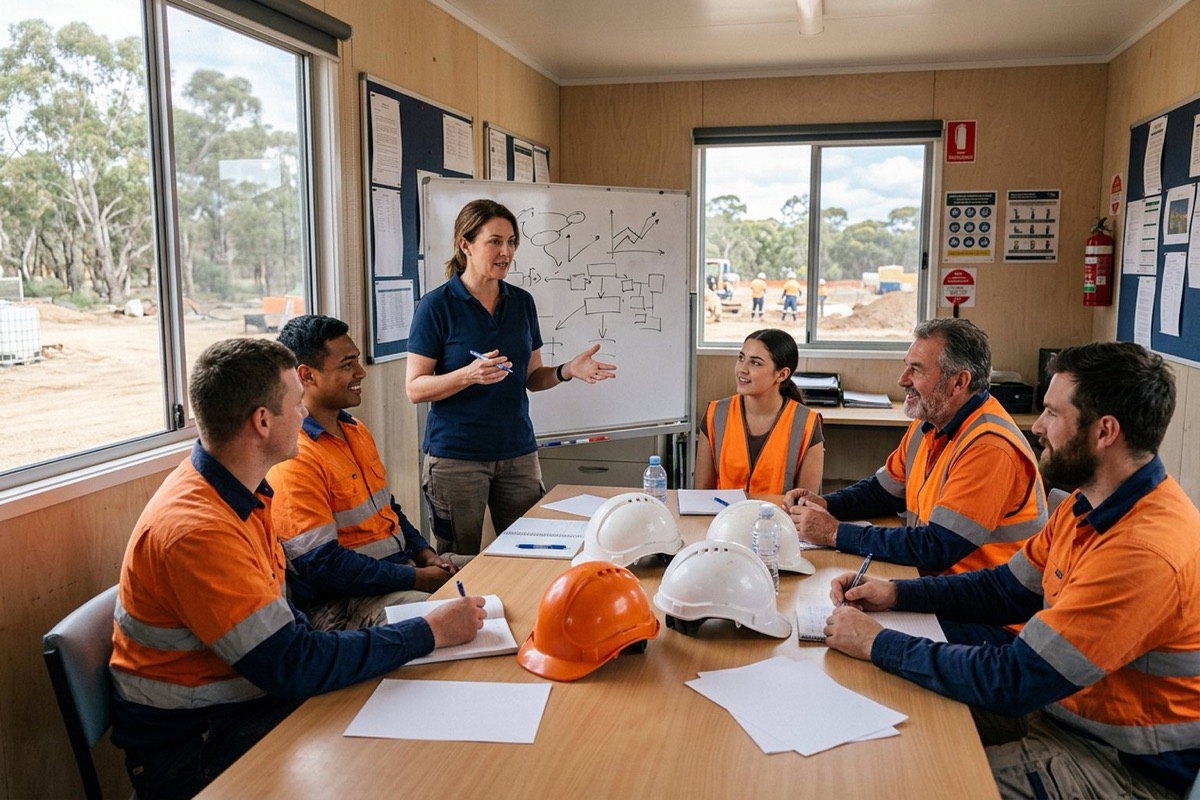
Psychosocial risk management checklist
- Name an owner. Make a senior person accountable for psychosocial risk, with time and budget.
- Consult first. Ask workers and health and safety representatives where the pressure points are.
- Use the data. Review incidents, complaints, overtime, sick leave and turnover for patterns.
- Map the hazards. Record each hazard, who is exposed, how often and for how long.
- Fix the work. Adjust programs, staffing, rosters and supervision before adding training.
- Train supervisors. Give leading hands and supervisors the skills to manage people and spot warning signs.
- Set reporting paths. Offer a confidential way to raise concerns, including someone outside the line manager.
- Check amenities. Provide clean, safe, private facilities, including separate facilities where needed.
- Plan for trauma. Have a post-incident response, including access to counselling.
- Review regularly. Review controls after any report, incident or change, and at set intervals.
- Promote support. Display helpline details such as Lifeline 13 11 14 and MATES 1300 642 111 where workers will see them.
Where the facts of a particular case are unclear, or a worker has been seriously harmed, get advice from your WHS regulator, an industry association or an employment lawyer.
Manage psychosocial risks with confidence
CPD-accredited online courses on mental health awareness, wellbeing, bullying and the positive duty, each with an assessment and a certificate.
- Mental Health Awareness in the Workplace View course →
- Wellbeing at Work View course →
- Preventing and Responding to Workplace Bullying View course →
- Meeting the Positive Duty to Prevent Workplace Sexual Harassment View course →
- Building Personal and Team Resilience at Work View course →
- Supervising and Communicating with Young Workers View course →
Frequently asked questions
What is a psychosocial hazard?
It is a hazard arising from the design or management of work, the work environment, plant at a workplace, or workplace interactions or behaviours that may cause psychological harm. Examples include excessive job demands, remote or isolated work, poor support, bullying and harassment.
Are psychosocial hazards a legal duty or just good practice?
They are a legal duty. The WHS laws have always covered psychological health, and the regulations now spell out how psychosocial risks must be managed. Victoria has its own psychological health regulations from 1 December 2025.
Is an employee assistance program enough to comply?
Usually not. An employee assistance program is a support, not a control on the hazard itself. Regulators expect businesses to address the source of the risk, such as workloads, rosters, supervision and behaviour, before relying on support services.
Do the rules apply to small building businesses?
Yes. The duty applies to every person conducting a business or undertaking, regardless of size. What is reasonably practicable for a small builder will differ from a tier one contractor, but the duty to identify and manage the risks is the same.
Who is responsible on a site with many subcontractors?
Every PCBU on the site has a duty for the risks its work creates or affects. Where duties overlap, they must consult, cooperate and coordinate with each other. The head contractor often controls the program and amenities, so it plays a central role.
Where can a worker get help right now?
In an emergency, call 000. Lifeline offers 24/7 crisis support on 13 11 14, and the MATES in Construction helpline is available 24/7 on 1300 642 111. Workers can also raise concerns with their health and safety representative or their state WHS regulator.
Sources and further reading
- Queensland Legislation — Work Health and Safety Regulation 2011 (Qld), Part 3.1 and Part 3.2 Division 11 Psychosocial risks (ss 55A-55H)
- Federal Register of Legislation — Work Health and Safety Regulations 2011 (Cth), regs 55A–55D
- ACT Legislation — Work Health and Safety Amendment Regulation 2023 (No 1), explanatory statement (model regulation 55C wording, commencement 27 November 2023)
- NSW Legislation — Work Health and Safety Amendment Regulation 2022 (psychosocial risks)
- SafeWork NSW — Psychosocial hazards
- Safe Work Australia — Model Code of Practice: Managing psychosocial hazards at work
- Safe Work Australia — Psychosocial hazards
- WorkSafe Queensland — Managing the risk of psychosocial hazards at work Code of Practice 2022
- WorkSafe Victoria — Psychological health regulations: frequently asked questions
- WorkSafe Victoria — New regulations make psychological health a priority (December 2025)
- Lifeline Australia — Crisis support 13 11 14
- MATES in Construction — MATES Helpline 1300 642 111