Since 13 December 2022, section 47C of the Sex Discrimination Act 1984 has required every employer and person conducting a business or undertaking (PCBU) to take reasonable and proportionate measures to eliminate, as far as possible, sexual harassment, sex-based harassment, hostile workplace environments, sex discrimination and related victimisation. It is a duty to prevent harm before it happens, not just to respond to complaints.
Since 12 December 2023, the Australian Human Rights Commission has had power to inquire into compliance, issue compliance notices that can be enforced in court, and accept enforceable undertakings. The duty sits alongside, and does not limit, the WHS duty to manage the psychosocial risk of sexual harassment.
What is the positive duty?
The positive duty was added to the Sex Discrimination Act by the Anti-Discrimination and Human Rights Legislation Amendment (Respect at Work) Act 2022. That Act received Royal Assent on 12 December 2022, and the positive duty commenced the following day, 13 December 2022.
Before the positive duty, the law mostly worked after the event. A worker who was harassed could make a complaint, and an employer could be held vicariously liable unless it had taken all reasonable steps to prevent the conduct. The positive duty changes the starting point. A business must act to prevent the conduct, whether or not anyone has complained.
Section 47C requires a duty holder to take reasonable and proportionate measures to eliminate the relevant conduct “as far as possible”. The duty is continuous: measures must be kept up to date as the business, its sites and its workforce change.
Who has the duty, and what conduct does it cover?
The duty holders are employers and PCBUs. For a construction business, that covers a builder employing its own staff and a head contractor or subcontractor engaging workers through other arrangements.
The duty covers two groups of conduct. The first is conduct by the duty holder itself, its employees or workers, and its agents:
- Sex discrimination in employment and related work relationships.
- Sexual harassment, or harassment on the ground of sex, that is unlawful under section 28B.
- Hostile workplace environments on the ground of sex, unlawful under section 28M.
- Victimisation of someone who complains, or is involved in a complaint, about that conduct.
The second group is harassment, hostile environments and victimisation directed at the duty holder’s employees or workers by anyone else. On a building site that could include a client, a supplier’s driver, a consultant, a visitor or a member of the public.
The hostile workplace environment provision is broad. Under section 28M, conduct can be unlawful where a reasonable person would have anticipated it making the workplace offensive, intimidating or humiliating to a person because of their sex. It does not need to be aimed at a particular person. Sexually explicit material displayed in a site shed, or a pattern of degrading jokes about women, can fall within it.
What counts as reasonable and proportionate?
Section 47C lists the matters taken into account in deciding whether a duty holder has complied:
- Size, nature and circumstances of the business or undertaking.
- Resources, financial or otherwise.
- Practicability and cost of the measures.
- Any other relevant matter.
A sole trader with two apprentices is not expected to build the same system as a national contractor. But every duty holder is expected to think about its own risks and act on them. A policy downloaded and filed away, with no training, no reporting path and no follow-up, is unlikely to be enough for any business.
How does the Human Rights Commission enforce the duty?
The Commission’s compliance powers commenced on 12 December 2023, under Division 4A of Part II of the Australian Human Rights Commission Act 1986. They allow the Commission to:
- Inquire into a person’s compliance if it reasonably suspects they are not complying.
- Give a compliance notice setting out what the business must do, or stop doing, to comply.
- Apply to the Federal Court or the Federal Circuit and Family Court for an order directing compliance with a notice.
- Accept enforceable undertakings, where a business commits to specific actions.
The Commission also publishes guidelines on complying with the duty. A worker who has been harassed can still make a complaint about the harassment itself through the existing complaint processes; the positive duty adds a regulator that can act on systemic failures.
What are the Commission's seven standards?
The Commission’s guidelines set out seven standards as a framework for meeting the duty. They are not separate legal requirements, but they show what the Commission expects to see.
- Leadership. Senior leaders make sure prevention and response measures are developed, recorded in writing, communicated and put in place.
- Culture. The business fosters a culture that is safe, respectful and inclusive, and values diversity and gender equality.
- Knowledge. A policy on respectful behaviour and unlawful conduct is developed, communicated and implemented.
- Risk management. Unlawful conduct is treated as both an equality risk and a health and safety risk, managed with a risk-based approach.
- Support. Workers can access support at any time, and anyone who reports conduct has a nominated contact person.
- Reporting and response. Responses are consistent, timely and put the safety and wellbeing of workers first, with consistent and appropriate consequences.
- Monitoring, evaluation and transparency. The business collects appropriate data and uses it to assess its culture and improve its measures.
How does the positive duty overlap with WHS laws?
Section 47C states that it does not limit or affect a duty under the Work Health and Safety Act 2011 or a state or territory WHS law. Both apply at once.
Under the WHS laws, sexual harassment is a psychosocial hazard that a PCBU must manage like any other risk. Safe Work Australia published a model Code of Practice on sexual and gender-based harassment in December 2023. Some states go further:
- Queensland. Its WHS regulation expressly requires PCBUs to manage the risk of sexual harassment and sex or gender-based harassment. Since 1 March 2025, a PCBU must prepare a written prevention plan where such a risk has been identified, and review it after a report of harassment.
- Victoria. The Occupational Health and Safety (Psychological Health) Regulations 2025, in force from 1 December 2025, name sexual harassment among the key psychosocial hazards employers must control.
The Fair Work Act 2009 also prohibits sexual harassment in connection with work, in section 527D. A person can apply to the Fair Work Commission to deal with a sexual harassment dispute, including by seeking a stop sexual harassment order, which the Commission must start to deal with within 14 days.
Our pillar guide to psychosocial hazards and the WHS regulations explains the WHS side in full.
What should builders do on construction sites?
Construction has features that raise the risk: male-dominated crews, many employers sharing one site, shifting subcontractor workforces, remote or regional work, and shared facilities. Practical measures include:
- Lead from the top. Have directors and senior managers set expectations in writing and repeat them at inductions and toolbox talks.
- Cover every site. Make respectful behaviour a site rule in inductions, so it binds subcontractors and visitors as well as your own staff.
- Remove hostile material. Clear sexually explicit or degrading images, graffiti and messages from sheds, amenities, vehicles and group chats.
- Provide proper amenities. Supply clean, lockable facilities, including separate facilities and change areas, so no worker has to use unsafe or exposed spaces.
- Plan for isolation. Consider the extra risk where workers are isolated, work alone with one other person for long periods, or share remote accommodation.
- Train supervisors. Leading hands and supervisors need to recognise harassment, step in early and know what to do with a report.
- Coordinate with others. On shared sites, agree with other PCBUs how reports will be handled and how information will be shared.
- Protect apprentices. Young and new workers are less likely to speak up, so check in with them regularly and give them someone outside their direct line to talk to.
Directors have their own obligations here. Our guide to officers’ due diligence explains what officers must do to keep informed about these risks.
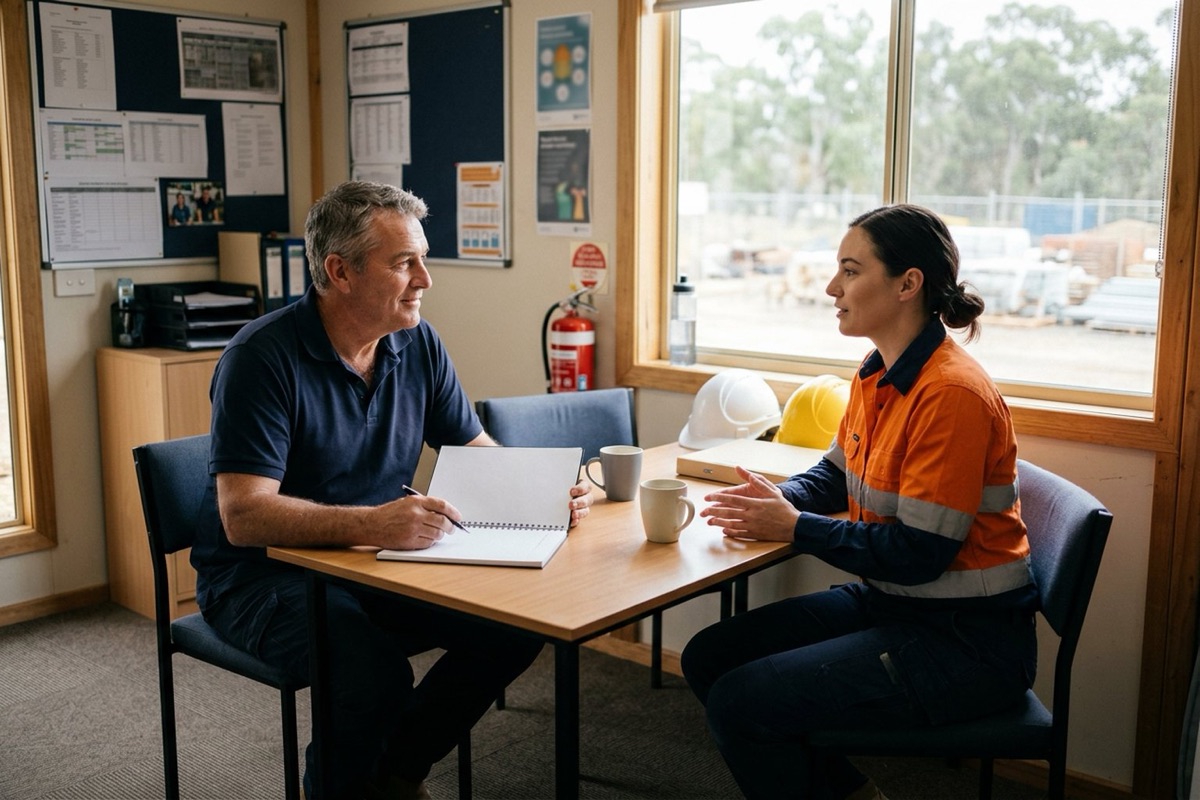
What should you do when someone reports harassment?
How a business responds shapes whether anyone reports again.
- Listen and take it seriously. Thank the person, take notes, and ask what they need to feel safe.
- Act on safety first. Separate the people involved where needed, without disadvantaging the person who reported.
- Offer choices. Explain the options, from an informal resolution to a formal investigation, and respect their wishes where it is safe to do so.
- Keep it confidential. Share information only with people who need it.
- Protect against victimisation. Make clear that retaliation against anyone involved in a report is unacceptable and is itself unlawful.
- Investigate fairly. Use a trained, independent investigator for serious allegations, and give everyone a fair hearing.
- Review your controls. Ask what allowed the conduct to happen and fix it.
If the conduct may be a crime, such as sexual assault or indecent exposure, the person can report it to police, and the business should support them to do so. Get advice from an employment lawyer or your industry association on serious or complex matters. Our guide to workplace bullying covers related duties and responses.

Positive duty checklist
- Assess your risks. Identify where harassment could occur across your sites, workforce and accommodation.
- Write the policy. Set out expected behaviour, unlawful conduct, reporting options and consequences.
- Train everyone. Include the policy in inductions and refresh it regularly, with extra training for supervisors.
- Offer several reporting paths. Include a confidential option and someone outside the line manager.
- Nominate a contact. Give every person who reports a named contact for support and updates.
- Fix the environment. Remove offensive material and provide safe, private amenities.
- Coordinate on site. Agree reporting and response processes with other PCBUs.
- Record and review. Keep records of reports and outcomes, and use them to improve your measures.
- Check state rules. In Queensland, prepare a written prevention plan where a risk is identified.
Meet the positive duty on your sites
CPD-accredited online courses on the positive duty, respectful workplaces and preventing bullying, each with an assessment and a certificate.
- Meeting the Positive Duty to Prevent Workplace Sexual Harassment View course →
- Respectful Workplaces: Understanding Sexual Harassment and the Positive Duty View course →
- Preventing and Responding to Workplace Bullying View course →
- Supervising and Communicating with Young Workers View course →
- Mental Health Awareness in the Workplace View course →
- Wellbeing at Work View course →
Frequently asked questions
When did the positive duty start?
The positive duty in section 47C of the Sex Discrimination Act commenced on 13 December 2022. The Australian Human Rights Commission's powers to enforce it commenced on 12 December 2023.
Does the positive duty apply to small businesses?
Yes. It applies to every employer and PCBU, whatever their size. What is reasonable and proportionate depends on factors including the size, nature and resources of the business, so a small builder's measures can be simpler, but they must still be real.
Does the duty cover harassment by clients or the public?
Yes. The duty extends to sexual harassment, sex-based harassment and hostile workplace environments directed at employees or workers by third parties, such as clients, suppliers, visitors or members of the public.
Is a sexual harassment policy enough to comply?
No. A policy is one measure. The Commission's guidelines expect leadership commitment, training, risk management, support for workers, a fair response process and regular review of whether the measures work.
What is a hostile workplace environment?
It is a workplace that is offensive, intimidating or humiliating to a person because of their sex. The conduct does not have to target a particular person. Sexually explicit images or persistent degrading jokes about one sex can create a hostile environment.
Where can someone get support after sexual harassment?
In an emergency, call 000. 1800RESPECT offers 24/7 counselling on 1800 737 732, and Lifeline offers 24/7 crisis support on 13 11 14. Workers can also seek advice from the Australian Human Rights Commission, the Fair Work Commission, their union or a lawyer.
Sources and further reading
- Federal Register of Legislation — Sex Discrimination Act 1984 (Cth), ss 28A, 28B, 28M and 47C
- Federal Register of Legislation — Anti-Discrimination and Human Rights Legislation Amendment (Respect at Work) Act 2022, s 2 commencement
- Federal Register of Legislation — Australian Human Rights Commission Act 1986 (Cth), Part II Division 4A (ss 35A-35K)
- Australian Human Rights Commission — Guidelines for Complying with the Positive Duty under the Sex Discrimination Act 1984 (2023)
- Australian Human Rights Commission — Positive duty for employers: Commission's powers commence
- Federal Register of Legislation — Fair Work Act 2009 (Cth), Part 3-5A (ss 527D, 527F, 527J)
- Safe Work Australia — Model Code of Practice: Sexual and gender-based harassment (December 2023)
- Queensland Legislation — Work Health and Safety Regulation 2011 (Qld), ss 55BA-55H (prevention plans)
- WorkSafe Queensland — Sexual harassment and sex or gender-based harassment
- 1800RESPECT — Calling 1800RESPECT