On a construction project, the principal contractor must identify itself with site signage, prepare and maintain a written WHS management plan before work starts, take all reasonable steps to obtain every safe work method statement before high risk work begins, and manage site-wide risks such as materials and waste, idle plant, traffic and essential services. As the business with management or control of the site, it must also secure the workplace from unauthorised access.
Under the model WHS Regulations a construction project is construction work costing $250,000 or more, and it has only one principal contractor at a time. The threshold is different in South Australia, the Northern Territory, Western Australia and Victoria.
What counts as a construction project?
The principal contractor duties apply only to a construction project. Under regulation 292 of the model WHS Regulations, that is a project involving construction work where the cost of the construction work is $250,000 or more.
The jurisdictions do not all use that figure:
- $250,000 or more — the model Regulations, New South Wales, Queensland and Tasmania;
- $450,000 or more — South Australia, according to SafeWork SA;
- $1,000,000 or more — the Northern Territory, according to NT WorkSafe;
- 5 or more persons working, or likely to be working, at the same time at the construction site — Western Australia, which defines a construction project by workforce rather than cost (regulation 292 of the WHS (General) Regulations 2022);
- $350,000 or more — Victoria, under its own OHS Regulations 2017.
Below the threshold there is no principal contractor role, but nothing else changes: every business on site still holds its own duties, and high risk construction work still needs a SWMS. See which WHS laws apply in your state for how the model and Victorian systems differ.
Who is the principal contractor?
Regulation 293 sets out who it is:
- By default, the business that commissions the project. A person conducting a business or undertaking (PCBU) that commissions a construction project is the principal contractor.
- Or the business it appoints. If the commissioning PCBU engages another PCBU as principal contractor and authorises it to have management or control of the workplace and to discharge the principal contractor duties, the engaged business is the principal contractor.
- Home owners do not become principal contractors. If an individual who owns residential premises engages a business to carry out a construction project there, that business is the principal contractor if it has management or control of the workplace.
- Only one at a time. A construction project has only one principal contractor at any specific time.
In practice, on most commercial projects the client appoints the head contractor in the contract and hands over control of the site. The appointment needs to be real: authority to control the workplace, not just the title.
What signs must a principal contractor put up?
Regulation 308 requires signs that:
- show the principal contractor’s name and telephone contact numbers, including an after-hours number;
- show the location of the site office, if there is one; and
- are clearly visible from outside the workplace, or from outside the work area where the project is under way.
The point is practical: emergency services, neighbours and regulators must be able to reach whoever controls the site, at any hour.
What must the WHS management plan contain?
The principal contractor must prepare a written WHS management plan for the workplace before work on the project commences (regulation 309). It must include:
- the names, positions and health and safety responsibilities of everyone at the workplace whose role involves specific health and safety responsibilities for the project;
- the arrangements for consultation, cooperation and coordination between the businesses at the workplace in complying with their WHS duties;
- the arrangements for managing WHS incidents that occur;
- any site-specific health and safety rules, and how everyone at the workplace will be told about them; and
- the arrangements for collecting, assessing, monitoring and reviewing safe work method statements at the workplace.
Those five items are the legal minimum. A plan that only restates the regulation is not much use on site; the best plans are short, specific to the site’s actual hazards and sequence of work, and written for the people who will use them.
How must the plan be shared, reviewed and kept?
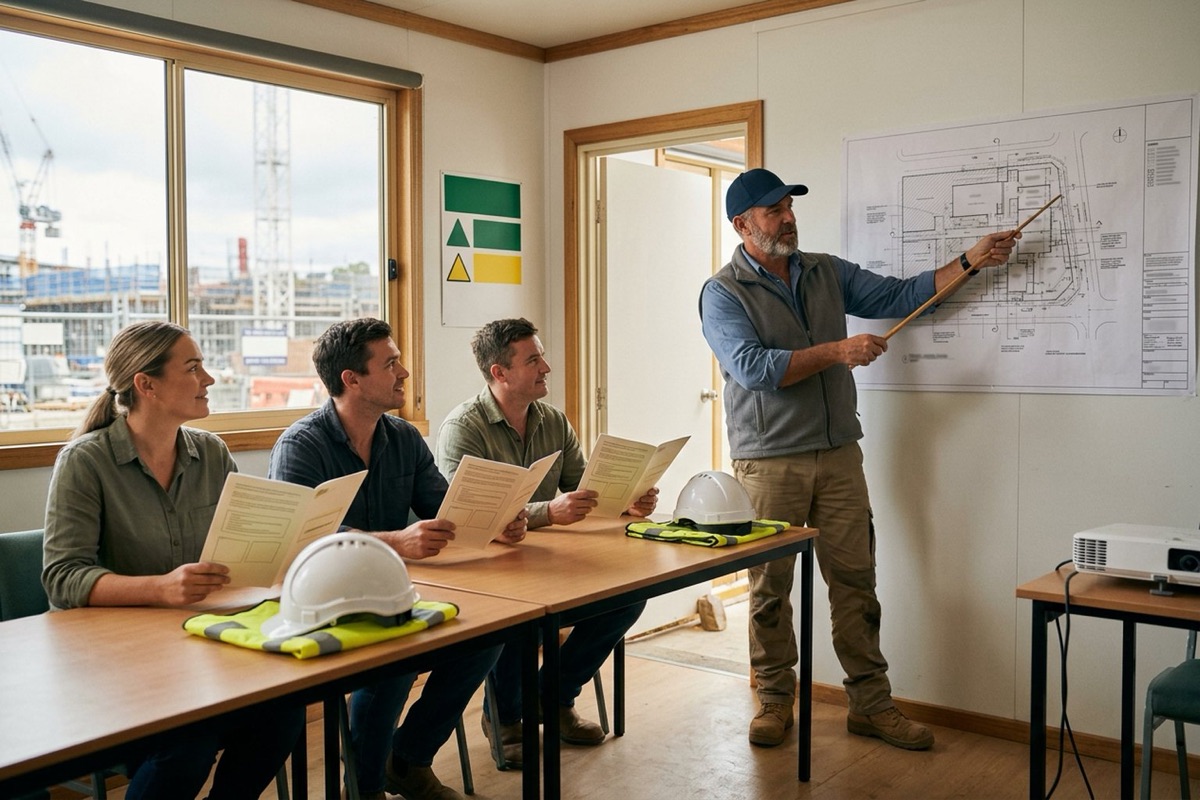
- Tell people before they start. Each person who is to carry out construction work on the project must be made aware, so far as is reasonably practicable, of the plan’s content and their right to inspect it — before they begin (regulation 310). Site induction is the usual place.
- Keep it current. The principal contractor must review and, as necessary, revise the plan so it stays up to date, and make sure workers know about revisions (regulation 311).
- Keep every version. A copy must be kept until the project is completed, or for at least 2 years after a notifiable incident connected with the project. It must be readily accessible to people doing construction work on the project and available for inspection. “The plan” means the initial plan and every revised version (regulation 313).
What does the principal contractor have to do about SWMS?
The business doing high risk construction work prepares its own safe work method statement. The principal contractor’s duty is to take all reasonable steps to obtain a copy of each SWMS before the high risk construction work commences (regulation 312).
Obtaining a copy is the floor, not the ceiling. The WHS management plan must set out how SWMS will be collected, assessed, monitored and reviewed (regulation 309(2)(e)), so the principal contractor is expected to have a system for checking that SWMS are fit for the site and that the work matches them. NT WorkSafe’s guidance adds that if there is no SWMS, the principal contractor must make arrangements for one to be prepared — for example by the contractor.
Which site-wide risks does the principal contractor own?
Regulation 315 requires the principal contractor to manage the risks associated with:
- the storage, movement and disposal of construction materials and waste at the workplace;
- the storage of plant that is not in use;
- traffic in the vicinity of the workplace that may be affected by the project’s construction work; and
- essential services at the workplace.
Regulation 314 also requires the principal contractor to put in place arrangements for ensuring compliance at the workplace with the regulations on:
- general workplace facilities;
- first aid;
- emergency plans;
- personal protective equipment;
- airborne contaminants;
- hazardous atmospheres;
- storage of flammable or combustible substances;
- falling objects; and
- falls — Part 4.4, covered in working at heights in construction.
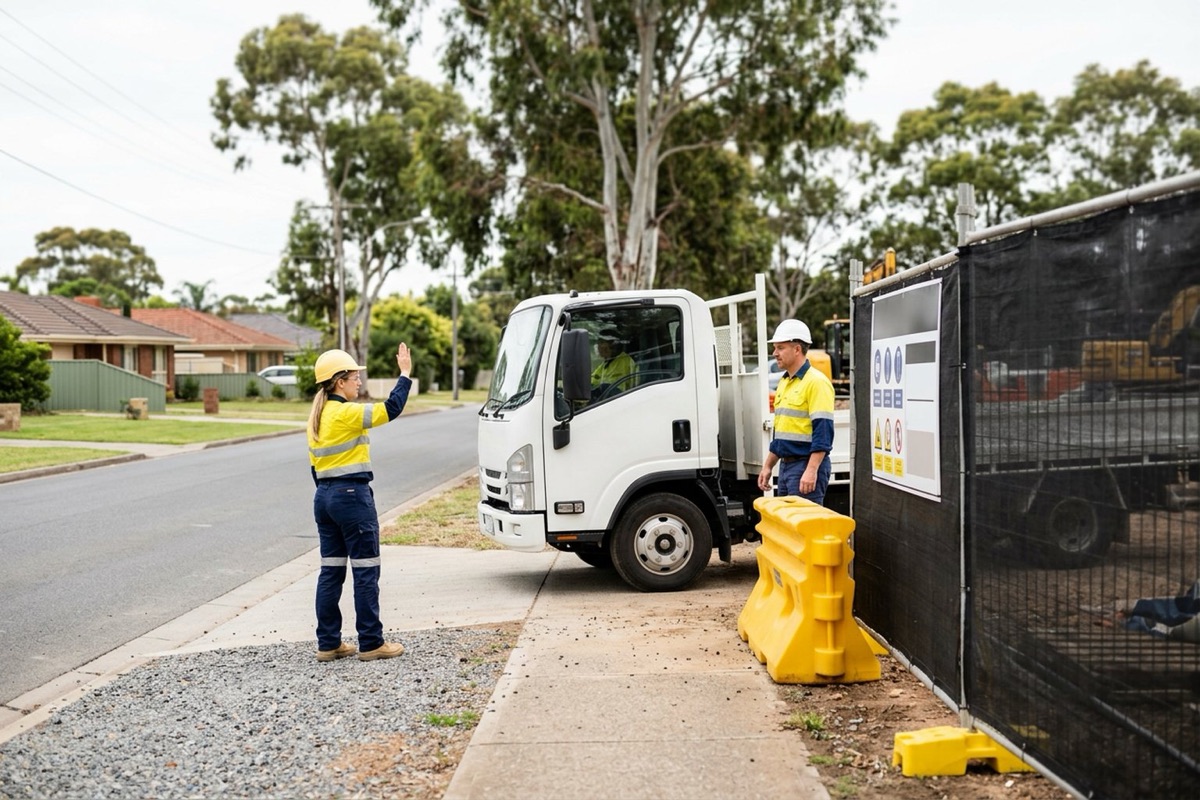
And because the principal contractor has management or control of the workplace, it carries those duties too — including securing the site from unauthorised access (regulation 298) and, before excavation starts, obtaining current information about underground essential services (regulation 304).
How does the principal contractor's role fit with everyone else's duties?
Being principal contractor does not take anyone else’s duties away. Every business on site remains a PCBU with its own primary duty, and the Regulations note that all of them share the duties listed in regulation 314.
The WHS Act deals with shared duties directly. More than one person can hold the same duty at the same time, each must comply with it fully, and each must discharge it to the extent of their capacity to influence and control the matter (section 16). Every duty holder must also, so far as is reasonably practicable, consult, cooperate and coordinate with the others (section 46).
For a head contractor, that means setting the site rules, coordinating trades and checking compliance. For a subcontractor, it means following the principal contractor’s plan and managing its own work — a principal contractor’s SWMS system does not replace a subcontractor’s own risk management. Directors of both have a personal duty to make sure this works in practice: see due diligence for directors and officers.
How is Victoria different?
Victoria has not adopted the model WHS laws. Under its Occupational Health and Safety Regulations 2017, a construction project is construction work costing $350,000 or more, and the principal contractor must prepare a health and safety coordination plan rather than a WHS management plan. WorkSafe Victoria publishes a template covering who holds specific health and safety responsibilities, how incidents will be managed and what the site safety rules are.
The concepts are similar, but the clause numbers, wording and some obligations differ. On a Victorian job, work from the Victorian Regulations and WorkSafe Victoria’s guidance, not from a model-law checklist.
Principal contractor checklist
- Confirm it is a construction project using your jurisdiction’s threshold.
- Get the appointment in writing, with real authority to manage and control the workplace.
- Put up signs with your name, phone numbers including after hours, and the site office location, visible from outside.
- Write a site-specific WHS management plan covering all five required items, before work starts.
- Induct everyone on the plan and their right to inspect it, and tell them when it changes.
- Obtain every SWMS before high risk work starts, and check the work against it.
- Manage the site-wide risks: materials and waste, idle plant, traffic, essential services, falls, falling objects, first aid and emergency plans.
- Secure the site from unauthorised access, especially after hours.
- Keep the plan and every revision until completion, or 2 years after a notifiable incident.
Run the site the law expects
CPD-accredited online courses on WHS management systems, subcontractor management and site supervision, each with an assessment and a certificate.
- Building a Work Health and Safety Management System on Site View course →
- Managing Work Health and Safety Risks: A Practical Framework View course →
- Engaging and Managing Subcontractors View course →
- Effective Site Supervision on Construction Projects View course →
- Safe Work Method Statements for High-Risk Construction Work View course →
- Traffic Management on Construction Sites View course →
Frequently asked questions
Who is the principal contractor when a home owner hires a builder?
The builder. Under the model WHS Regulations, if an individual who owns residential premises engages a business to carry out a construction project there, the business is the principal contractor if it has management or control of the workplace. The home owner does not take on the role.
What is the construction project threshold in my state?
Under the model WHS Regulations, and in New South Wales, Queensland and Tasmania, it is construction work costing $250,000 or more. South Australia uses $450,000, the Northern Territory $1,000,000 and Victoria $350,000, while Western Australia applies it where 5 or more persons are working at the same time.
Can a project have two principal contractors?
No. A construction project has only one principal contractor at any specific time. The role can change hands, for example between stages, but there is never more than one at once.
Is a WHS management plan the same as a SWMS?
No. The principal contractor's WHS management plan covers the whole site: responsibilities, coordination between businesses, incident arrangements, site rules and how SWMS will be managed. A SWMS is prepared by the business doing a particular high risk construction task and covers the hazards and controls for that work.
How long must the WHS management plan be kept?
Until the construction project is completed, or for at least 2 years after a notifiable incident connected with the project. Every revised version counts as part of the plan, and it must be readily accessible to people working on the project.
Does the principal contractor have to check subcontractors' SWMS?
It must take all reasonable steps to obtain each SWMS before high risk construction work starts, and its WHS management plan must set out how SWMS will be collected, assessed, monitored and reviewed. In practice that means checking them against the site and the work, not just filing them.
Sources and further reading
- Federal Register of Legislation — Work Health and Safety Regulations 2011 (Cth), regs 292–293, 298, 307–315 (model text)
- Federal Register of Legislation — Work Health and Safety Act 2011 (Cth), ss 16 and 46
- SafeWork NSW — Undertaking a construction project
- WorkSafe Queensland — Principal contractors
- SafeWork SA — Principal contractors and construction projects
- WorkSafe Tasmania — Safety in construction (guidance, January 2025)
- NT WorkSafe — Safe work method statement for high risk construction work
- WA Legislation — Work Health and Safety (General) Regulations 2022, reg 292
- WorkSafe Victoria — Health and safety coordination plan template