Australian WHS law requires any risk of a fall from one level to another that is reasonably likely to cause injury to be managed, at any height. Where it is reasonably practicable, the work must be done on the ground or on solid construction; if it isn’t, the risk must be minimised with, in order, a fall prevention device such as edge protection or a working platform, then a work positioning system, then a fall arrest system — and anyone relying on fall arrest needs a tested rescue plan.
Separately, a risk of falling more than 2 metres makes the work high risk construction work that needs a safe work method statement in most of Australia. The Northern Territory uses 3 metres for residential construction, Victoria applies its own falls rules above 2 metres, and Western Australia moved to the national falls rule on 1 October 2026.
What do the WHS Regulations say about working at heights?
The core rules are in Part 4.4 of the model WHS Regulations, which every jurisdiction except Victoria has adopted in its own law. Regulation 78 requires a person conducting a business or undertaking (PCBU) to manage the risks of a fall by a person from one level to another that is reasonably likely to cause injury — to that person or anyone else.
That expressly includes the risk of a fall:
- in or on an elevated workplace;
- in the vicinity of an opening through which someone could fall;
- in the vicinity of an edge over which someone could fall;
- on a surface through which someone could fall — such as a skylight or fragile roof sheeting; and
- in any other place from which someone could fall.
Two practical duties follow. So far as is reasonably practicable, the work must be carried out on the ground or on a solid construction, and the PCBU must provide safe means of access to and exit from the workplace and every area where there is a fall risk.
A “solid construction” has a surface structurally capable of supporting everyone and everything on it, barriers around its perimeter and any openings, an even and readily negotiable surface and gradient, and a safe way in and out. A finished floor slab with permanent balustrades is one; a slab edge without guardrails is not.
What is the order of fall controls?
If the fall risk can’t be eliminated, regulation 79 requires it to be minimised by providing adequate protection: a safe system of work, including, in this order:
- A fall prevention device, if it is reasonably practicable to provide one. The Regulations list secure fences, edge protection, working platforms and covers.
- A work positioning system, if a fall prevention device is not reasonably practicable — equipment that lets a person work supported while preventing or restricting a fall.
- A fall arrest system, so far as is reasonably practicable, if neither of the first two is — equipment that stops a person after they have fallen.
The Regulations give examples of a safe system of work: providing temporary work platforms, training in the risks of the workplace, safe work procedures, safe sequencing of work, safe use of ladders, permit systems and appropriate signs. A combination of controls may be used where a single control is not enough.
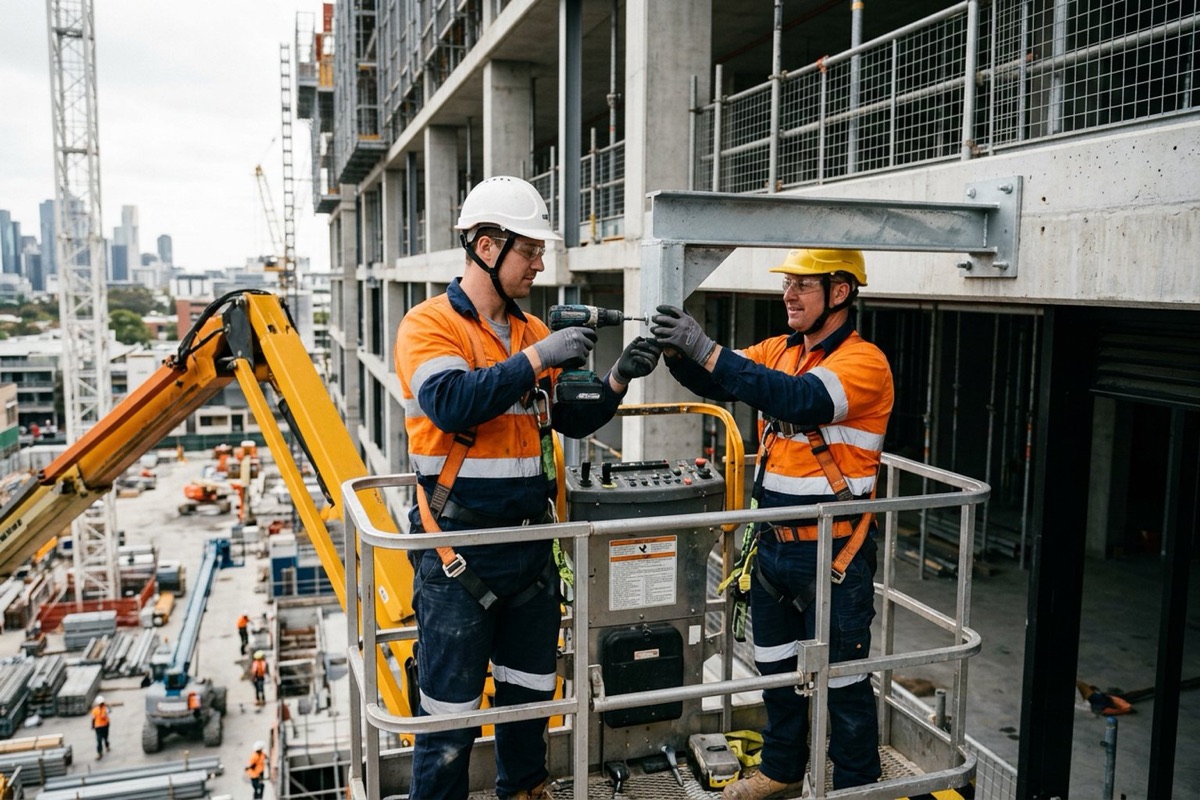
Is there a minimum height for fall protection?
No. Under the model Regulations the duty applies to any fall from one level to another that is reasonably likely to cause injury. A worker who falls 1.5 metres onto reinforcing bar or into an open excavation can be killed; the height is only one factor.
The heights you hear quoted on site mostly come from other rules:
- 2 metres (3 metres for residential construction in the Northern Territory) is the trigger for a safe work method statement — not a safe height.
- 4 metres is the scaffold height above which scaffolding work needs a licence and formal inspections.
- More than 2 metres is where Victoria’s own falls regulations apply.
When does working at height need a SWMS?
Construction work involving a risk of a person falling more than a set height is high risk construction work, which needs a SWMS before it starts. As at October 2026, the trigger is a risk of falling:
- more than 2 metres under the model Regulations and in the Commonwealth, New South Wales, Queensland, Western Australia, Tasmania and the ACT;
- more than 2 metres in South Australia from 1 July 2026, down from more than 3 metres;
- more than 3 metres for residential construction in the Northern Territory since 17 July 2026, and more than 2 metres for other construction; and
- more than 2 metres in Victoria, under its own Occupational Health and Safety Regulations 2017.
The SWMS sets out how the fall risk will be controlled. It does not replace the controls in regulation 79 — it records them.
What does a rescue plan need to cover?
Whenever a fall arrest system is used as a control, regulation 80 requires the PCBU to:
- establish emergency procedures, including rescue procedures, for the use of the fall arrest system;
- test those procedures so that they are effective; and
- provide relevant workers with suitable and adequate information, training and instruction in them.
A worker left hanging in a harness after a fall can suffer suspension intolerance, so rescue has to be fast — measured in minutes, not the time it takes an ambulance to arrive and a fire crew to reach them. A real rescue plan names who will do the rescue, with what equipment (an elevating work platform, a rescue kit, ladder access), and is practised on site. “Call 000” is part of the plan, not the plan.
Which controls work best on a building site?
- Edge protection and guardrails. Install perimeter protection at slab edges, roof edges, stairwells and voids before the risk arises, and keep it in place until permanent barriers replace it. Only competent people should alter or remove it.
- Scaffolds and working platforms. A properly designed, erected and inspected scaffold is a fall prevention device and one of the most reliable controls available. See scaffolding licences, inspections and handover.
- Elevating work platforms (EWPs). Scissor lifts and boom lifts are working platforms. Operating a boom-type EWP with a boom length of 11 metres or more requires a high risk work licence, and Safe Work Australia’s Elevating work platforms code covers their safe use.
- Covers over openings. Penetrations, voids, pits and stair openings must be covered with secured covers strong enough to take the loads on them, and clearly marked — or barricaded.
- Fragile surfaces. Treat skylights and fragile roof sheeting as openings: protect them so no one can step on or fall through them.
- Ladders. In the model falls Regulations, safe use of ladders is listed as part of a safe system of work, and Victoria’s regulations put ladders at the bottom of the hierarchy. Use them for access and short, light tasks, not as a working platform for extended or heavy work.
- Sequencing. Plan the work so that permanent stairs, floors and barriers go in early and as much work as possible happens at ground level — including prefabricating and lifting into place.
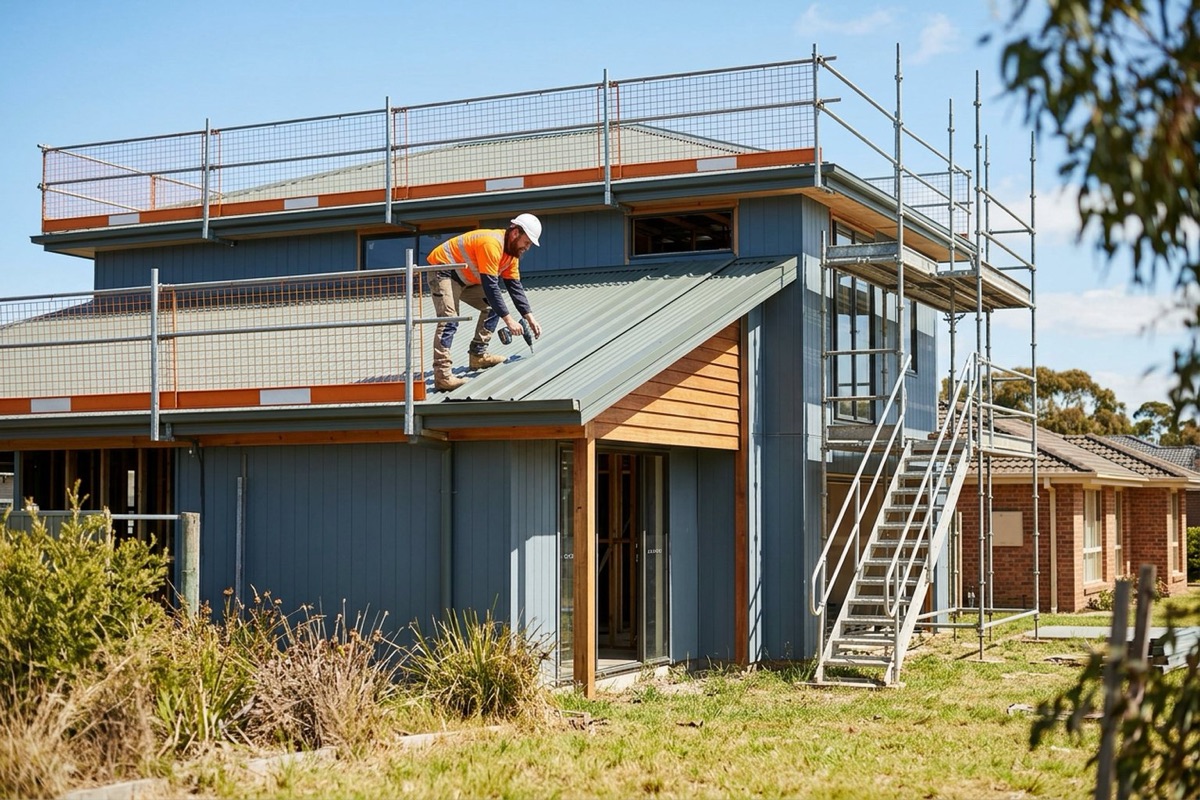
How is Victoria different?
Victoria has not adopted the model WHS laws, and its falls rules sit in the Occupational Health and Safety Regulations 2017. They apply where there is a risk of a fall of more than 2 metres. The employer must assess the risk and eliminate it, or, if that is not reasonably practicable, reduce it using the following, in order of priority, so far as is reasonably practicable:
- work on the ground or on a solid construction;
- a passive fall prevention device, such as scaffolding or an elevating work platform;
- a work positioning system, such as a travel restraint system;
- a fall arrest system, such as an industrial safety net, catch platform or harness system; and
- a fixed or portable ladder, or an administrative control.
The structure mirrors the model hierarchy, but Victoria’s height threshold, terms and clause numbers are its own. Falls below 2 metres are still covered by the employer’s general duty under the OHS Act 2004.
What changed in Western Australia on 1 October 2026?
Until 30 September 2026, Western Australia’s falls controls came from regulation 3.55 of the Occupational Safety and Health Regulations 1996, which applied where there was a risk of a fall of 2 metres or more from the edge of certain structures such as scaffolds, or 3 metres or more from any other edge.
From 1 October 2026, regulation 79 of the Work Health and Safety (General) Regulations 2022 applies instead. It sets specific requirements to minimise the risk of a fall — fall prevention devices and safe systems of work — and does not prescribe a height. WA sites should update procedures and SWMS that still cite the old 2 and 3 metre rules.
What do the Codes of Practice add?
Safe Work Australia’s model Codes of Practice turn the Regulations into practical detail:
- Managing the risk of falls at workplaces — the general falls code for all workplaces.
- Managing the risk of falls in housing construction — practical guidance for residential building work.
- Elevating work platforms — selecting, operating and maintaining EWPs.
A code of practice becomes enforceable guidance once a jurisdiction approves it, and courts can rely on it as evidence of what is known about a hazard and what is reasonably practicable. Which codes are approved varies between jurisdictions; see which WHS laws apply in your state.
Working at heights checklist
- Look for every fall risk, at any height: edges, openings, fragile surfaces, ladders and access ways.
- Eliminate it first — work on the ground, prefabricate, install permanent stairs and barriers early.
- Use a fall prevention device next: edge protection, scaffolds, EWPs, secured covers.
- Only then use work positioning, then fall arrest — and write and test a rescue plan before anyone relies on a harness.
- Prepare a SWMS where your jurisdiction’s height trigger is met.
- Check licences for scaffolding work over 4 metres and boom-type EWPs with a boom of 11 metres or more.
- Provide safe access and exit to every work area.
- Inspect edge protection, scaffolds and anchors before use, and after changes or weather events.
Get fall prevention right
CPD-accredited online courses on managing falls, scaffolds and working platforms, and fall protection in buildings, each with an assessment and a certificate.
- Managing the Risk of Falls: Working at Heights in Construction View course →
- Scaffolding and Working Platforms: Safety and Compliance View course →
- Balustrades, Barriers and Fall Protection in Buildings View course →
- Safe Work Method Statements for High-Risk Construction Work View course →
- Formwork and Falsework Safety View course →
- Cranes, Rigging and Lifting Operations Safety View course →
Frequently asked questions
Is there a height below which fall protection isn't required?
No. Under the model WHS Regulations, PCBUs must manage the risk of any fall from one level to another that is reasonably likely to cause injury, whatever the height. Victoria's specific falls regulations apply above 2 metres, but its general duty still covers lower falls.
At what height do you need a harness in Australia?
There is no fixed height. A fall arrest system such as a harness is the third choice under the model Regulations, used only if a fall prevention device or work positioning system is not reasonably practicable, and it must come with tested rescue procedures.
Do I need a SWMS to work on a roof?
Yes, if there is a risk of falling more than 2 metres, because that is high risk construction work in most jurisdictions. In the Northern Territory the trigger for residential construction is more than 3 metres.
Can I use a ladder to work at height?
Ladders can be part of a safe system of work, but they are a lower-order control. Victoria's regulations put ladders at the bottom of the hierarchy, and they are best suited to access and short, light tasks rather than extended work.
Do you need a licence to operate an elevating work platform?
A high risk work licence is required to operate a boom-type elevating work platform with a boom length of 11 metres or more. Other EWPs, such as scissor lifts, still require the operator to be trained and competent.
What is a rescue plan for working at heights?
It is the emergency procedure the WHS Regulations require whenever a fall arrest system is used. It must cover how a fallen worker will be rescued quickly, by whom and with what equipment, and it must be tested so that it is effective.
Sources and further reading
- Federal Register of Legislation — Work Health and Safety Regulations 2011 (Cth), regs 78–80 and 291 (model text)
- Safe Work Australia — Model Code of Practice: Managing the risk of falls at workplaces
- Safe Work Australia — Model Code of Practice: Managing the risk of falls in housing construction
- Safe Work Australia — Model Code of Practice: Elevating work platforms
- SafeWork SA — High-risk construction work changes from 1 July
- NT WorkSafe — Safe work method statement for high risk construction work
- WorkSafe WA — Managing the risk of falls at workplaces
- WorkSafe Victoria — A guide to falls prevention
- WorkSafe Tasmania — Classes of high risk work