Erecting, altering or dismantling a scaffold from which a person or object could fall more than 4 metres needs a high risk work licence: basic, intermediate or advanced, depending on the scaffold. Under the model WHS Regulations, a scaffold of that height, or any suspended, cantilevered, spur or hung scaffold, cannot be used until a competent person who has inspected it confirms in writing that it is complete. It must then be inspected at least every 30 days, after repairs and after any incident that could affect its stability.
That written confirmation is the handover certificate; scaffold tags are good practice, not the legal requirement. Victoria’s regulations have no 30-day or written-confirmation rule, and Queensland and Western Australia add requirements of their own.
When do you need a scaffolding licence?
Under the model WHS Regulations, scaffolding work means erecting, altering or dismantling a temporary structure that supports a platform, where a person or object could fall more than 4 metres from the platform or the structure. It is high risk work and needs a licence of the right class. Each class includes the one below it:
- Basic (SB) — modular or prefabricated scaffolds, cantilevered materials hoists with a maximum working load of 500 kg, ropes, gin wheels, safety nets and static lines, and bracket scaffolds.
- Intermediate (SI) — adds tube and coupler scaffolds, cantilevered and spur scaffolds, cantilevered crane loading platforms, barrow ramps and sloping platforms, perimeter safety screens and shutters, and mast climbing work platforms.
- Advanced (SA) — adds cantilevered hoists, hung scaffolds and suspended scaffolds.
A business must see written evidence of a worker’s licence before directing or allowing them to do the work (reg 85). Licences last five years. Narrow exceptions cover supervised trainees, people being assessed and, briefly, people who have passed the course and await their licence.
Below 4 metres no licence is needed, but the scaffold should still be erected by people trained in the system, to the manufacturer’s instructions.
Scaffolding work usually needs a SWMS as well, because a risk of falling more than 2 metres makes it high risk construction work under the model regulations and in Victoria. The Northern Territory moved to 3 metres for residential construction in July 2026.
What inspections does the law require?
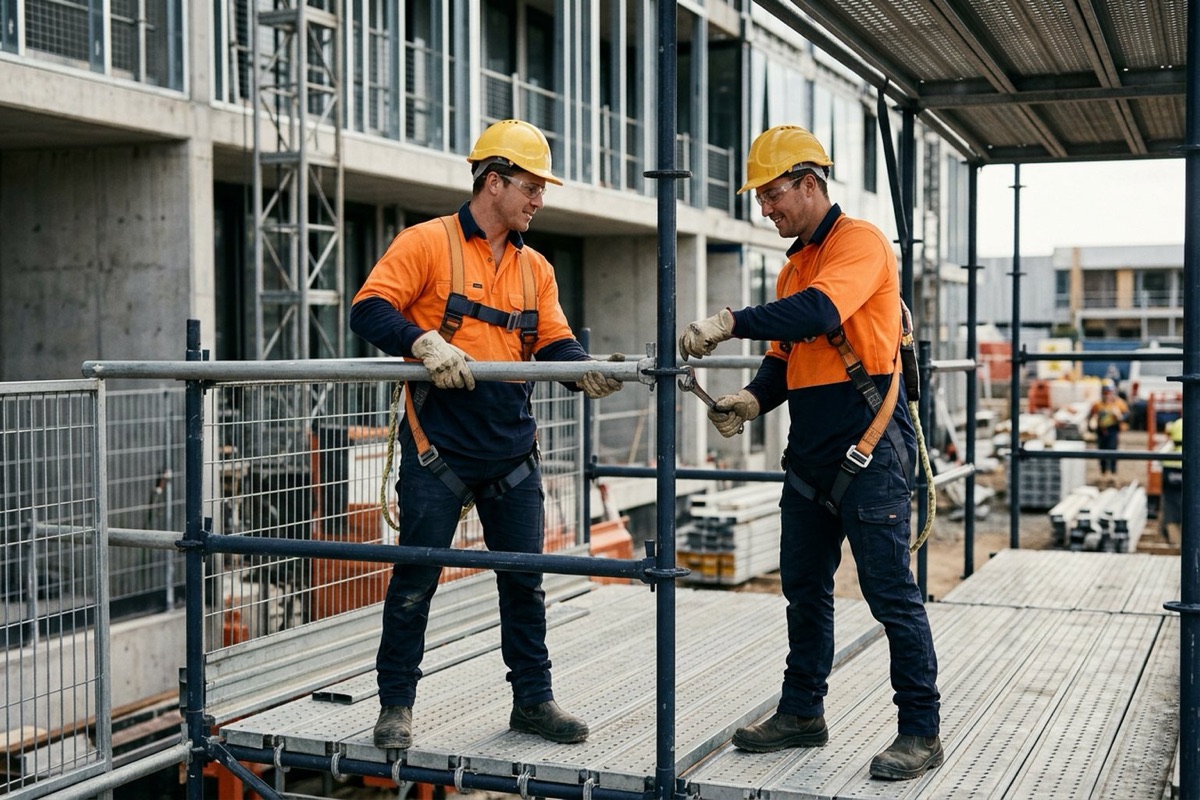
Regulation 225 of the model WHS Regulations covers every suspended, cantilevered, spur and hung scaffold, whatever its height, and any other scaffold from which a person or thing could fall more than 4 metres. The duty sits with whoever has management or control of the scaffold, usually the business it was handed over to, such as the builder or principal contractor. They must ensure that:
- Nobody uses it until a competent person who has inspected it confirms in writing that it is complete.
- It and its supporting structure are inspected by a competent person at least every 30 days, and before use resumes after repairs or after an incident that could affect its stability.
- Anything unsafe is fixed and re-inspected before use resumes.
- Unauthorised access is prevented while it is incomplete or unattended, for example with danger tags and warning signs.
A competent person need not hold a scaffolding licence; it is someone with the knowledge and skills for the task, gained through training, qualification or experience. Queensland’s reg 225 adds an inspection before first use.
Are handover certificates and scaffold tags legally required?
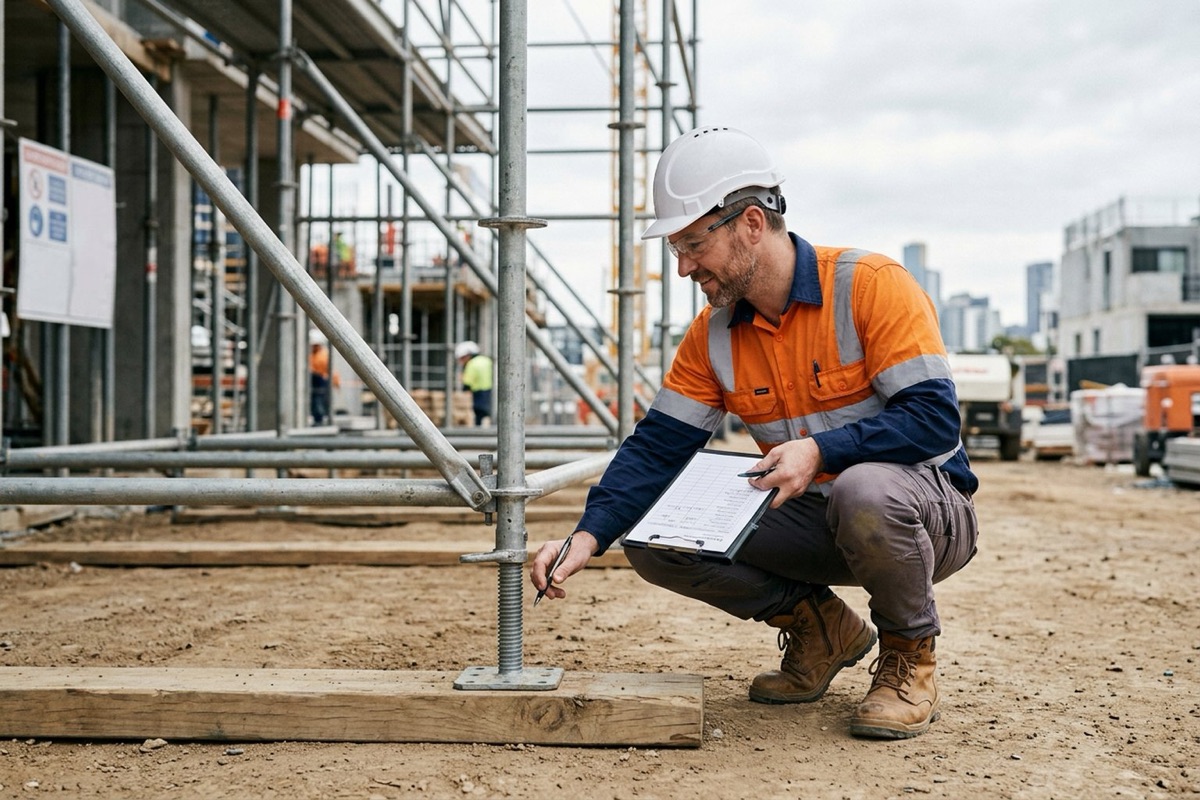
The law requires written confirmation, not a particular form. SafeWork NSW gives the handover certificate as its example, and tells builders to inspect the scaffold themselves before accepting one.
- Required (reg 225): written confirmation before first use; inspections after incidents, after repairs and at least every 30 days; keeping people off incomplete or unattended scaffolds.
- Good practice: a handover certificate recording the area, intended use, duty rating, how many platforms can be loaded at once, drawings, and the signer’s name, licence number and date, as in WorkSafe Victoria’s template.
- Good practice: tags at access points showing the last inspection. WorkSafe Victoria notes a tag does not carry enough information to serve as a handover certificate.
- Good practice: an inspection register on site, because the record is what proves the inspections happened.
Who is allowed to alter a scaffold?
On a scaffold where someone could fall more than 4 metres, any alteration is scaffolding work, so only a licensed scaffolder of the right class may do it. That covers the usual trade shortcuts: moving ties to reach a wall, pulling planks off hop-ups, or removing ledgers, transoms or braces to clear a path. SafeWork NSW is plain that unlicensed workers must not remove scaffold components, including planks. WorkSafe Victoria recommends regular checks of ties, which finishing trades may loosen or remove.
- Make it a site rule at induction that only the scaffold contractor alters the scaffold, and give trades a way to ask for changes.
- Plan staged changes, such as ties coming out for cladding, before work starts.
- Treat each alteration like a new handover: inspect it and record what changed, who did it and when.
In Victoria, reg 105 of the OHS Regulations 2017 requires employers to take steps to prevent unpermitted alterations to plant.
Do mobile scaffolds need a licence and inspections?
Yes, once they are tall enough. The model regulations treat mobile scaffolds as scaffolds, and the basic class covers prefabricated scaffolds, which aluminium mobile towers typically are. There is no general exemption: if a person or object could fall more than 4 metres, erecting, altering or dismantling a mobile tower needs at least a basic licence, and the reg 225 handover and inspection rules apply.
At any height, WorkSafe Victoria’s guidance is to:
- erect it to the manufacturer’s instructions on a hard, level surface;
- lock the castors while anyone is on it, and never move it with people on it;
- deck the working platform fully, with no split decks; and
- fit guardrails, mid-rails, toe boards and internal ladder access where the platform is over 2 metres.
For wider fall controls, see working at heights in construction.
Which Australian Standards apply to scaffolding?
- AS/NZS 1576 Scaffolding series (Parts 1 to 6) — design and performance. Part 1 is AS/NZS 1576.1:2019, General requirements.
- AS 4576:2020 Guidelines for scaffolding — the companion guide to erection, alteration, dismantling, inspection and use. It replaced AS/NZS 4576:1995, which older SWMS still cite.
WorkSafe Victoria’s industry standard lists the usual duty ratings: light, medium and heavy duty allow up to 225 kg, 450 kg and 675 kg per platform per bay, each including a concentrated load.
In Western Australia the standards are mandatory: reg 225 requires scaffolds to be erected and dismantled in accordance with the relevant requirements of AS/NZS 1576 Parts 1 to 6, and scaffolding equipment to comply with them.
How do the rules differ in Victoria, WA and Queensland?
Victoria has not adopted the model WHS laws, but its licensing matches in substance: the same three classes, the same 4-metre trigger and recognition of interstate licences (OHS Regulations 2017, regs 128–131). Its scaffold rule, reg 118, is narrower: no work except erection or dismantling from an incomplete scaffold; the scaffold secure and able to support the work; repairs before use once it is known to be unsafe; and, so far as reasonably practicable, anyone who would not ordinarily use it kept off while it is unattended.
There is no written-confirmation or 30-day rule. Reg 105 requires plant to be inspected as far as needed to monitor risk, and WorkSafe Victoria’s Scaffolding industry standard (December 2024) recommends a handover certificate for scaffolds over 4 metres and inspections before first use, every 30 days and after storms, impacts, repairs or alterations.
Western Australia adds the AS/NZS 1576 requirements above. Queensland adds a pre-use inspection to reg 225 and has an approved Scaffolding Code of Practice 2021, in force since 1 July 2021.
What do inspectors find most often?
SafeWork NSW’s Scaff Safe campaign visited 343 sites between August and December 2024 and issued 613 compliance notices. The most common problems were:
- missing handrails or mid-rails: 39% of sites;
- incomplete decks, with missing ledgers, planks or hop-ups: 37%;
- no written confirmation from a competent person: 27%;
- gaps over 225 mm between the working deck and the building: 27%;
- alterations by someone other than a licensed scaffolder: 23%; and
- inadequate ties: 18%.
Yet 95% of sites had an inspection within the previous 30 days. An inspection on file is not the same as a compliant scaffold today.
Checklist: relying on someone else's scaffold
- Get the written handover from a competent person who inspected it, covering the area and use you need.
- Check the licence class fits: tube and coupler, cantilevered and spur scaffolds need at least intermediate; hung and suspended scaffolds need advanced.
- Walk it first: full decks, guardrails, mid-rails and toe boards, ties and bracing as designed, base plates on sole boards, safe access and no wide gaps at the building face.
- Know its limits: the duty rating and how many platforms can be loaded at once, and tell the trades.
- Book the inspections: every 30 days and after storms, impacts or repairs, with records kept on site.
- Lock down alterations: only the scaffold contractor changes it, and each change is inspected.
- Close it off when incomplete or unattended, with danger tags, barricades and blocked access.
Nexis CPD’s Scaffolding and Working Platforms course covers these steps in depth.
Get scaffolding and work at height right
CPD-accredited online courses on scaffolding, falls prevention and high-risk construction work, each with an assessment and a certificate.
- Scaffolding and Working Platforms: Safety and Compliance View course →
- Managing the Risk of Falls: Working at Heights in Construction View course →
- Safe Work Method Statements for High-Risk Construction Work View course →
- Formwork and Falsework Safety View course →
- Cranes, Rigging and Lifting Operations Safety View course →
Frequently asked questions
Do you need a licence to erect a scaffold under 4 metres?
No, provided no person or object could fall more than 4 metres from the platform or the structure. The erectors should still be trained in the system and follow the manufacturer's instructions. A SWMS is likely to be needed anyway, because under the model regulations high risk construction work starts at a fall of more than 2 metres.
How often does a scaffold need to be inspected?
Under the model WHS Regulations, at least every 30 days, and before use resumes after repairs or after an incident that could affect its stability. Queensland also requires an inspection before first use. Victoria's regulations set no interval, but WorkSafe Victoria recommends the same 30-day cycle.
Who can inspect a scaffold?
A competent person, meaning someone with the knowledge and skills for the task, gained through training, qualification or experience. The regulation does not require a licensed scaffolder, but the inspector must be competent for that type of scaffold. Arranging inspections is the duty of whoever manages or controls the scaffold.
Is a safe-to-use scaffold tag a legal requirement?
No. The law requires written confirmation before first use and regular inspections, and mentions danger tags only as a way to keep people off incomplete or unattended scaffolds. Status tags usefully show the last inspection, but WorkSafe Victoria notes they cannot replace a handover certificate.
Can a tradesperson move a plank or remove a tie?
Not on a scaffold where a person or object could fall more than 4 metres. Moving planks, removing ties or taking out any other component is altering the scaffold, which is licensed work. Ask the scaffold contractor to make the change, and have the section inspected before it is used again.
Is a scaffolding licence from another state valid?
Yes. The model WHS Regulations recognise high risk work licences granted under another jurisdiction's WHS laws, and Victoria recognises equivalent interstate licences. A suspended, cancelled or expired licence is not recognised.
Sources and further reading
- Federal Register of Legislation — Work Health and Safety Regulations 2011 (Cth): regs 5, 81–92, 225, 291 and Schedule 3
- Queensland Legislation — Work Health and Safety Regulation 2011 (Qld), s 225
- Queensland Legislation — Work Health and Safety (Codes of Practice) Notice 2022 (Scaffolding Code of Practice 2021)
- WA Legislation — Work Health and Safety (General) Regulations 2022, r 225
- Victorian Legislation — Occupational Health and Safety Regulations 2017, regs 105, 118, 128–131, 322 and Schedule 3
- WorkSafe Victoria — Scaffolding industry standard (December 2024)
- SafeWork NSW — Scaffolding
- SafeWork NSW — Findings report: Scaff Safe in Construction 2024
- NT WorkSafe — Safe work method statement for high risk construction work