A rainwater tank that supplies a building is part of its plumbing, so it must meet the Plumbing Code of Australia (NCC Volume Three) and Section 15 of AS/NZS 3500.1. The central rule is protecting the drinking water supply: where mains water tops up the tank or a switching device changes between tank and mains, a backflow prevention device is required, and the tank pipework and outlets must be marked as rainwater.
Good design does the rest: collect roof water only, divert the first flush, screen every opening against mosquitoes, send overflow to the approved stormwater system, and maintain the gutters, screens and tank. Some states and councils also require a tank on new homes.
Which plumbing rules apply to rainwater tanks?
Two Parts of NCC Volume Three, the Plumbing Code of Australia, cover rainwater connected to a building:
- Part B6 Rainwater services. Covers the pipework from the point of connection at the tank to the outlets it serves, where the building also has a separate drinking water supply from a water utility. It does not apply to rainwater used only for irrigation.
- Part B7 Rainwater storage. Covers the tank itself, from the point where rainwater enters it to the point of connection to the building’s water service. It does not apply to tanks for fire-fighting water or irrigation systems.
Where a site has no mains water and rainwater is the main source for drinking and personal hygiene, the NCC treats it as a cold water service supplied by an alternative source, so the cold water rules in Part B1 apply instead.
The Deemed-to-Satisfy Provision B6D2 requires a rainwater service to comply with Section 15 of AS/NZS 3500.1, the water services part of the plumbing and drainage standard. NCC 2022 and NCC 2025 both use this structure. NCC 2025 applies in Victoria, Western Australia, the ACT and, for plumbing, South Australia from 1 May 2026; New South Wales and Queensland stay on NCC 2022 until 1 May 2027. Our guide to the Plumbing Code of Australia explains the wider framework.
Connecting a tank to a building’s water service is regulated plumbing work, so it needs a licensed plumber. Stormwater connections to and from the tank can sit with a different authority. In South Australia, for example, the NCC notes that the Office of the Technical Regulator regulates the plumbing from the tank to fixtures, while the roof-to-tank and overflow stormwater connections are regulated by the council.
How do you protect the mains supply from tank water?
If tank water can flow back into the mains, it can contaminate the public supply. That is why the NCC treats any possible cross-connection between a drinking water service and a rainwater service as a hazard that must be rated and protected (B5D2).
Most tanks on mains-connected homes are topped up with mains water or use a switching device, sometimes called a changeover or interchange device, that supplies toilets or laundries from the tank and switches to mains when the tank runs low. Under B5D6 of NCC 2025:
- Class 1 buildings. Where drinking water tops up a tank or supplements a rainwater service through a changeover device, zone protection with a low hazard device is required, whether the tank is above ground, buried or partially buried.
- Other building classes. Zone protection with a high hazard device for buried tanks, and a low hazard device for partially buried and above-ground tanks.
- Device selection. Devices are selected and installed in accordance with Section 4 of AS/NZS 3500.1.
If drinking water is not connected to the tank or rainwater service at all, the NCC notes that backflow prevention is not required. A water utility may set stricter rules, and those should be followed. New South Wales has its own variation of B5D6 based on tank location. In NCC 2022, B5D6 instead refers to clause 16.4 and Table 16.4 of AS/NZS 3500.1:2018, with an option to use a dual check valve after a risk assessment.
Some states add switching rules. South Australia’s variation to B6D2 requires an automatic changeover, top-up or switching device, without manual intervention, where drinking water supplements a rainwater service for a Class 1 building. Victoria’s variation requires an automatic or manual interchange device where a tank supplies toilet flushing in a mains-connected building, so toilets never lose water. Our guide to backflow prevention covers device types and testing.
What else must a rainwater service include?
Part B6 sets several further requirements for the rainwater pipework and fixtures. Clause numbers below are from NCC 2025:
- Pressure. Outlets need a working pressure of at least 50 kPa and a static pressure within the building of no more than 500 kPa, unless a fixture needs something different (B6P1). In practice this usually means a pump.
- Velocity. Water velocity in the pipework must not exceed 3 m/s for at least 99% of the time during the peak hour (B6P2).
- Toilet and urinal efficiency. Where rainwater flushes toilets or urinals, dual flush cisterns of 6/3 or 4.5/3 litres, or urinal flushing of no more than 2.5 litres per stall, are required (B6P3).
- Access and isolation. Pumps, valves and controls must be accessible and able to be isolated for maintenance (B6D5 and B6D6).
- Bushfire-prone areas. In NCC 2025, a rainwater service in a designated bushfire-prone area must comply with AS 3959 (B6D7).
Do you have to install a rainwater tank?
The NCC itself does not require tanks nationally. Its introduction to Part B7 notes that state, territory or local governments may require them in some areas. Two examples:
- South Australia. SA Part H9 of NCC 2022 Volume Two applies to defined new Class 1 buildings and extensions in council areas. Where it applies, run-off from at least 50 m² of roof, or the whole roof if it is smaller, must be collected in a tank of at least 1,000 litres and plumbed to at least a toilet, a water heater or all laundry cold water outlets. The tank’s inlet and overflow need mosquito-proof, non-degradable screens. Check SA H9P1 for exactly which applications it covers.
- New South Wales. BASIX does not mandate a tank, but its water section assesses fixtures, landscaping and alternative water sources against a target of up to 40% below the pre-BASIX benchmark. A tank plumbed to toilets, laundry and garden is a common way to meet it, and the tank size and connections on the BASIX certificate become conditions of approval.
Planning approval for the tank itself varies. In New South Wales, above-ground and some below-ground tanks can be exempt development if they meet the development standards in the State Policy, but not in foreshore or environmentally sensitive areas, and on a heritage item the tank must be in the rear yard. Elsewhere, check with the council.
How should a rainwater system be designed?
Design starts at the roof. The NCC requires rainwater storage to contain only roof-captured rainwater, although it may be topped up with drinking water where necessary. Good practice from health authorities adds:
- Clean catchment. Keep large tree branches clear of the roof, and use leaf guards, mesh traps or enclosed gutters to keep debris out.
- First flush. Fit a first-flush diverter in the downpipe so the dirtiest water from the start of each rain is diverted before it reaches the tank.
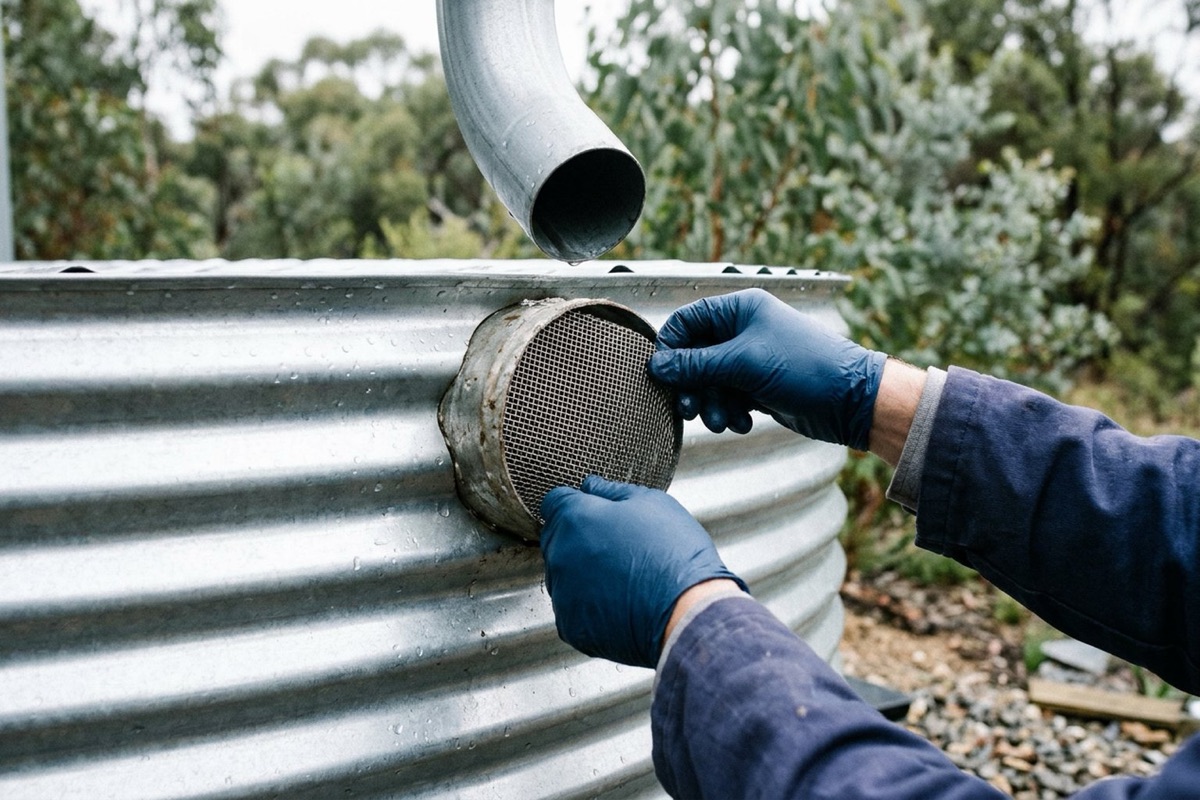
- Mosquito-proofing. Seal the tank and fit mosquito-proof screens or flap valves to every opening, including overflows. Victoria’s Department of Health advises mesh no coarser than 1 to 1.5 mm.
- Self-draining pipework. Make sure gutters, pipes and outlets drain fully and do not pond water.
- Overflow. Discharge overflow to the approved stormwater system or legal point of discharge set by the council. In South Australia, SA H9D4 requires overflow to meet the authority’s requirements and Part 3.3 of the ABCB Housing Provisions.
- Support. A tank on a stand or platform needs a structure designed for the full weight of water. SA H9D6 refers to the Housing Provisions for this.
Coordinate the tank with any on-site detention. Our guide to stormwater and water sensitive urban design covers that side.
Is tank water safe to drink?
The national health guidance is enHealth’s Guidance on the use of rainwater tanks, which covers design, installation, maintenance and health risks. Victoria’s Department of Health says rainwater is generally a safe and reliable source of drinking water when the system is well maintained, and that after mains water, rainwater is the next safest choice.
Contamination can come from industrial pollutants, dust, leaves, pollen, pesticide sprays, fertilisers, birds, small animals and insects, and the risk rises with poor maintenance. Where mains water is available, Part B6 is written for the common arrangement of mains for drinking and personal hygiene and rainwater for uses such as toilets, laundry and garden.
How should rainwater tanks be maintained?
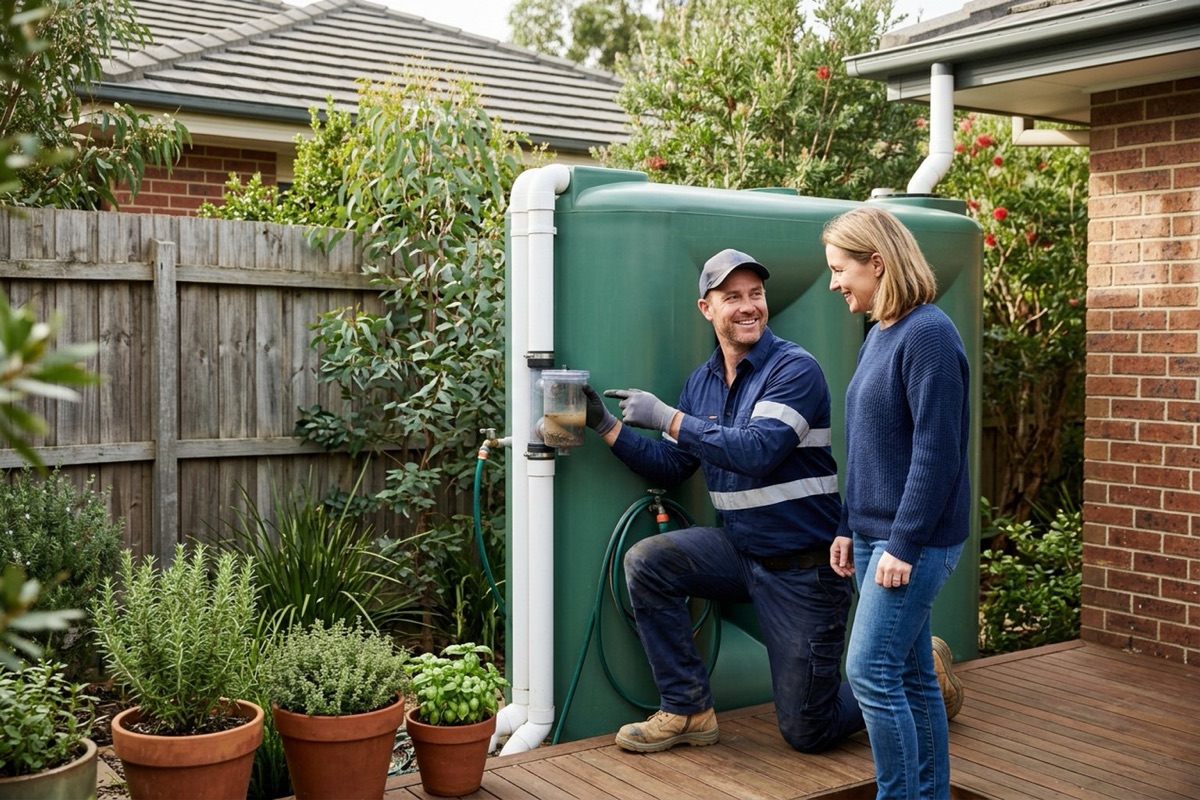
Victoria’s Department of Health recommends a simple schedule:
- After rainfall. Open and clean first-flush devices.
- Every three months. Check first-flush diverters and look for pooling water around the tank.
- Every six months. Check mosquito mesh for holes, and clear debris from the roof and gutters.
- Every two to three years. Check the tank for sludge build-up.
Pumps and backflow devices also need attention. Testable backflow devices must be tested as the state and water utility require. Cleaning out sludge should be done from outside the tank where possible: a tank can be a confined space under WHS law, so entry needs the controls in our guide to confined spaces.
Rainwater tank plumbing checklist
- Check the approval. Note any tank size, connections or BASIX commitments required.
- Confirm the scope. Decide whether Part B6 and B7 or Part B1 applies, depending on the drinking water source.
- Protect the mains. Fit the backflow device B5D6 and the water utility require for any top-up or changeover.
- Fit the right switch. Install an automatic changeover or interchange device where South Australia or Victoria require one.
- Mark it. Identify rainwater pipes, outlets and non-drinking tanks under AS/NZS 3500.1.
- Screen and divert. Fit first flush, leaf protection and mosquito-proof screens on every opening.
- Discharge overflow. Connect overflow to the approved stormwater system.
- Hand over. Give the owner a maintenance schedule and device test requirements.
Design and install rainwater systems that comply
CPD-accredited online courses on rainwater harvesting, backflow prevention and the Plumbing Code of Australia, each with an assessment and a certificate.
- Rainwater Harvesting for Buildings: An Introduction View course →
- Advanced Rainwater Harvesting System Design View course →
- Backflow Prevention Basics View course →
- Testable Backflow Prevention Device Installation and Testing View course →
- The Plumbing Code of Australia: NCC Volume Three View course →
- Roof Drainage Basics View course →
Frequently asked questions
Which standard covers rainwater tank plumbing?
AS/NZS 3500.1, the water services part of the plumbing and drainage standard. The Plumbing Code of Australia's Deemed-to-Satisfy Provision B6D2 requires a rainwater service to comply with Section 15 of AS/NZS 3500.1, and backflow devices are selected under its Section 4.
Do I need a backflow device on a rainwater tank?
Yes, if mains water tops up the tank or a changeover device switches between tank and mains. NCC 2025 B5D6 requires zone protection, with a low hazard device for Class 1 buildings. If drinking water is not connected to the tank at all, backflow prevention is not required.
What is a rainwater changeover device?
It is a device that supplies fixtures from the tank and switches to mains water when the tank is low or the pump fails. South Australia requires automatic switching for Class 1 buildings where mains supplements a rainwater service, and the changeover needs backflow protection.
What mesh size stops mosquitoes getting into a tank?
Victoria's Department of Health advises mesh no coarser than 1 to 1.5 mm, made from materials such as brass, copper, aluminium or bronze wire. Every opening needs a screen or flap valve, including the overflow.
Can rainwater tank overflow go onto the ground?
Generally it should go to the approved stormwater system or legal point of discharge. The council or relevant authority sets the requirements, so check the approval before relying on overflow to a garden or soakage area.
How often should a rainwater tank be cleaned?
Victoria's Department of Health recommends checking for sludge every two to three years, cleaning first-flush devices after rain, and checking screens and gutters every six months. Remove sludge from outside the tank where possible, because tank entry can be confined space work.
Sources and further reading
- ABCB — NCC 2025 Volume Three (PCA), Part B6 Rainwater services
- ABCB — NCC 2025 Volume Three (PCA), Part B7 Rainwater storage
- ABCB — NCC 2025 Volume Three (PCA), Part B5 Cross-connection control (B5D6 Rainwater)
- ABCB — NCC 2022 Volume Three (PCA), Part B5 Cross-connection control (B5D6 Rainwater)
- ABCB — NCC 2022 Volume Three (PCA), Part B6 Rainwater services
- ABCB — NCC 2022 Volume Two, SA Part H9 Water efficiency
- enHealth — Guidance on the use of rainwater tanks
- Department of Health (Vic) — Rainwater
- Department of Health (Vic) — Keeping your rainwater tank safe from mosquitoes
- NSW Planning Portal — BASIX water section
- NSW Planning Portal — Exempt development: rainwater tanks