Under the model WHS Regulations, a confined space is an enclosed or partially enclosed space that is not designed or intended primarily to be occupied by a person, is at normal atmospheric pressure while someone is in it, and is or is likely to be a risk to health and safety from an unsafe oxygen level, flammable or harmful airborne contaminants, or engulfment. A mine shaft or the workings of a mine is excluded.
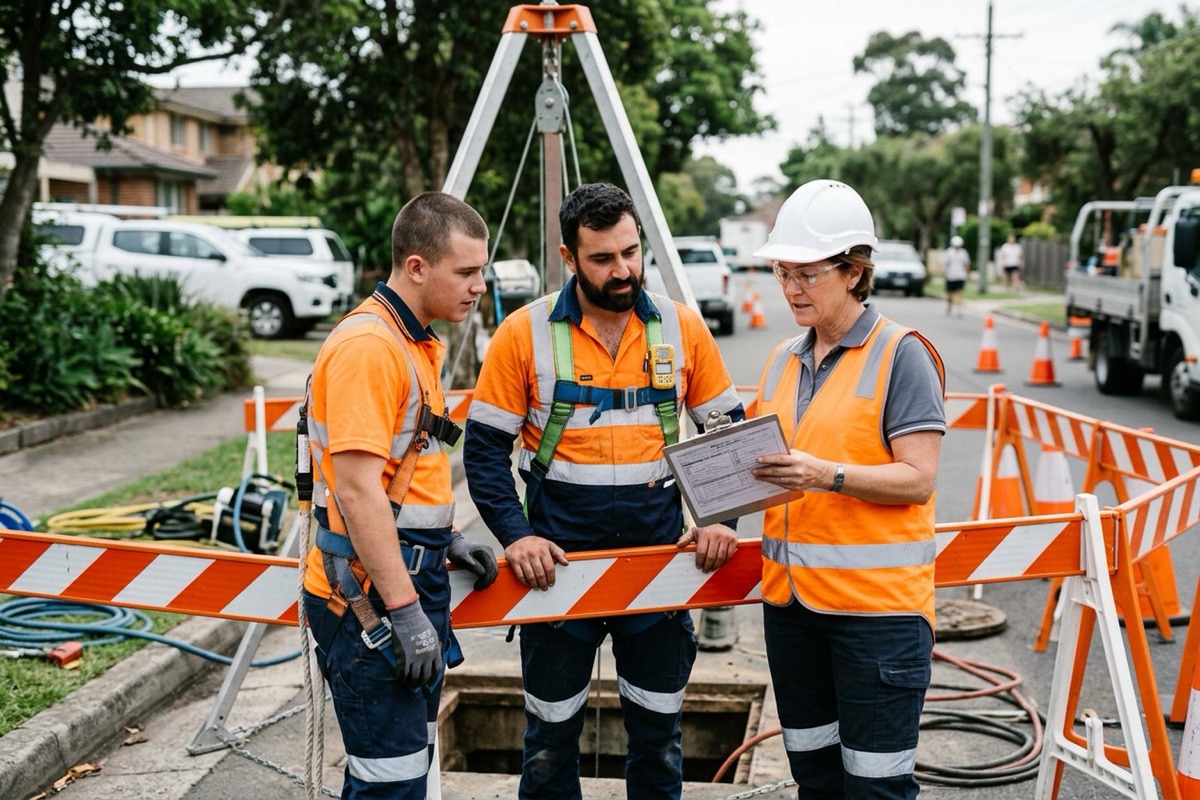
If a space meets that definition, a competent person must assess the risks in writing, and no worker may be directed to enter until a written entry permit is issued, signs are up, the atmosphere is safe, a standby person is in place and rescue procedures are ready.
What is a confined space under the WHS Regulations?
Regulation 5 of the model WHS Regulations defines a confined space as an enclosed or partially enclosed space that meets all three of these tests:
- it is not designed or intended primarily to be occupied by a person;
- it is, or is designed or intended to be, at normal atmospheric pressure while any person is in it; and
- it is or is likely to be a risk to health and safety from an atmosphere without a safe oxygen level, contaminants (including airborne gases, vapours and dusts) that may cause injury from fire or explosion, harmful concentrations of any airborne contaminant, or engulfment.
The definition does not include a mine shaft or the workings of a mine. Pressurised spaces also fall outside it, because the space must be at normal atmospheric pressure.
The Part 4.3 rules apply to any confined space that is entered, is intended or likely to be entered, or could be entered inadvertently. A confined space is defined by its hazards, not its size.
Which spaces on a construction site are confined spaces?
The model Code of Practice lists vats, tanks, pits, pipes, ducts, flues, chimneys, silos, containers, pressure vessels, underground sewers, wet or dry wells, shafts, trenches and tunnels as common examples — but only when they meet the definition. On construction and civil sites, the usual candidates are:
- Pits and access chambers for stormwater, sewer, electrical and telecommunications services.
- Sewers and stormwater pipes, where hydrogen sulphide and other gases can build up.
- Tanks — rainwater, septic, fuel and chemical tanks, and the inside of large pipes or ducts.
- Deep excavations, shafts and trenches, where gases heavier than air (or exhaust fumes from nearby plant) can collect, or where loose material could engulf a worker.
- Lift pits, sealed voids and similar spaces can also qualify if they are poorly ventilated, not designed to be worked in, and likely to hold a hazardous atmosphere.
Work that changes the atmosphere — welding, solvents, or a petrol pump running in a pit — can turn an ordinary space into a confined space. Our guide to excavation and trenching explains when a trench can also be a confined space.
What must happen before anyone goes in?
Regulation 65 says a business must ensure, so far as is reasonably practicable, that no worker enters a confined space until the confined space rules have been complied with. Before entry:
- Ask whether entry is needed at all, for example by using cameras or remote tools.
- Have a competent person assess the risks, in writing. Regulation 66 requires the assessment to consider the space, how oxygen or contaminant levels may change, the work methods, and the emergency and rescue procedures needed.
- Isolate connected plant and services. Under regulation 70, the risk of substances entering through connected pipes or plant, or of connected plant being energised, must be eliminated so far as is reasonably practicable — for example by isolation and lockout.
- Prevent inadvertent entry. Cover or barricade openings when no work is happening.
What must an entry permit and signs include?
Under regulation 67, a business must not direct a worker to enter a confined space to carry out work unless it has issued a confined space entry permit for that work. The permit must be completed by a competent person, be in writing, and specify:
- the confined space it relates to;
- the names of the people permitted to enter;
- the period during which the work will be carried out; and
- the control measures for the work, based on the risk assessment, including the measures for safe entry and the communication and monitoring system.
It must also have space to record that the work is finished and everyone has left the space, and the competent person must complete that acknowledgement when the work ends.
Regulation 68 requires signs next to each entry, put up immediately before work starts and kept up during the work and while preparing for and finishing it. The signs must identify the confined space, tell workers not to enter without a permit, and be clear and prominently located.
How must the atmosphere be tested and controlled?
Regulations 71 to 73 set firm limits while work is under way:
- Oxygen: the space must have a safe oxygen level, which the Regulations define as 19.5% to 23.5% by volume. If that is not reasonably practicable and oxygen is below 19.5%, workers must be given air-supplied respiratory equipment.
- Purging and ventilation: contaminants must be purged or ventilated out so far as is reasonably practicable, and pure oxygen, or gas mixtures above 21% oxygen, must never be used to do it.
- Flammable gases and vapours: the concentration must be kept below 5% of the lower explosive limit (LEL) so far as is reasonably practicable. From 5% to under 10% of the LEL, workers must leave immediately unless a suitably calibrated, continuous-monitoring flammable gas detector is used in the space. At 10% of the LEL or more, workers must leave immediately.
- Ignition sources must not be introduced if they could cause a fire or explosion.
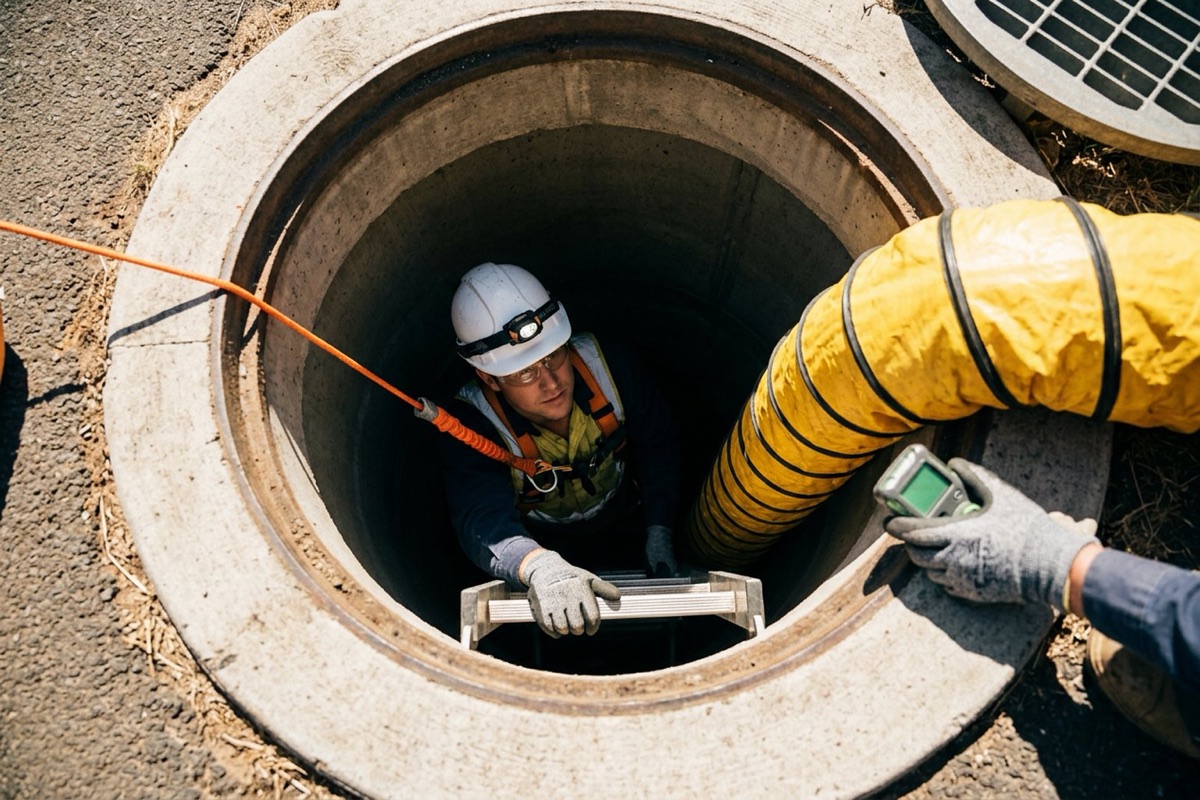
The Code of Practice says testing should be done by a competent person with a correctly calibrated gas detector, from outside the space and top to bottom, because gases settle at different levels. Test for oxygen, flammable gases and toxic gases such as hydrogen sulphide and carbon monoxide, re-test after ventilating, and never rely on your senses.
Who must watch the worker, and how does rescue work?
Regulation 69 says a worker must not enter a confined space unless there is a system of work that includes continuous communication with the worker from outside the space, and monitoring of conditions by a standby person who is near the space and, if practicable, watching the work.
For emergencies, regulations 74 and 75 require the business to:
- establish first aid and rescue procedures for the space and practise them as often as needed to keep them effective;
- ensure first aid and rescue are started from outside the space as soon as practicable;
- keep entry and exit openings large enough for emergency access and unobstructed, and rescue equipment in good order; and
- provide air-supplied respiratory equipment to rescuers where the atmosphere is or may become unsafe, and suitable protective equipment where there is an engulfment risk.
What training and records are required?
Regulation 76 requires information, training and instruction for every worker who could enter a confined space, anyone with a role in the work or emergency procedures (such as the standby person), and their supervisors. It must cover the hazards, control measures, personal protective equipment, the entry permit and the emergency procedures. A record of the training must be kept for 2 years.
Under regulation 77:
- the risk assessment must be kept until at least 28 days after the work is completed;
- the entry permit must be kept at least until the work is completed; and
- if a notifiable incident occurs, both must be kept for at least 2 years after the incident.
Copies must be available for inspection and to relevant workers on request.
Is confined space work high risk construction work?
Yes. Under regulation 291 of the model WHS Regulations, construction work in or near a confined space is high risk construction work, so a safe work method statement (SWMS) must be prepared before it starts. The SWMS sits alongside the entry permit — it does not replace it. See our guide to safe work method statements.
Access into pits and shafts often involves a fall risk too. Our guide to working at heights covers those controls.
How is Victoria different?
Victoria has not adopted the model WHS laws. Confined spaces are regulated by Part 3.4 of the Occupational Health and Safety Regulations 2017, supported by WorkSafe Victoria’s compliance code. The core duties are similar, but the details differ:
- The definition is different. Victoria’s definition lists types of structure (such as vats, tanks, pits, pipes, ducts, silos, underground sewers, wells, shafts, trenches and tunnels) and requires that the space has a limited or restricted means of entry or exit that makes it physically difficult to get in or out. Its engulfment limb covers stored substances other than liquids.
- Permits: each permit applies to one confined space only, may cover one or more employees, and must name any person assigned to the communication role.
- Records: the employer must keep each permit until the work is completed, or for at least 2 years after a notifiable incident, and must keep a written record that all employees have left the space.
Victoria’s list of high risk construction work also includes work involving a confined space, so a SWMS is required there too.
Confined space checklist
- Identify pits, tanks, sewers, shafts and deep excavations that meet the definition.
- Avoid entry if the work can be done from outside.
- Get a written risk assessment from a competent person.
- Isolate and lock out connected pipes, plant and services.
- Prepare a SWMS and issue a written entry permit.
- Erect signs at every entry and barricade openings.
- Test, ventilate and re-test the atmosphere, and monitor during the work.
- Station a standby person with continuous communication.
- Rehearse rescue from outside, with equipment ready.
- Close out the permit once everyone is out, and keep the records.
Get in and out safely
CPD-accredited online courses on confined spaces, excavation, underground services and electrical isolation, each with an assessment and a certificate.
- Working Safely in Confined Spaces View course →
- Excavation, Trenching and Ground Support Safety View course →
- Working Safely Around Underground Utilities (Before You Dig) View course →
- Electrical Safety on Construction Sites View course →
- Managing the Risk of Falls: Working at Heights in Construction View course →
Frequently asked questions
Is a trench a confined space?
It can be, if it meets the definition: not designed to be occupied, and likely to have an unsafe oxygen level, flammable or harmful contaminants, or a risk of engulfment. If it qualifies, the confined space rules apply on top of the excavation rules.
Who can issue a confined space entry permit?
Under the model WHS Regulations, the permit must be completed by a competent person and be in writing. The business directing the work is responsible for issuing it and must not direct a worker to enter the space without one.
What is a safe oxygen level in a confined space?
The model WHS Regulations define a safe oxygen level as a minimum of 19.5% and a maximum of 23.5% oxygen by volume at normal atmospheric pressure. If the level is below 19.5% and it is not reasonably practicable to fix, workers must use air-supplied respiratory equipment.
Does a standby person have to stay outside the confined space?
The model Regulations require monitoring of conditions by a standby person who is in the vicinity of the space and, if practicable, observing the work, plus continuous communication from outside. First aid and rescue must also be started from outside the space as soon as practicable.
How long must confined space records be kept?
Under the model Regulations, keep the risk assessment for at least 28 days after the work is completed and the entry permit until the work is completed. If a notifiable incident occurs, keep both for at least 2 years. Training records must be kept for 2 years.
Do emergency services need an entry permit to rescue someone?
No. Under the model Regulations, the permit and signage requirements do not apply to an emergency service worker who, at the direction of their emergency service organisation, enters the space to rescue a person or provide first aid.
Sources and further reading
- Federal Register of Legislation — Work Health and Safety Regulations 2011 (Cth), reg 5 and Part 4.3, regs 62–77 (model text)
- Safe Work Australia — Model Code of Practice: Confined spaces
- Victorian Legislation — Occupational Health and Safety Regulations 2017, reg 5 and Part 3.4
- WorkSafe Victoria — Compliance code: Confined spaces
- SafeWork NSW — Confined spaces