You need a backflow prevention device wherever a cross-connection could let contaminated water flow back into the drinking water supply, and the hazard rating decides which device. The Plumbing Code of Australia requires each hazard to be rated High, Medium or Low and isolated with a suitable device under AS/NZS 3500.1, at the fixture (individual), at a section of the system (zone) or at the property boundary (containment).
Testable devices, such as reduced pressure zone devices and double check valves, must be tested when installed and then at least every 12 months by a licensed plumber with backflow accreditation or endorsement. Water authorities or local councils run the testing programs, and the property owner is responsible for getting it done.
What is backflow?
Backflow is the unintended reverse flow of water from a property, fixture or process back into the drinking water supply. If that water carries chemicals, sewage, irrigation water or other contaminants, it can make people seriously ill. Sydney Water’s guidance for plumbers warns that backflow can cause serious or even fatal injuries.
Backflow happens in two ways:
- Backsiphonage. Pressure in the supply drops below the pressure at the point of use, for example during a water main break or heavy firefighting demand, and water is sucked back up the pipe. A hose left in a bucket of chemical is the classic example.
- Backpressure. Pressure on the property side rises above supply pressure, for example from a pump, boiler, elevated tank or fire booster, and pushes water back into the supply.
Both rely on a cross-connection: any actual or potential link between the drinking water service and something that could contaminate it.
What does the Plumbing Code require?
Backflow is covered by Part B5 Cross-connection control of NCC Volume Three, the Plumbing Code of Australia (PCA). In PCA 2022, Performance Requirement B5P1 states that water services must be designed, constructed and installed to avoid contamination. The Deemed-to-Satisfy route then works in three steps:
- Identify the hazards. B5D2 requires each cross-connection hazard to the drinking water service to be identified, including connections to non-drinking water, rainwater, alternative supplies, swimming pools and equipment holding harmful substances.
- Rate them. Each hazard is given a Hazard Rating for individual or zone protection under Specification 41.
- Isolate them. Each hazard is isolated with an appropriate backflow prevention device in accordance with Section 4 of AS/NZS 3500.1.
B5D3 and B5D4 apply similar rules to non-drinking water services and fire-fighting water services. Where a hazard is not listed in Specification 41, its rating can be set through a Performance Solution, such as one using Verification Method B5V1, which scores the building, its water services and the type of cross-connection. Our guide to the Plumbing Code of Australia explains how Part B5 fits into the wider code.
What do high, medium and low hazard mean?
AS/NZS 3500.1 uses three hazard ratings. As set out in Sydney Water’s guidance for plumbers:
- High hazard. Any condition, device or practice which, in connection with the water supply system, has the potential to cause death.
- Medium hazard. Any condition, device or practice which could endanger health.
- Low hazard. Any condition, device or practice which is a nuisance but does not endanger health or cause injury.
Specification 41 lists ratings for many known hazards. For individual protection, examples include drinking fountains and food preparation sinks at low hazard, dental consoles and low-toxicity chemical dispensers at medium hazard, and chlorinators, steam boilers, cooling towers and equipment handling toxic chemicals at high hazard.
For containment, Specification 41 rates whole sites. Hospitals with patient care areas, car washes, chemical plants and abattoirs are among the high hazard examples, while many smaller residential properties are low hazard. Where a site’s hazards are unknown, water authorities often default to high hazard. Sydney Water does this for new commercial, industrial and mixed developments.
What is the difference between containment, zone and individual protection?
The three protection types work in layers:
- Individual protection. A device at the water connection to a single fixture or appliance, such as a chemical dispenser or a dental chair.
- Zone protection. A device where a section of the plumbing system, such as a laboratory floor or a plant room, can be isolated from the rest of the building.
- Containment protection. A device at the property boundary, or directly after the main meter, protecting the water utility’s network from everything on the site.
Containment does not replace individual and zone protection. It protects the public supply, while individual and zone devices protect the people inside the building from each other’s hazards. Sydney Water, for example, requires every property connected to its drinking and recycled water supplies to have an appropriate level of containment, and directs plumbers to NSW Fair Trading on zone and individual devices.
Which backflow device suits each hazard rating?
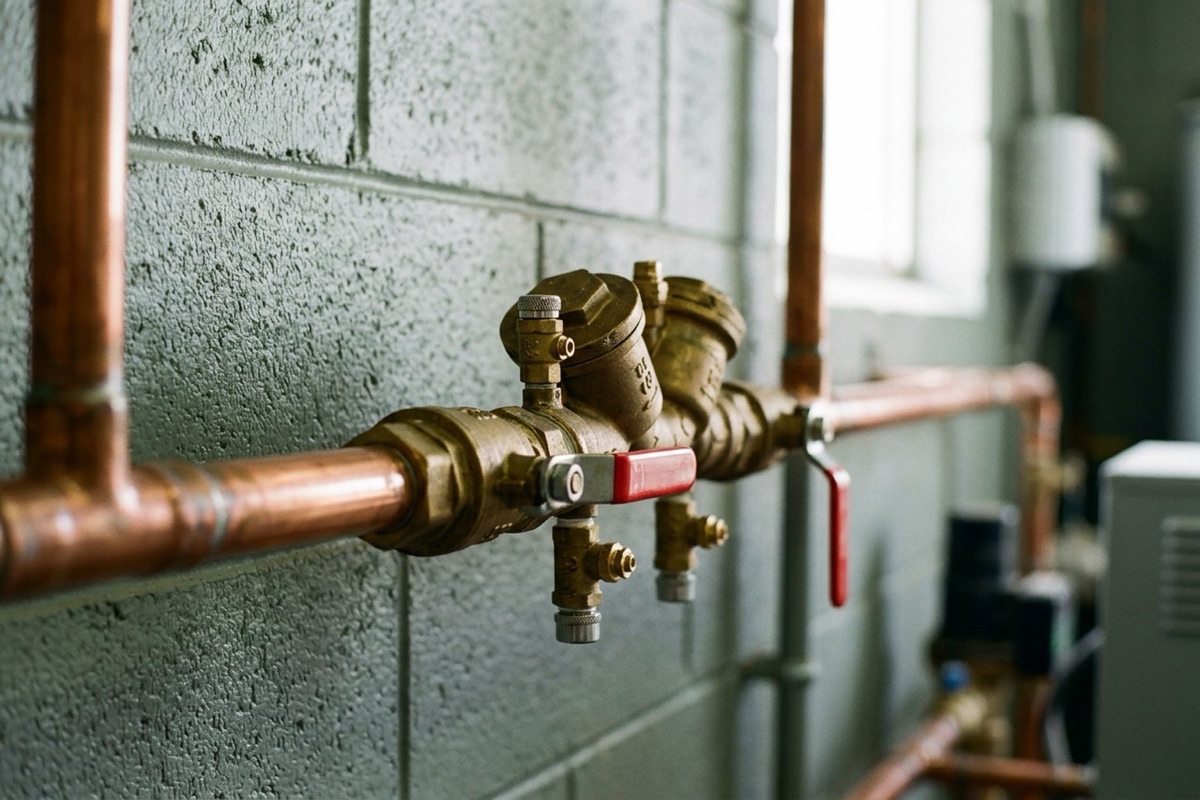
The hazard rating sets the minimum device. Water authority policies that follow AS/NZS 3500.1 and AS/NZS 2845.1 commonly describe the main devices as:
- Registered air gap or break tank. A physical gap between the supply and the hazard, suitable for high hazard sites.
- Reduced pressure zone device (RPZD). A testable device suitable for high hazard.
- Double check valve (DCV). A testable device suitable for medium hazard.
- Single check valve, testable. A low hazard testable device, often used on fire services.
- Dual check valve. A non-testable device for low hazard, often built into small residential meters.
Lower Murray Water’s containment policy, for example, requires owners of high hazard properties to install an RPZD or registered air gap, and owners of medium hazard properties to install at least a double check valve. Sydney Water notes that its 20 mm and 25 mm water meters have an integral dual check valve for low hazard properties.
Installation details matter too. Sydney Water’s guidance says containment devices must not be installed in pits or below ground, and an RPZD’s relief port needs 300 mm clearance from the ground. Devices usually reduce water pressure, so check pressure and flow first and tell the owner in writing about any pressure loss. Devices must be WaterMark certified.
Do rainwater tanks and fire services need backflow protection?
Often, yes. A rainwater tank with mains top-up creates a cross-connection, so the top-up arrangement needs backflow protection suited to the hazard. Sydney Water’s guidance treats above-ground rainwater tanks as low hazard, requires a vented dual check valve for below-ground tanks taking rainwater only, and applies high hazard to alternative supplies such as stormwater or greywater. Our guide to rainwater tank plumbing rules covers tank connections in more detail.
Fire services are another common case. Sydney Water requires a testable double check detector assembly on connections serving separate sprinkler and fire hydrant services. Requirements vary between water authorities, so always check the local authority’s rules.
Who tests backflow devices, and how often?
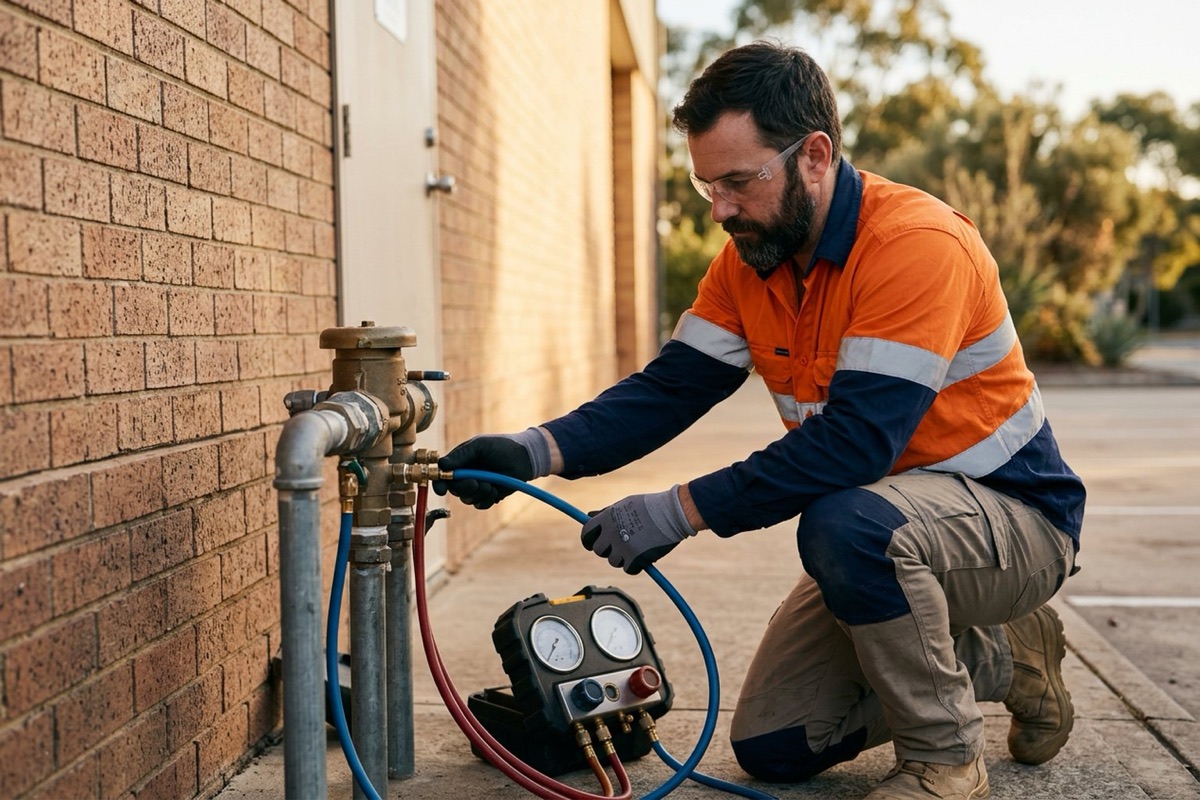
Testable devices must be tested when installed and then at least every 12 months, and only by a licensed plumber who holds backflow accreditation or endorsement. The detail is set by the water authority or, in Queensland, the local council:
- New South Wales (Sydney Water). Devices must be tested by a backflow-accredited plumber and registered immediately after installation. Customers must have testable devices tested every year, and plumbers lodge reports online.
- Victoria (Yarra Valley Water). If a testable device is installed at the water meter, it must be tested every 12 months by an accredited backflow plumber and the results sent to the water corporation.
- Queensland. Under the Plumbing and Drainage Regulation 2019, local governments must run a program for registering and testing testable devices. Devices must be registered with council, tested at least once a year by an endorsed backflow plumber, and the test report (Form 9) lodged within 10 business days.
The property owner is responsible for arranging the annual test, and missed tests can lead to enforcement action. Sydney Water also expects plumbers to retest a device after any work on the customer’s water service.
What records should be kept?
Backflow records prove that the public water supply is protected, so water authorities rely on them. A complete record for each device includes:
- Device details. Type, size, make, serial number and WaterMark certification.
- Location and purpose. Where it is and whether it provides containment, zone or individual protection.
- Hazard rating. The rating the device was selected for and how it was decided.
- Commissioning test. The date and result of the test at installation.
- Annual tests. Each test date, result, any repairs and the tester’s licence details.
- Test equipment. The calibration details of the test kit used.
- Lodgement. Confirmation that each report was lodged with the water authority or council.
Sydney Water specifically asks plumbers to keep their licence expiry and test gauge details up to date, and to select the correct device purpose when lodging reports.
Backflow prevention checklist
- Audit the site. Identify every cross-connection, including tanks, pools, fire services and process equipment.
- Rate each hazard. Use Specification 41 or a Verification Method for unlisted hazards.
- Choose the right protection. Provide individual, zone and containment protection as required.
- Match the device. Use an RPZD or air gap for high hazard and at least a DCV for medium.
- Use certified products. Confirm devices are WaterMark certified.
- Install to the rules. Keep containment devices out of pits and give RPZDs drainage clearance.
- Test on installation. Commission, test and register each testable device.
- Diarise annual tests. Test every 12 months and lodge reports with the authority.
- Keep the file. Hold device, hazard rating and test records for the life of the building.
Install and test backflow devices properly
CPD-accredited online courses on backflow prevention, testable device installation and testing, and the Plumbing Code of Australia, each with an assessment and a certificate.
- Backflow Prevention Basics View course →
- Testable Backflow Prevention Device Installation and Testing View course →
- The Plumbing Code of Australia: NCC Volume Three View course →
- Decoding Plumbing Legislation in Australia View course →
- Rainwater Harvesting for Buildings: An Introduction View course →
Frequently asked questions
What is the difference between backsiphonage and backpressure?
Backsiphonage happens when supply pressure drops and water is sucked back into the main. Backpressure happens when pressure on the property side, from a pump, boiler or elevated tank, rises above supply pressure and pushes water back.
Does a house need a backflow prevention device?
Most houses are low hazard, and many water authorities fit small residential meters with an integral dual check valve. Extra protection may be needed for hazards such as a rainwater tank with mains top-up, an irrigation system or a pool.
Which device is needed for a high hazard site?
A reduced pressure zone device or a registered air gap is commonly required for high hazard containment. Check the water authority's policy, because some also accept a registered break tank.
How often must a testable backflow device be tested?
At installation and then at least every 12 months. Sydney Water, Yarra Valley Water and Queensland councils all require annual testing of testable devices, with results lodged with the authority.
Who can test a backflow prevention device?
A licensed plumber who holds backflow accreditation or endorsement and uses calibrated test equipment. Many water authorities keep lists of accredited backflow plumbers.
Who is responsible for annual backflow testing?
The property owner. The owner must arrange for an accredited plumber to test each testable device every year and make sure the report is lodged with the water authority or council.
Sources and further reading
- ABCB — NCC 2022 Volume Three, Part B5 Cross-connection control (B5P1, B5D2 to B5D4, B5V1)
- ABCB — NCC 2022 Volume Three, Specification 41 Cross-connection hazards
- Sydney Water — Backflow prevention for plumbers
- Sydney Water — Backflow prevention: information for plumbers (brochure)
- Yarra Valley Water — Backflow prevention testing and reporting
- Redland City Council (Qld) — Backflow prevention devices (Plumbing and Drainage Regulation 2019)
- Lower Murray Water (Vic) — Backflow Prevention Containment Policy
- MidCoast Council (NSW) — Backflow prevention procedure