Asbestos was totally banned in Australia from 31 December 2003, so any building built or renovated before then may contain it — and homes built or renovated before 1990 very often do. Before demolition or refurbishment, the asbestos likely to be disturbed must be identified and, so far as is reasonably practicable, removed first.
Removing friable asbestos needs a Class A licence. Removing more than 10 square metres of non-friable asbestos needs a Class B (or Class A) licence. Licensed removal must be notified to the regulator at least 5 days before it starts and ends with an independent clearance inspection. Victoria has its own, broadly similar rules.
Where is asbestos found in Australian buildings?
Asbestos was phased out from the 1980s and has been completely banned — manufacture, use, import and sale — since 31 December 2003. Asbestos Awareness NSW warns that many homes and buildings built or renovated before 1990 still contain it. Common places include:
- fibre cement (“fibro”) wall and ceiling sheeting, eaves and soffit linings;
- wet-area linings, roof sheeting, gutters and flues;
- vinyl floor tiles, sheet vinyl backing and adhesives;
- older electrical switchboard panels and pipe lagging; and
- loose-fill ceiling insulation in some ACT and NSW homes.
The Regulations draw a key distinction. Friable asbestos is material that is in powder form, or can be crumbled, pulverised or reduced to powder by hand pressure when dry. Non-friable asbestos is bonded into a material, such as asbestos cement — but it becomes friable as it weathers, breaks or burns.
You can’t identify asbestos by eye. Under regulation 423, samples must go to a NATA-accredited or regulator-approved laboratory; otherwise, treat the material as asbestos.
Who needs an asbestos register and an asbestos management plan?
Under the model WHS Regulations, which apply everywhere except Victoria, the person with management or control of a workplace must:
- ensure, so far as is reasonably practicable, that all asbestos is identified by a competent person — or assume material is asbestos if a competent person reasonably believes it is, and assume it is present in inaccessible areas likely to contain it (regulation 422);
- clearly indicate the presence and location of identified asbestos, by label where reasonably practicable (regulation 424);
- prepare, keep and maintain an asbestos register recording the date it was identified and the location, type and condition of each item (regulation 425); and
- prepare a written asbestos management plan if asbestos is identified or likely to be present, covering identification, management decisions and reasons, incident and emergency procedures, and the workers involved (regulation 429).
Both must be readily accessible to workers, their representatives and businesses working at the site. The plan must be reviewed at least every 5 years and whenever asbestos is removed, disturbed, sealed or enclosed.
Two exceptions matter to builders. A register isn’t required for a building constructed after 31 December 2003 where no asbestos has been identified and none is likely to be present. And the register and management plan duties don’t apply to domestic premises used only for residential purposes — which is why the renovation rules below put the duty directly on the builder.
What must happen before demolition or refurbishment?
Part 8.6 applies to demolition or refurbishment of a structure or plant built or installed before 31 December 2003, other than minor or routine maintenance. Before work starts:
- the person in control must review the asbestos register, and revise it if it’s inadequate for the work — for example, where demolition will open up an area the register couldn’t inspect;
- that person must give a copy of the register to the business doing the work, and that business must obtain it before starting;
- if there is no register, the business doing the work must have a competent person inspect for asbestos first, assume asbestos is present where the competent person is uncertain or areas are inaccessible, and tell the owner and occupier of residential premises (or the person in control of other workplaces); and
- all asbestos likely to be disturbed must be identified and, so far as is reasonably practicable, removed before the work begins (regulations 452 to 457).
For domestic premises, those last duties sit with the business doing the work — usually the builder. A 1970s kitchen renovation is exactly the job this rule is written for.
When do you need a licence to remove asbestos?
Under regulations 458, 485 and 487 of the model WHS Regulations:
- Class A licence — required to remove friable asbestos of any amount, and asbestos-contaminated dust or debris (ACD) other than ACD associated with removing non-friable asbestos or minor contamination.
- Class B licence (or Class A) — required to remove more than 10 square metres of non-friable asbestos or ACM, and ACD associated with that removal.
- No licence — removing 10 square metres or less of non-friable asbestos, or minor ACD contamination. The business commissioning the work must still ensure it is done by a competent person trained in identifying and safely handling asbestos under regulation 445.
Treat the 10 square metres as the total for the job — splitting a job up to stay under it defeats the rule.
Whatever the amount, regulation 446 bans using high-pressure water spray or compressed air on asbestos, and power tools, brooms and similar implements may be used only if they are enclosed, designed to capture or suppress fibres, or used in a way that does.
What happens during licensed removal and clearance?
Licensed removal follows a set sequence:
- Asbestos removal control plan covering the method, equipment, PPE and the asbestos itself, given to whoever commissioned the work (regulation 464).
- Notification. The removalist gives the regulator written notice at least 5 days before licensed work starts. Only a sudden, unexpected event or an essential-service breakdown allows an immediate start, with phone notice and written notice within 24 hours (regulation 466).
- Telling people. The removalist must tell the person in control of the workplace; on domestic premises, so far as reasonably practicable, also the owner, the occupier and anyone occupying premises in the immediate vicinity (regulations 467 and 468).
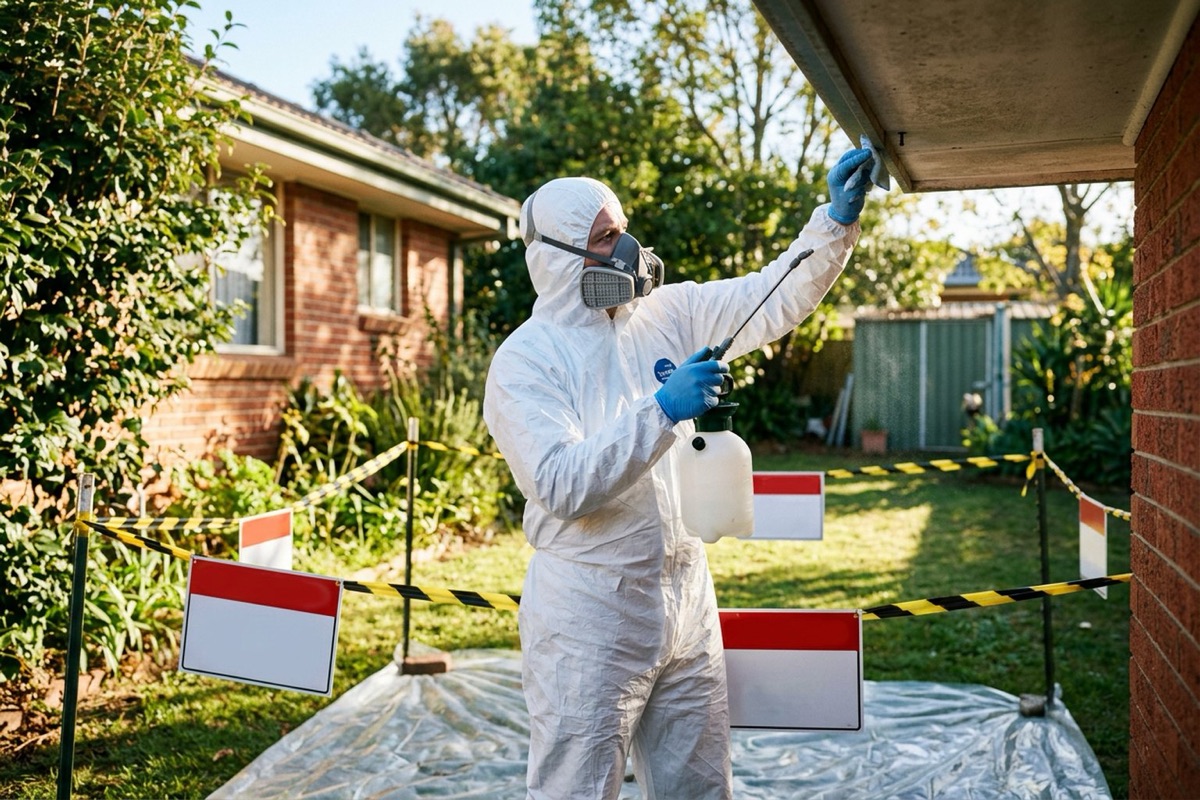
- Signs, barricades and access. The removal area is signed, barricaded and closed to everyone not involved (regulations 469 and 470).
- Decontamination and waste. Decontamination facilities must be available; waste and contaminated PPE must be sealed, labelled and taken to a site authorised to accept asbestos waste (regulations 471 and 472).
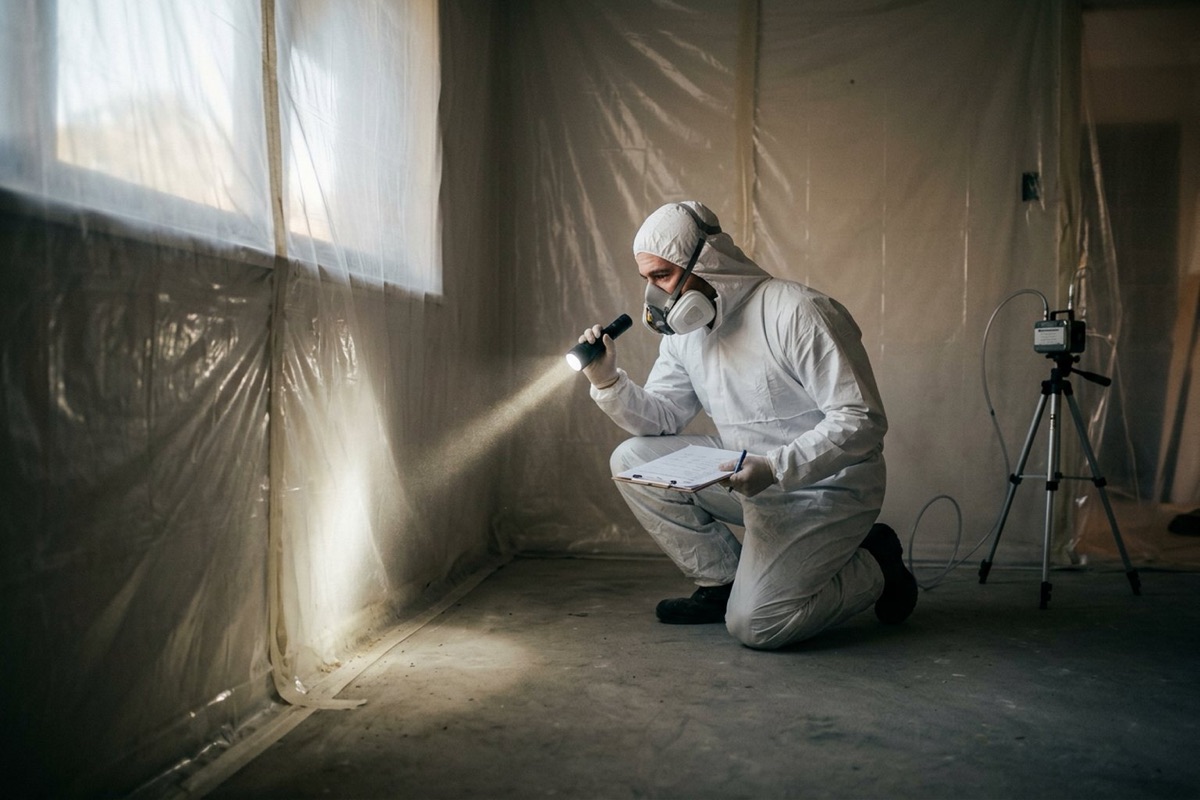
- Air monitoring for Class A work by an independent licensed asbestos assessor (regulation 475).
- Clearance. When work is finished, an independent licensed asbestos assessor (for Class A work) or an independent competent person (for other licensed work) inspects the area. A written clearance certificate must be issued before the area is reoccupied, and only if there is no visible asbestos residue and any air monitoring shows less than 0.01 fibres/ml (regulations 473 and 474).
On domestic premises, it is the licensed removalist who must arrange the clearance inspection.
Is disturbing asbestos high risk construction work?
Yes. Regulation 291 of the model WHS Regulations lists construction work that involves, or is likely to involve, the disturbance of asbestos as high risk construction work, so a safe work method statement must be prepared before it starts. That catches trades who drill, cut or sand near asbestos, not just removalists.
Regulation 445 also requires asbestos training for workers likely to do asbestos removal or asbestos-related work, with records kept for 5 years after they leave.
The same demolition work usually releases crystalline silica too — see silica dust in construction.
What is loose-fill asbestos and where is it found?
Loose-fill asbestos is raw crushed asbestos that was blown into ceiling spaces as insulation. It is friable, so it is the most dangerous form, and it can migrate into wall cavities, subfloors and living areas.
- ACT. Much of it was installed by a business known as “Mr Fluffy”. The ACT Government’s Loose Fill Asbestos Insulation Eradication Scheme bought back and demolished affected houses, and WorkSafe ACT publishes guidance for anyone working on affected premises.
- NSW. It was installed in an unknown number of pre-1980 homes, and NSW Fair Trading keeps a public register of homes confirmed to contain it, searchable by address.
Before working in the roof space, cavities or subfloor of an older ACT or NSW home, check the register — and if loose-fill is suspected, stop and get a licensed assessor.
How is Victoria different?
Victoria regulates asbestos under the OHS Act 2004 and Part 4.4 of the OHS Regulations 2017. The structure is similar, with some differences:
- Buildings constructed before 31 December 2003 need their asbestos identified, labelled and recorded in an accessible asbestos register.
- Removal licences are A class (friable and non-friable) and B class (non-friable).
- Limited removal without a licence is narrower than elsewhere: up to 10 square metres of non-friable asbestos, and only if removal takes no more than 1 hour in a 7-day period — shared between workers, so two people get 30 minutes each.
- Licensed removalists must notify WorkSafe before each job: at least 5 days ahead for friable asbestos or more than 10 square metres of non-friable, and at least 24 hours ahead for non-friable jobs of 10 square metres or less.
- Work involving removal or likely disturbance of asbestos is on Victoria’s list of high risk construction work, so it needs a SWMS.
For how the two systems compare more generally, see which WHS laws apply in your state.
Asbestos checklist for builders
- Check the build date — anything built or renovated before 31 December 2003 may contain asbestos.
- Get the asbestos register from the person in control before demolition or refurbishment, or have a competent person inspect where there isn’t one.
- Identify what you will disturb, by NATA-accredited lab analysis or by assuming it is asbestos.
- Remove it before the work so far as is reasonably practicable.
- Use the right removalist: Class A for friable, Class B for more than 10 square metres non-friable.
- Train anyone doing small non-friable jobs under the licence threshold, and keep the records.
- Prepare a SWMS for any work likely to disturb asbestos.
- Ban compressed air, high-pressure water and uncontrolled power tools on asbestos.
- Check loose-fill registers for older homes in the ACT and NSW.
- Don’t reoccupy until a clearance certificate has been issued.
Know asbestos before you disturb it
CPD-accredited online courses on asbestos awareness and management, silica dust, hazardous chemicals and contaminated land, each with an assessment and a certificate.
Frequently asked questions
Can I remove asbestos myself without a licence?
Under the model WHS Regulations, a business can remove up to 10 square metres of non-friable asbestos without a licence, using a competent person trained in safe asbestos handling. Friable asbestos always needs a Class A licence. In Victoria the unlicensed limit also caps removal time at 1 hour in a 7-day period.
What is the difference between Class A and Class B asbestos removal?
A Class A licence allows removal of friable asbestos, non-friable asbestos and asbestos-contaminated dust. A Class B licence allows removal of non-friable asbestos and the dust associated with it. Both are needed only above the thresholds set in the Regulations.
Do houses need an asbestos register?
No. The register and asbestos management plan duties do not apply to domestic premises used only for residential purposes. Instead, the business carrying out demolition or refurbishment of a home must identify the asbestos likely to be disturbed and remove it, so far as is reasonably practicable, before work starts.
How much notice must be given before asbestos removal?
A licensed asbestos removalist must give the regulator written notice at least 5 days before licensed removal work starts. Work can start immediately only after a sudden unexpected event or an essential-service breakdown, with phone notice straight away and written notice within 24 hours.
Who can issue an asbestos clearance certificate?
After Class A removal, an independent licensed asbestos assessor. After other licensed removal, an independent competent person. The certificate must be issued before the area is reoccupied and confirms no visible asbestos residue and, if air monitoring was done, a level below 0.01 fibres per millilitre.
When was asbestos banned in Australia?
Asbestos was totally banned in Australia from 31 December 2003, covering its manufacture, use, import and sale. Its use had been phased out from the 1980s, so homes built or renovated before 1990 are the most likely to contain it.
Sources and further reading
- Federal Register of Legislation — Work Health and Safety Regulations 2011 (Cth), Chapter 8 and reg 291 (model text)
- Asbestos Awareness NSW — When was asbestos banned in Australia?
- NSW Government — About loose-fill asbestos insulation
- WorkSafe ACT — Mr Fluffy (loose-fill asbestos insulation)
- WorkSafe Victoria — Asbestos
- WorkSafe Victoria — Safe work method statements (SWMS)
- WorkSafe Victoria — Understand and manage asbestos in workplaces
- WorkSafe Victoria — Asbestos removal notification