Every business that uses, handles or stores hazardous chemicals on site must obtain the current safety data sheet (SDS) for each one, keep it readily accessible, list every chemical in a hazardous chemicals register, make sure every container — including anything decanted — is correctly labelled under the GHS, and manage the risks of using and storing them.
Australia classifies and labels workplace chemicals under the 7th revised edition of the GHS (GHS 7), mandatory since 1 January 2023. Larger quantities of some chemicals, such as LPG or flammable liquids, also trigger placards, a manifest and notice to the regulator. Victoria applies equivalent rules under its own OHS and dangerous goods regulations.
What counts as a hazardous chemical?
Under the model WHS Regulations, a hazardous chemical is a substance, mixture or article that meets the criteria for one or more hazard classes in the Globally Harmonised System of Classification and Labelling of Chemicals (GHS). A few low-level categories are excluded, such as category 5 acute toxicity, category 3 skin irritation and environmental-only hazards.
On a building site that means far more than drums of solvent: fuels, LPG, cement, admixtures, adhesives, sealants, paints, form oils, acid cleaners, curing compounds, epoxies and spray foams are all likely candidates. Part 7.1 also covers hazardous substances generated at work, such as fumes or silica dust from cutting.
Some things are carved out, including fuel in a vehicle or plant’s own tank and fuel of up to 25 kilograms or litres in a portable fuel-burning appliance.
Which version of the GHS applies, and what must a label show?
The model WHS Regulations define the GHS as the Seventh revised edition (GHS 7). Australia transitioned from GHS 3 between 1 January 2021 and 31 December 2022; from 1 January 2023 only GHS 7 may be used to classify chemicals and prepare labels and SDS. Victoria adopted the same date. Stock that was manufactured or imported before 1 January 2023 with a correct GHS 3 label can still be used.
The manufacturer or importer must label a hazardous chemical correctly. Under Schedule 9, a full label must be in English and include:
- the product identifier;
- the name, Australian address and business phone number of the manufacturer or importer;
- the identity and proportion of ingredients as Schedule 8 requires;
- any hazard pictograms;
- the signal word (“Danger” or “Warning”), hazard statements and precautionary statements;
- any other hazard, first aid and emergency information; and
- the expiry date, if it has one.
On site, regulation 342 matters most: a chemical decanted or transferred into another container and not used immediately must be labelled with at least the product identifier and a hazard pictogram or hazard statement, and a labelled container may hold only that chemical.
Who must provide and keep safety data sheets?
The duties run down the supply chain:
- Manufacturers and importers must prepare an SDS before first supplying a hazardous chemical, review it at least every 5 years, and keep it current (regulation 330). Schedule 7 requires it to be in English, with an Australian emergency phone number, the date it was last reviewed, and the standard 16 sections.
- Suppliers must provide the current SDS when they first supply the chemical to a workplace, and again after it is amended (regulation 339). Retailers and consumer products are exempt from this duty.
- The business using the chemical must obtain the current SDS no later than first supply — or, if that’s impossible, before the chemical is used — and keep it readily accessible to workers who use it and to emergency service workers (regulation 344).
“First supplied” means the first supply in 5 years, so an SDS older than five years is a prompt to get the latest one. A business can’t edit an SDS, other than attaching a clearly identified translation (regulation 345).
A narrow exception covers consumer products used in household quantities and ways, but safe-use information must still be readily accessible.
Do you need a hazardous chemicals register, a manifest or placards?
The register. Under regulation 346, every business that uses, handles or stores hazardous chemicals at a workplace must keep a register at that workplace: a list of the hazardous chemicals and the current SDS for each one. It must be kept up to date and readily accessible to workers and anyone else likely to be affected. On a shared site, each business that brings chemicals is responsible for its own.
Placards and the manifest. Schedule 11 sets placard and manifest quantities for each hazard class. Above the placard quantity, warning placards must be displayed. Above the manifest quantity, the business must keep a manifest, notify the regulator in writing at least 14 days before first use (or immediately on finding out, if that is earlier), and give its emergency plan to the fire service. Examples that matter on construction sites:
- Flammable gases, category 1A or 1B (such as LPG): placard 200 L, manifest 5,000 L.
- Flammable liquids, category 1: placard 50 L, manifest 500 L.
- Flammable liquids, category 2: placard 250 L, manifest 2,500 L.
- Flammable liquids, category 3: placard 1,000 L, manifest 10,000 L.
Most sites stay below these, but a large compound with fuel storage and gas cages can cross them. Check each SDS’s section 2 for the category and add up the quantities.
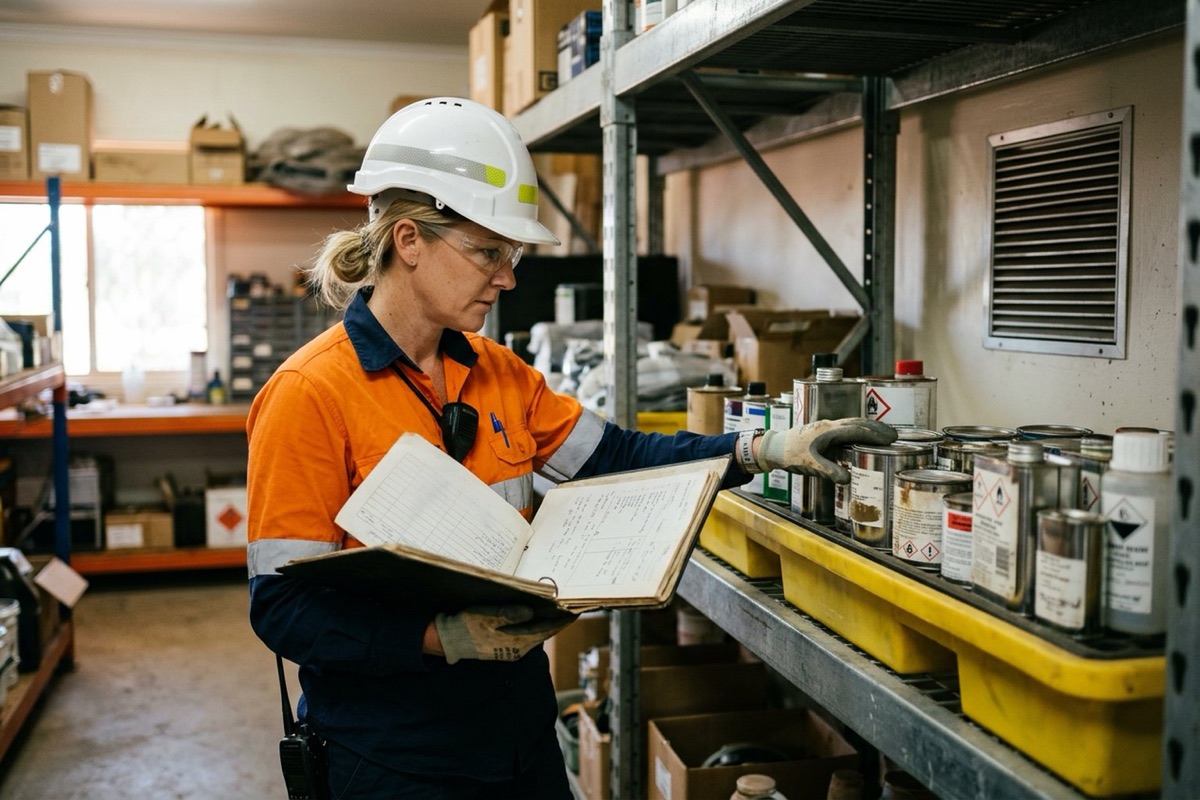
How should chemicals be stored, segregated and kept ready for spills?
Regulation 351 requires the risks of using, handling, generating and storing hazardous chemicals to be managed with the hierarchy of control — eliminate, substitute, isolate, engineer, administer, then PPE — taking account of the chemical’s properties, possible reactions with other substances, the work, and the plant and systems involved. The specific duties include:
- Identify reaction risks between chemicals, and keep them away from food and personal items (regulation 354).
- Keep ignition sources out of any area where flammable vapours could ignite (regulation 355).
- Keep chemicals stable, including any temperature limits in the SDS (regulation 356).
- Contain spills within the workplace, without bringing incompatible chemicals together, and with a way to clean up and dispose of the spill (regulation 357).
- Protect containers and pipework from impact and excessive loads (regulation 358).
- Provide fire protection, emergency and safety equipment suited to the chemicals and quantities on site (regulations 359, 360 and 362).
In practice: a ventilated store or flammable liquids cabinet away from exits and hot work, bunding or spill pallets, oxidisers and acids apart from flammables, gas cylinders upright and secured in a ventilated cage, a stocked spill kit, the right extinguishers, and an emergency plan that covers chemical incidents. Chemicals used in tanks, pits or basements can also create a hazardous atmosphere — see what counts as a confined space.
What are exposure standards, and when is health monitoring required?
Regulation 49 requires that no one at a workplace is exposed to an airborne concentration of a substance above its exposure standard. Regulation 50 requires air monitoring if the business isn’t certain on reasonable grounds whether the standard is exceeded, or if monitoring is needed to work out whether there is a health risk. Results must be kept for 30 years.
The standards are changing name. From 1 December 2026, the Workplace Exposure Standards are replaced by Workplace Exposure Limits (WEL) as each jurisdiction implements them, with the current standards applying until 30 November 2026. Some values change in the new list, so check each chemical’s limit on Safe Work Australia’s Hazardous Chemical Information System rather than relying on an old SDS.
Health monitoring is required under regulation 368 where a worker doing ongoing work with a chemical listed in Schedule 14 faces a significant risk to their health from exposure. The list includes isocyanates, crystalline silica and benzene; lead has its own rules. Monitoring must be supervised by a registered medical practitioner with relevant experience, and paid for by the business.
Which construction chemicals need the most care?
Always work from the SDS for the actual product, but these are the usual problem groups:
- Solvent-based adhesives, primers and paints — often flammable, with vapours that can build up in poorly ventilated rooms, pits and roof spaces.
- Cement, mortar and wet concrete — alkaline; prolonged skin contact can cause chemical burns and dermatitis.
- Isocyanates — in two-part polyurethane coatings, adhesives and spray foam insulation. They are respiratory and skin sensitisers that can cause occupational asthma, and are on the Schedule 14 health monitoring list.
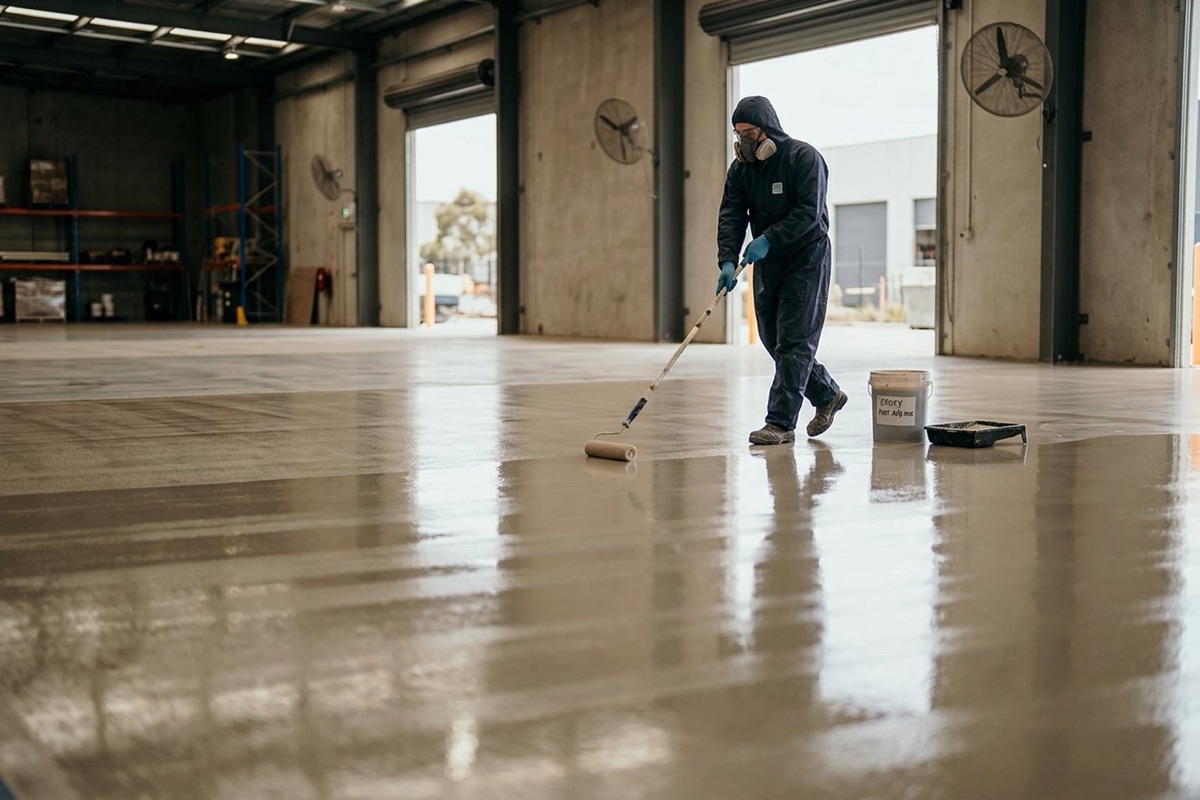
- Epoxy resins and hardeners — common skin sensitisers in flooring, grouts and anchoring systems.
- Curing compounds, form release oils and sealers — some are solvent-based and flammable; others are irritants.
- Acid-based brick and masonry cleaners — corrosive, and dangerous if mixed with incompatible products.
- Fuels and LPG — the largest flammable quantities on most sites.
Hot weather raises vapour levels and makes PPE harder to bear; see working in heat.
How is Victoria different?
Victoria hasn’t adopted the model WHS laws. In Victoria:
- Hazardous substances are regulated by Part 4.1 of the Occupational Health and Safety Regulations 2017. Employers must keep a register of hazardous substances with current SDS, make SDS available to employees, keep supplied containers labelled, not alter an SDS, apply the hierarchy of control, and carry out health monitoring where exposure may harm health.
- Dangerous goods storage and handling — including placarding, manifests and notification thresholds — is regulated separately under the Dangerous Goods Act 1985 and the Dangerous Goods (Storage and Handling) Regulations 2022, with WorkSafe Victoria’s code of practice as guidance.
- GHS 7 has applied since 1 January 2023, the same as under the model laws.
The obligations are similar, but thresholds, terms and regulation numbers differ.
Hazardous chemicals checklist
- List every chemical you bring to site, including fuels, gas and consumer products used in trade quantities.
- Get the current SDS for each one before it is used, and check it is less than 5 years old.
- Keep a hazardous chemicals register at the workplace and keep it up to date.
- Check every label, and label every decanted container with at least the product identifier and a pictogram or hazard statement.
- Add up quantities of flammable gases and liquids against the Schedule 11 placard and manifest thresholds.
- Store and segregate: ventilated cabinets, bunding, incompatibles apart, cylinders secured, ignition sources out.
- Stock spill kits and extinguishers suited to the chemicals, and include chemical spills in the emergency plan.
- Control exposure with substitution, ventilation and PPE, and air-monitor where you are unsure.
- Arrange health monitoring for ongoing work with Schedule 14 chemicals such as isocyanates.
Handle chemicals safely on site
CPD-accredited online courses on hazardous chemicals and dangerous goods, dust and lung disease, flammable refrigerants and contaminated land, each with an assessment and a certificate.
- Managing Hazardous Chemicals and Dangerous Goods on Site View course →
- Dust and Occupational Lung Disease: Awareness and Prevention View course →
- Flammable Refrigerant Safety View course →
- Contaminated Land and Site Remediation View course →
- Asbestos Awareness and Management in Construction View course →
Frequently asked questions
Do I need a safety data sheet for every chemical on site?
You need the current SDS for every hazardous chemical used, handled or stored at the workplace, obtained no later than when it is first supplied and kept readily accessible to workers. A narrow exception applies to consumer products used only in household quantities and ways, but safe-use information must still be available.
How often must a safety data sheet be updated?
The manufacturer or importer must review the SDS at least every 5 years and amend it whenever needed to keep it correct and current. A business using the chemical must obtain the current SDS when it is first supplied, and supply after a 5-year gap counts as first supply again.
What must be on a label for a decanted chemical?
If a hazardous chemical is decanted or transferred and not used immediately, the new container must be labelled in English with at least the product identifier and a hazard pictogram or hazard statement. The container must then be used only for that chemical.
Which GHS version does Australia use?
Australia uses the seventh revised edition of the GHS, known as GHS 7. It became mandatory for classifying, labelling and preparing safety data sheets from 1 January 2023, after a two-year transition from GHS 3. Older stock correctly labelled under GHS 3 can still be used.
What is the difference between a hazardous chemicals register and a manifest?
A register is required at every workplace with hazardous chemicals and lists each chemical with its current safety data sheet. A manifest is required only when quantities exceed the manifest quantities in Schedule 11, and it is kept for emergency services, with notice given to the regulator.
Do workers using isocyanates need health monitoring?
Yes, where a worker carries out ongoing work with isocyanates and there is a significant risk to their health from exposure. Isocyanates are listed in Schedule 14 of the WHS Regulations, and the monitoring must be supervised by a registered medical practitioner with relevant experience.
Sources and further reading
- Federal Register of Legislation — Work Health and Safety Regulations 2011 (Cth), Part 7.1, regs 49–50 and Schedules 7, 9, 11 and 14 (model text)
- Safe Work Australia — Adoption of GHS 7
- WorkSafe Victoria — Transition to the Globally Harmonized System (GHS) 7
- WorkSafe Victoria — Hazardous substances: safety basics
- WorkSafe Victoria — Code of practice: The storage and handling of dangerous goods
- Safe Work Australia — New workplace exposure limits (WEL) to apply from 1 December 2026