A hazardous manual task is any lifting, lowering, pushing, pulling, carrying, holding or restraining that involves repetitive or sustained force, high or sudden force, repetitive movement, sustained or awkward posture, or exposure to vibration. Under regulation 60 of the model WHS Regulations, a person conducting a business or undertaking (PCBU) must manage the risk of musculoskeletal disorders from those tasks using the standard risk management process — eliminate the risk if reasonably practicable, otherwise minimise it.
There is no legal maximum weight. What matters is the whole task: the load, the posture, the force, how often and how long, and the conditions it is done in.
What is a hazardous manual task?
The model WHS Regulations define a hazardous manual task as a task that requires a person to lift, lower, push, pull, carry or otherwise move, hold or restrain any person, animal or thing, and that involves one or more of:
- repetitive or sustained force;
- high or sudden force;
- repetitive movement;
- sustained or awkward posture;
- exposure to vibration.
The definition is about how a task is done, not just how heavy something is. Tying reinforcement steel bent over for hours, holding a power tool overhead, laying blocks all day or catching a sheet of plasterboard that slips can all be hazardous manual tasks, even when no single item is heavy.
The injury the rules target is a musculoskeletal disorder (MSD) — damage to muscles, tendons, ligaments, joints, nerves, discs or blood vessels. MSDs can come from one sudden event, such as a back injury lifting an awkward load, or build up gradually from repeated strain.
What does regulation 60 require?
Regulation 60 requires a PCBU to manage risks to health and safety relating to a musculoskeletal disorder associated with a hazardous manual task, in accordance with Part 3.1 of the Regulations. Part 3.1 is the general risk management process: identify the hazard, eliminate the risk so far as is reasonably practicable, and if that is not reasonably practicable, minimise it using the hierarchy of control measures, then maintain and review those controls.
In deciding which controls to use, regulation 60 says the PCBU must have regard to all relevant matters that may contribute to an MSD, including:
- the postures, movements, forces and vibration involved;
- the duration and frequency of the task;
- environmental conditions that may affect the task or the worker, such as heat, wind, wet or uneven ground, and poor lighting;
- the design of the work area;
- the layout of the workplace;
- the systems of work used; and
- the nature, size, weight or number of the persons, animals or things involved.
What do designers, manufacturers and suppliers have to do?
Regulation 61 pushes the duty upstream. A designer of plant or a structure must ensure it is designed to eliminate the need for any hazardous manual task in connection with it, or, if that is not reasonably practicable, to minimise that need so far as is reasonably practicable. The designer must also give adequate information about the features that eliminate or minimise hazardous manual tasks to whoever receives the design.
Manufacturers have matching duties for how plant or structures are made, and importers and suppliers must take all reasonable steps to obtain that information and pass it on.
For construction, this is where the biggest gains sit. Specifying lighter or smaller-format products, designing for prefabrication and craneage, providing access for materials handling equipment and locating plant where it can be serviced without awkward postures all remove manual tasks before anyone reaches the site.
How do you identify and assess hazardous manual tasks on site?
Start by finding the tasks. Useful sources include:
- injury and incident records, including early reports of aches and strains;
- talking to workers — they know which jobs hurt;
- watching the work, especially repetitive, forceful or awkward tasks; and
- looking at the materials list for heavy, bulky or awkward items such as plasterboard, blocks, bagged products, doors, glass and steel.
Then assess each task against the regulation 60 factors. Look for the warning signs: loads handled away from the body or above shoulder height, bending and twisting, kneeling or squatting for long periods, high grip forces, jerky or sudden movements, long durations without breaks, and vibration from hand-held tools.
The model Code of Practice: Hazardous manual tasks sets out a practical risk management process and includes tools for identifying and assessing these risks. Consultation is a duty in its own right: under the model WHS Act, a PCBU must consult workers who are, or are likely to be, directly affected by a work health and safety matter, so involve the people who actually do the task.
What controls work best?
Work down the hierarchy of controls, and combine controls where one alone is not enough.
Eliminate the task:
- deliver materials by crane or forklift directly to the work level;
- use prefabricated or pre-assembled components;
- have suppliers deliver and stack materials where they will be used, rather than double handling.
Substitute or redesign:
- order lighter or smaller-format products, or smaller bag sizes;
- reorganise work so loads are handled between knee and shoulder height, close to the body;
- raise work to a comfortable height with benches, trestles or stands.
Use engineering controls:
- trolleys, sheet carts, pallet jacks and wheelbarrows;
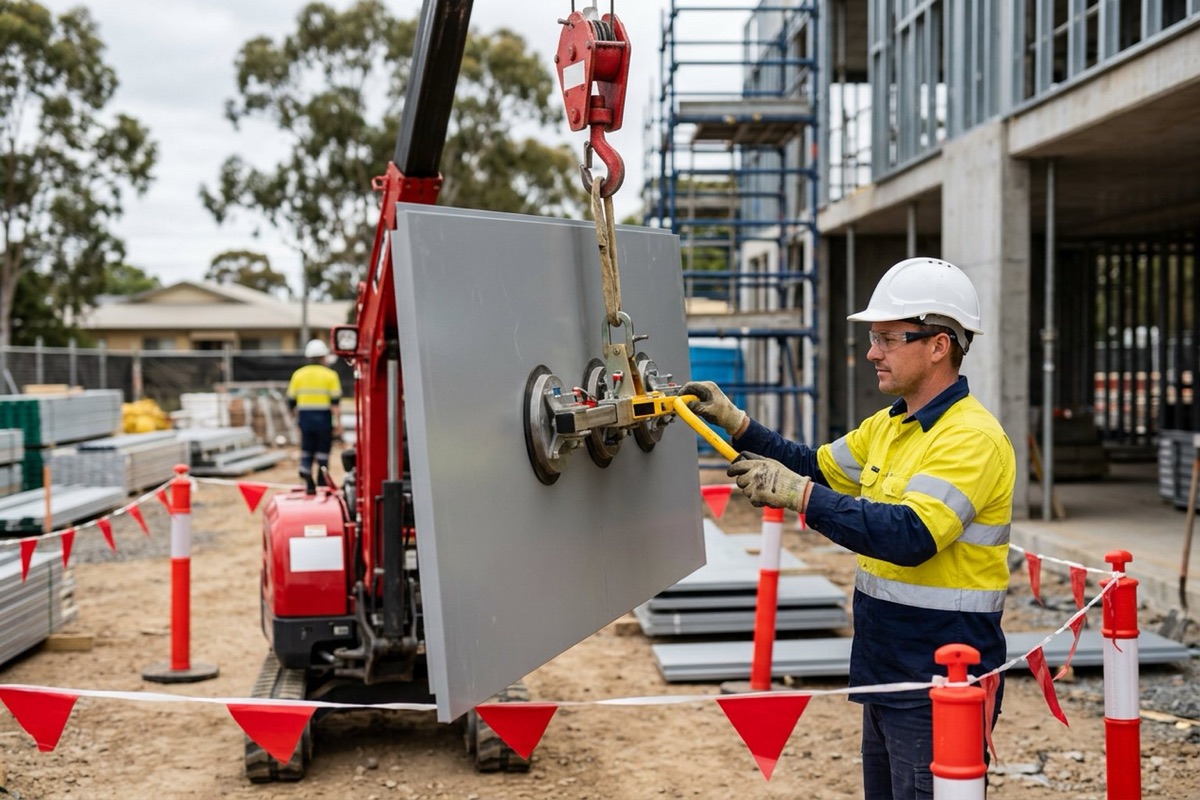
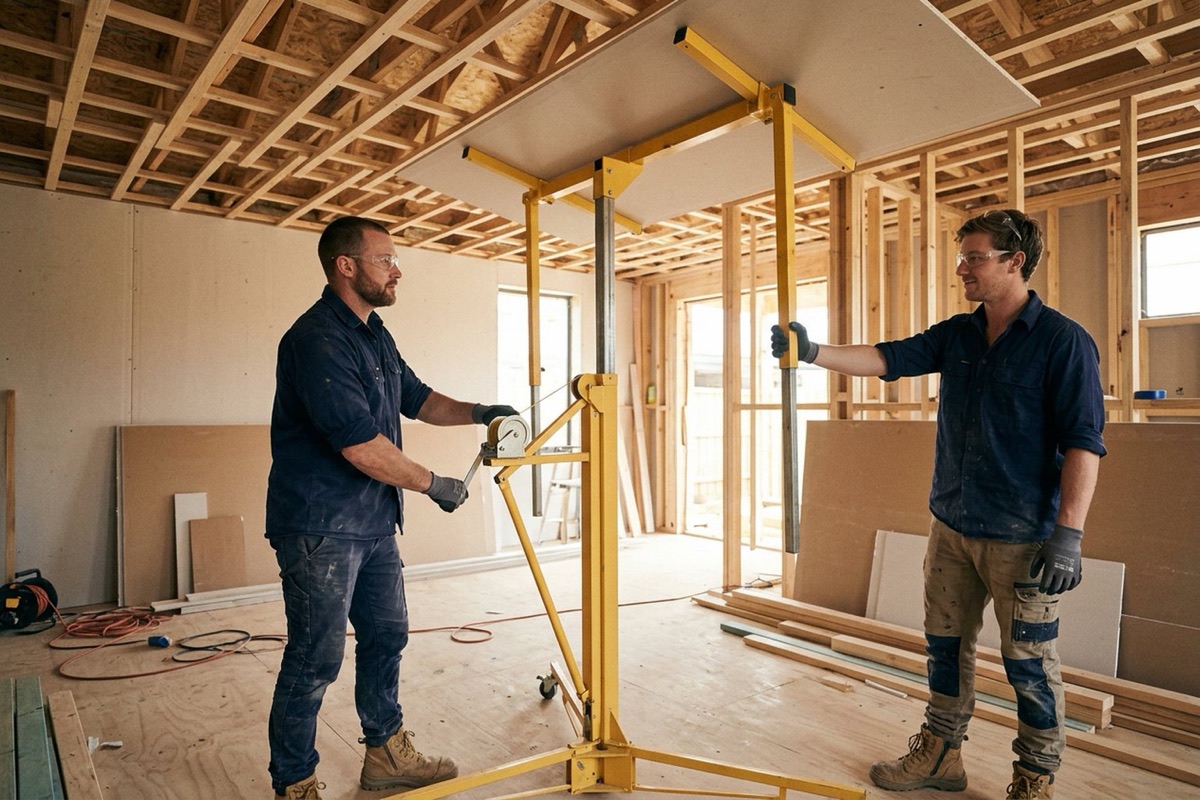
- vacuum lifters, panel lifters and plasterboard hoists;
- material hoists and mechanical aids for repetitive lifting;
- tools with lower vibration and better grips.
Administrative controls, used only to support higher-order controls:
- job rotation and scheduled breaks;
- team lifting, with a plan, enough people and a clear leader;
- training in the specific task and the equipment provided.
What does this look like on a residential build?
A few common examples and better ways to do them:
- Plasterboard: use sheet trolleys and plasterboard lifters for ceilings, and have sheets delivered to each room or level by crane or hoist.
- Blocks and bricks: keep pallets close to the wall line and at a workable height, and limit how far blocks are carried.
- Bagged cement and render: choose smaller bags where available, and move pallets with a pallet jack or forklift rather than by hand.
- Reinforcement tying: use rebar tying tools and long-handled tools to reduce sustained bending.
- Doors, windows and glass: use glass trolleys, suction lifters and enough people to control the load.
Our guide to running a toolbox talk is a good way to agree these controls with the crew before the job starts.
How is Victoria different?
Victoria has not adopted the model WHS laws. Its rules sit in Part 3.1 (Hazardous manual handling) of the Occupational Health and Safety Regulations 2017, under the Occupational Health and Safety Act 2004. The concepts are very similar — identify hazardous manual handling, eliminate the risk of musculoskeletal disorders so far as is reasonably practicable, otherwise reduce it, and review the controls — but the wording and structure differ. WorkSafe Victoria’s Compliance code: Hazardous manual handling gives practical guidance on meeting those duties. Our guide to which WHS laws apply in your state explains how the two systems fit together.
How does this connect to workers compensation?
Musculoskeletal injuries are a common cause of workers compensation claims. Good manual task controls reduce injuries, and a clear process for early reporting, early treatment and suitable duties helps injured workers recover and return to work sooner. Workers compensation and return-to-work schemes are run separately in each state and territory, so check your own scheme’s requirements.
Hazardous manual tasks checklist
- List the tasks that involve lifting, carrying, pushing, pulling, holding or restraining.
- Ask the workers which tasks cause discomfort or strain, and check injury records.
- Assess each task against the regulation 60 factors: posture, force, movement, vibration, duration, frequency, environment, layout, systems of work and the load itself.
- Eliminate the task where you can — craneage, prefabrication and delivery to the point of use.
- Redesign or substitute — lighter products, better working heights, shorter carries.
- Provide mechanical aids and make sure they are available, maintained and actually used.
- Support with administrative controls — rotation, breaks, planned team lifts and task-specific training.
- Review after any injury, change of task or worker report, and at regular intervals.
Cut manual handling injuries on your sites
CPD-accredited online courses on manual handling, WHS risk management and return to work, each with an assessment and a certificate.
- Manual Handling Awareness: Preventing Musculoskeletal Injury at Work View course →
- Managing Work Health and Safety Risks: A Practical Framework View course →
- Ergonomics in Building Design View course →
- Managing Workers Compensation Claims and Return to Work View course →
- Personal Injury and Recovery at Work View course →
Frequently asked questions
What is the maximum weight a worker can lift in Australia?
There is no legal maximum weight in the WHS Regulations. The risk depends on the whole task, including the posture, force, frequency, duration, environment and the nature of the load. A PCBU must assess the task and eliminate or minimise the risk of musculoskeletal disorders.
What counts as a hazardous manual task?
A task that requires a person to lift, lower, push, pull, carry or otherwise move, hold or restrain any person, animal or thing, and that involves repetitive or sustained force, high or sudden force, repetitive movement, sustained or awkward posture, or exposure to vibration.
Who is responsible for managing manual handling risks?
The person conducting a business or undertaking must manage the risks under regulation 60. Designers, manufacturers, importers and suppliers of plant and structures also have duties under regulation 61 to eliminate or minimise the need for hazardous manual tasks and to pass on information. Workers must take reasonable care and follow reasonable instructions.
Is team lifting a safe control?
Team lifting is an administrative control and sits low on the hierarchy. It can support other controls when a mechanical aid is not reasonably practicable, but it needs planning, enough people of suitable capability and a clear leader. Eliminating the task or using mechanical aids should be considered first.
Is manual handling training enough?
No. Training alone does not make a hazardous task safe. It should support higher-order controls such as eliminating the task, redesigning it or providing mechanical aids, and it should cover the specific task and equipment.
Are Victoria's manual handling rules different?
Victoria regulates hazardous manual handling under Part 3.1 of the Occupational Health and Safety Regulations 2017, with guidance in WorkSafe Victoria's Compliance code: Hazardous manual handling. The approach is similar to the model WHS Regulations, but the wording and structure differ.
Sources and further reading
- Federal Register of Legislation — Work Health and Safety Regulations 2011 (Cth), reg 5 definition of hazardous manual task, regs 60–61 (model text)
- Safe Work Australia — Lifting, pushing and pulling (manual tasks), including the model Code of Practice: Hazardous manual tasks
- WorkSafe Victoria — Compliance code: Hazardous manual handling
- WorkSafe Victoria — Hazardous manual handling health and safety guide