Impairment from alcohol, illicit drugs or medicines is a work health and safety hazard, so it must be managed like any other risk on a construction site. Employers have a duty to ensure health and safety so far as is reasonably practicable, and workers must take reasonable care and cooperate with reasonable safety policies.
The most effective approach is a written alcohol and other drugs (AOD) policy developed in consultation with workers, combining clear standards, education, a fair process for dealing with impairment, testing to Australian Standards where it is used, and genuine support for people who need help.
Why are alcohol and other drugs a WHS issue?
Construction is full of safety-critical work: operating plant, working at height, driving, lifting and working near live services. A worker whose judgement, coordination or reaction time is affected puts themselves and everyone around them at risk.
The Alcohol and Drug Foundation (ADF) lists construction among the industries with higher rates of workplace alcohol and drug use. It also points out that impairment is not only about being drunk or high at work. A hangover, coming down from drugs or exhaustion after a big weekend can all reduce concentration and slow decision-making. Prescription and over-the-counter medicines, including medicinal cannabis, can cause side effects that affect safety, especially for workers new to a medication or combining it with alcohol.
Under the model WHS Act, the duties are shared:
- PCBUs (section 19). A person conducting a business or undertaking must ensure, so far as is reasonably practicable, the health and safety of workers and others affected by the work, which includes managing the risk of impairment.
- Workers (section 28). Workers must take reasonable care for their own health and safety, take reasonable care that their acts or omissions do not adversely affect others, comply with reasonable instructions, and cooperate with any reasonable health and safety policy or procedure that has been notified to them.
Victoria applies equivalent general duties under its OHS Act 2004. Because AOD use is often linked to stress, long hours and insecure work, it also connects to the psychosocial risks covered in our guide to psychosocial hazards.
What should an AOD policy include?
A good policy is short, clear and applied consistently to everyone on site, from directors to labourers and visitors. Typical contents include:
- Purpose and scope. Who it covers, including subcontractors, labour-hire workers and visitors, and where it applies (site, vehicles, site accommodation and work functions).
- The standard. What fitness for work means, including any alcohol limit the business adopts and the expectation that no one attends work affected by drugs.
- Medicines. How workers should manage prescription and over-the-counter medicines that may affect safety, such as checking with their GP or pharmacist and telling their supervisor about any safety impact.
- Identifying impairment. What supervisors should do if they think someone is impaired.
- Testing. Whether testing is used, when, by whom and to which standards.
- Consequences. What happens after a confirmed positive result or a refusal, applied fairly and consistently.
- Support. How to get confidential help through the employee assistance program (EAP) and external services, and how to self-disclose without penalty.
- Confidentiality. Who can see results and how records are stored.
- Review. When the policy will be reviewed and how workers will be consulted.
The ADF cautions that policies focused mainly on punishment are likely to add to stigma, and recommends co-designing the policy with employees and backing it with education and EAP access.
Do you have to consult workers?
Yes. Section 49 of the model WHS Act requires a PCBU to consult workers when identifying hazards and assessing risks, when deciding how to eliminate or minimise them, when proposing changes that may affect health or safety, and when making decisions about procedures such as monitoring the health of workers. An AOD policy, and especially a testing program, touches every one of those.
Where workers are represented by a health and safety representative, the consultation must involve that representative. In practice:
- Share a draft. Give workers and representatives the draft policy and time to comment.
- Explain the why. Link the policy to the actual risks on your sites, not general suspicion.
- Check other obligations. Look at any enterprise agreement, contract or client requirement that deals with AOD before you finalise.
- Communicate it. Cover the policy at induction and in a toolbox talk, and notify workers in writing.
Section 28(d) obliges workers to cooperate with a reasonable policy that has been notified to them, so proper notification matters. Our guide on running a toolbox talk covers how to introduce a new policy to a crew.
How does workplace drug and alcohol testing work?
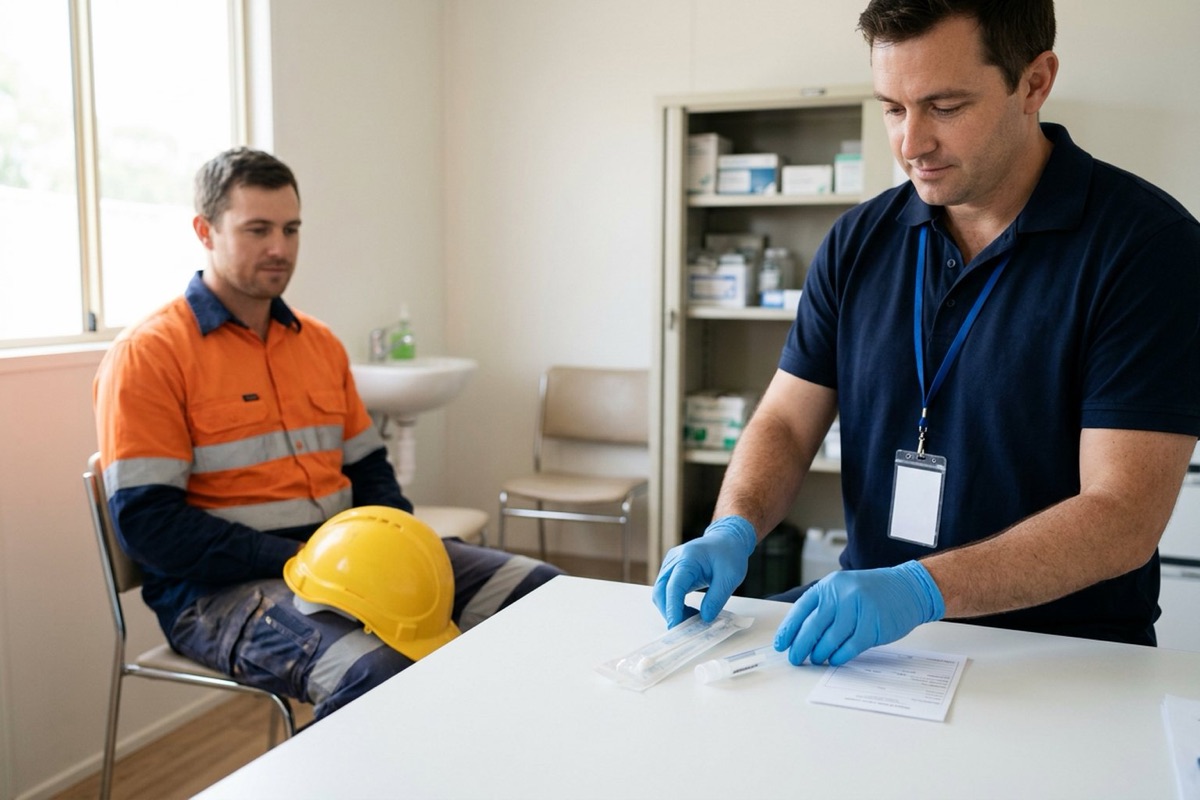
Testing is optional, not a legal requirement in most construction work, but if you use it, it must be done properly. Common types are pre-engagement, random, post-incident and reasonable-cause testing, and the policy should say which apply.
- Alcohol. Usually a breath test using a breath alcohol testing device. Look for devices that meet AS 3547, and set out in the policy how a positive reading will be confirmed, typically by a second test after a short wait.
- Drugs in urine. AS/NZS 4308:2023 sets procedures for urine specimen collection, on-site screening, laboratory confirmation and reporting. It replaced the 2008 edition.
- Drugs in oral fluid. AS/NZS 4760:2019 sets procedures for oral fluid collection, on-site screening and laboratory confirmation. It replaced AS 4760:2006.
A key point in both drug standards is the difference between screening and confirmation. An on-site screen that is not negative is not proof of drug use. The sample should go to an accredited laboratory for confirmatory testing before any finding is made, and the worker should be stood down from safety-critical work in the meantime according to the policy.
Urine and oral fluid tests detect use over different time windows, so they answer different questions. Ask your testing provider to explain what each method can and cannot tell you before choosing one, and make sure collectors are trained to the relevant standard.
The ADF also warns against relying on random or one-off testing alone, saying it has been shown to be less effective than a comprehensive policy that includes education and support.
What should a supervisor do if someone seems impaired?
Supervisors are often the first to notice a problem. A fair, consistent process protects both the worker and the business:
- Act on safety first. Stop the person doing safety-critical work straight away, including operating plant or driving.
- Talk privately. Speak to them away from the crew, with a second person present if possible, and ask whether they are okay.
- Describe what you see. Focus on observed behaviour, such as slurred speech, unsteadiness or the smell of alcohol, not assumptions.
- Follow the policy. Apply the testing or stand-down steps exactly as written.
- Get them home safely. Never let a worker you suspect is impaired drive; arrange transport.
- Record it. Note the date, time, observations and actions taken.
- Follow up. Meet with the worker when they are fit, and offer the EAP and other support.
Remember that what looks like impairment can have a medical cause, such as a diabetic episode, head injury or a reaction to medication. Treat the situation as a safety issue first, not a disciplinary one.
How should testing results and privacy be handled?
Test results are sensitive personal information and should be handled with care:
- Limit access. Only people who need the result to manage safety should see it.
- Store securely. Keep records separate from general personnel files.
- Use for safety. Use results only for the purposes the policy states.
- Tell the worker. Explain how their information will be collected, used and stored.
The Office of the Australian Information Commissioner explains that a private sector employer’s handling of employee records directly related to a current or former employment relationship is exempt from the Privacy Act. That exemption is limited to the employer’s own employee records, and construction sites also involve subcontractors, labour-hire workers and visitors whose information may be treated differently. Get advice when designing a testing program, and check any state privacy or workplace surveillance laws that apply.
What support should be offered?
Testing and discipline alone do not reduce harm. A policy that encourages people to ask for help early is more likely to keep them, and their workmates, safe. Practical support includes:
- EAP. Confidential counselling for workers and their families, promoted at induction and on the noticeboard.
- Self-disclosure. A pathway for workers to come forward before an incident without automatically facing discipline.
- Return to work. A plan agreed with the worker, which may include adjusted duties while they get treatment.
- Supervisor training. So supervisors can raise concerns early and respectfully.
External services include the National Alcohol and Drug Hotline on 1800 250 015 for confidential counselling, information and referral, Beyond Blue on 1300 22 4636, and MensLine Australia on 1300 78 99 78. The MATES in Construction helpline on 1300 642 111 is available 24/7. Our guide to mental health in construction covers the wider picture.

Do federal building rules still require drug and alcohol testing?
No. The Code for the Tendering and Performance of Building Work 2016, which applied to Commonwealth-funded building work, once required fitness for work policies and drug and alcohol testing on certain projects. The Code for the Tendering and Performance of Building Work Amendment Instrument 2022 removed the fitness for work and drug and alcohol testing requirements from 26 July 2022. The Code itself was repealed from 7 December 2022, when its enabling provision in the Building and Construction Industry (Improving Productivity) Act 2016 was repealed.
Many principal contractors, clients and project agreements still require AOD policies and testing as a condition of working on site. On a multi-contractor project, the principal contractor’s site rules will usually set the standard, so check them before you start. Our guide to principal contractor duties explains how site rules are set.
AOD management checklist
- Assess the risk. Identify safety-critical tasks and the factors that drive AOD use on your sites.
- Consult first. Involve workers and health and safety representatives in drafting the policy.
- Write it down. Cover scope, standards, medicines, testing, consequences, support and confidentiality.
- Use the standards. Specify AS/NZS 4308:2023 or AS/NZS 4760:2019 for drug testing and confirm screens in a laboratory.
- Train supervisors. Teach them how to respond to suspected impairment consistently.
- Protect privacy. Restrict access to results and store them securely.
- Promote support. Publicise the EAP and helplines, and allow self-disclosure.
- Check site rules. Confirm principal contractor and client AOD requirements before mobilising.
- Review regularly. Revisit the policy after incidents and at set intervals.
Manage alcohol and drug risks fairly
CPD-accredited online courses on managing alcohol and other drugs, mental health awareness and wellbeing at work, each with an assessment and a certificate.
Frequently asked questions
Is drug and alcohol testing mandatory on construction sites?
Not under the general WHS laws. Employers must manage the risk of impairment, but testing is one option among several. Many principal contractors, clients and project agreements do require testing as a site condition, so check the rules for each project.
Which Australian Standards apply to workplace drug testing?
AS/NZS 4308:2023 covers drug testing in urine and AS/NZS 4760:2019 covers drug testing in oral fluid. Both set procedures for collection, on-site screening and laboratory confirmation. Breath alcohol testing devices are covered by AS 3547.
Does a non-negative on-site drug screen mean the worker has used drugs?
No. An on-site screen is a preliminary result. It should be confirmed by an accredited laboratory before any finding is made. Until then, the worker should be managed according to the policy, which usually means standing them down from safety-critical work.
Can workers refuse a drug or alcohol test?
Workers must cooperate with reasonable health and safety policies that have been notified to them. The policy should explain what happens if someone refuses a test. Get advice on how refusals are treated under your policy, contracts and any enterprise agreement.
Do prescription medicines count?
Yes, if they affect a person's ability to work safely. Workers should check with their GP or pharmacist about side effects and tell their supervisor if a medicine could affect safety, so duties can be adjusted while they need it.
Does the Building Code 2016 still require drug testing?
No. The drug and alcohol testing requirements were removed on 26 July 2022, and the Code for the Tendering and Performance of Building Work 2016 was repealed from 7 December 2022. Individual clients and principal contractors may still impose their own requirements.
Sources and further reading
- Queensland Legislation — Work Health and Safety Act 2011 (ss 19, 28, 47-49), current as at 3 August 2026
- Alcohol and Drug Foundation — Alcohol, drugs and workplace safety (April 2025)
- Alcohol and Drug Foundation — Impact of AOD on the workplace
- Standards Australia — AS/NZS 4308:2023 Procedures for specimen collection and the detection and quantitation of drugs in urine
- Standards Australia — AS/NZS 4760:2019 Procedure for specimen collection and the detection and quantitation of drugs in oral fluid
- Federal Register of Legislation — Code for the Tendering and Performance of Building Work 2016 (status and versions)
- OAIC — Employment and your privacy (employee records exemption)