Construction workers in Australia die by suicide at a markedly higher rate than other workers, and the causes are tied to how construction work is organised as much as to the individuals involved. University of Melbourne research for MATES in Construction found the suicide rate among male construction workers was almost double that of other male workers over 2001 to 2021, with the gap widest among younger workers.
What helps is a mix of both: employers managing psychosocial hazards such as job insecurity, long hours and time away from home, as WHS law requires, and crews who know how to notice, ask and connect a mate to help.
How big is the mental health risk in construction?
The most reliable Australian data comes from a long-running series of reports by the University of Melbourne for MATES in Construction, based on coronial records in the National Coronial Information System. The seventh volume, published in September 2025, covers 2001 to 2021. It found:
- 4,582 suicides among male and female construction workers across Australia over those 21 years.
- A rate almost double other workers. The age-standardised suicide rate for male construction workers was 25.7 per 100,000, against 14.3 per 100,000 for male workers in other industries.
- The gap is narrowing. The national rate ratio between construction and other male workers fell from 2.34 to 1.55 across the study period, driven mainly by declines in Victoria, Queensland and South Australia.
- Young workers are most exposed. The disparity was most marked in the 15–24, 25–34 and 35–44 age groups, and suicide is the leading cause of death for Australian men aged 15 to 44.
The researchers also flag real limits: some deaths are still being classified by coroners, and the occupation codes make it hard to separate construction from mining workers, which may affect estimates in Western Australia. Rates also vary considerably between states.
Why are construction workers at higher risk?
The report describes two groups of factors. The first is who works in the industry: construction is overwhelmingly male, and in Australia three times as many men as women die by suicide. The second is how the work is organised. The contextual factors the researchers name are:
- Limited job control. Workers often have little say over programs, sequencing or hours.
- Job insecurity. Work is project-based, with gaps between jobs and frequent changes of employer.
- Unemployment and underemployment. Periods without enough work, which hit subcontractors and labour-hire workers hard.
- Travel and time away. Long commutes, fly-in fly-out and regional work keep people away from family and support.
For apprentices and young workers, the report points to earlier studies finding higher psychological distress and alcohol and other drug harm, with bullying associated with that distress. Job stress, a lack of social support and knowing someone who has died by suicide were also linked to suicidal behaviour in young workers. Our guide to workplace bullying covers how to prevent and respond to it.
What does WHS law require employers to do?
Mental health is a work health and safety issue, not just a welfare program. The general duty to ensure health and safety so far as is reasonably practicable already covers psychological health, and every state and territory now has specific psychosocial rules on top of it.
In the jurisdictions that use the model WHS laws, regulations 55A to 55D define a psychosocial hazard as one arising from the design or management of work, the work environment, plant at a workplace, or workplace interactions or behaviours, that may cause psychological harm. A person conducting a business or undertaking (PCBU) must eliminate psychosocial risks so far as is reasonably practicable, and otherwise minimise them. In choosing controls, regulation 55D requires a PCBU to consider matters including:
- Exposure. The duration, frequency and severity of exposure to the hazard.
- Combined hazards. How hazards interact or combine, such as long hours plus conflict plus travel.
- Work design. Job demands and tasks, and how work is managed, organised and supported.
- Workplace and accommodation. The design, layout and conditions of the workplace and of any worker accommodation.
- People. Workplace interactions and behaviours, and the information, training, instruction and supervision provided.
In Queensland these provisions commenced on 1 April 2023. Victoria, which has its own OHS laws, introduced the Occupational Health and Safety (Psychological Health) Regulations 2025 from 1 December 2025, with a supporting compliance code. On multi-contractor sites, PCBUs must consult, cooperate and coordinate with each other on these risks as they do for physical hazards. Our pillar guide to psychosocial hazards and the WHS regulations explains the risk management process in full.
What are the signs a workmate might be struggling?
There is rarely one clear sign. What supervisors and crews usually notice is a change from how a person normally is. Common examples include:
- Withdrawal. Going quiet, eating lunch alone or skipping the usual banter.
- Changes at work. Lateness, absences, uncharacteristic mistakes or near misses.
- Mood. Irritability, anger or flatness that is out of character.
- Life events. A relationship breakdown, money trouble, a legal problem, an injury or losing work.
- Talk. Comments about being a burden, feeling trapped or not seeing a way forward.
- Coping. Drinking or using other drugs more than before.
None of these proves anything on its own. They are a prompt to ask, not a diagnosis. If someone says they are thinking about suicide, take it seriously, stay with them if you can and connect them to help straight away.
How should a supervisor start the conversation?
R U OK? recommends a simple four-step approach that suits a site setting:
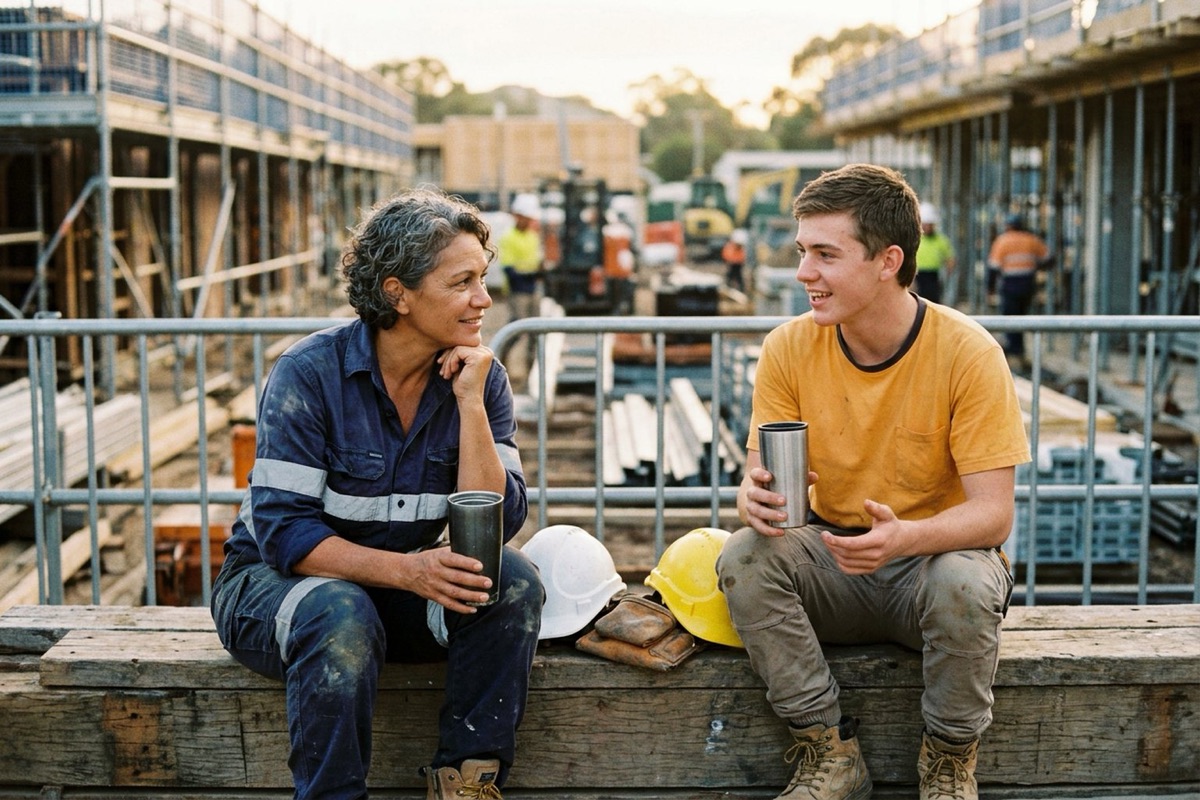
- Ask. Be relaxed, friendly and concerned. Choose a private moment, such as walking to the ute, rather than in front of the crew.
- Listen with an open mind. Take what they say seriously, don’t interrupt and don’t rush to fix it.
- Encourage action. Help them think about what might help, and suggest a GP, the employee assistance program (EAP) or a helpline if things have been hard for a while.
- Check in. Follow up in a couple of weeks, or sooner if you are worried.
Lifeline advises that asking someone directly whether they are thinking about suicide will not put the idea in their head. If the answer worries you, it is fine to say you want to get them some help and to make the call together. Supervisors are not counsellors; the job is to notice, ask and connect.
What support services are available?
Several free, confidential services operate 24 hours a day, 7 days a week:
- MATES in Construction: 1300 642 111.
- Lifeline: 13 11 14, with text and webchat options.
- Suicide Call Back Service: 1300 659 467, for anyone feeling suicidal or affected by suicide.
- Beyond Blue: 1300 22 4636.
- MensLine Australia: 1300 78 99 78.
- 13YARN: 13 92 76, for Aboriginal and Torres Strait Islander people.
Many employers also fund an EAP that offers a set number of confidential counselling sessions. Put the numbers on the site noticeboard, in the induction pack and in the WHS management plan, and make sure workers know the EAP covers them, including how to access it without going through their supervisor.
What actually helps on a construction site?
The evidence points to two levels of action working together.
Fix the work. Because the hazards come from how work is organised, the strongest controls change that:
- Realistic programs. Avoid programs that rely on sustained excessive hours, and review them when delays push overtime up.
- Predictable rosters. Give notice of shifts and weekend work, and protect rest days.
- Job control. Involve crews in sequencing and planning decisions that affect them.
- Accommodation and travel. For regional and FIFO work, consider rosters, accommodation conditions and contact with home.
- Respectful behaviour. Act early on bullying, harassment and aggression, including towards apprentices.
- Consultation. Ask workers and health and safety representatives what is causing stress, and record the controls agreed.
Build the crew’s capacity. MATES in Construction delivers on-site General Awareness Training, Connector training for workers who volunteer to help link mates to support, and ASIST suicide intervention training, backed by field officers, case management and the helpline. It operates in Queensland and the Northern Territory, New South Wales, South Australia and Western Australia; Victoria has an adaptation called Blue Hats. The University of Melbourne report notes a review finding that MATES improved suicide prevention literacy and helping intentions and reduced stigma, and that younger workers respond well to this training.
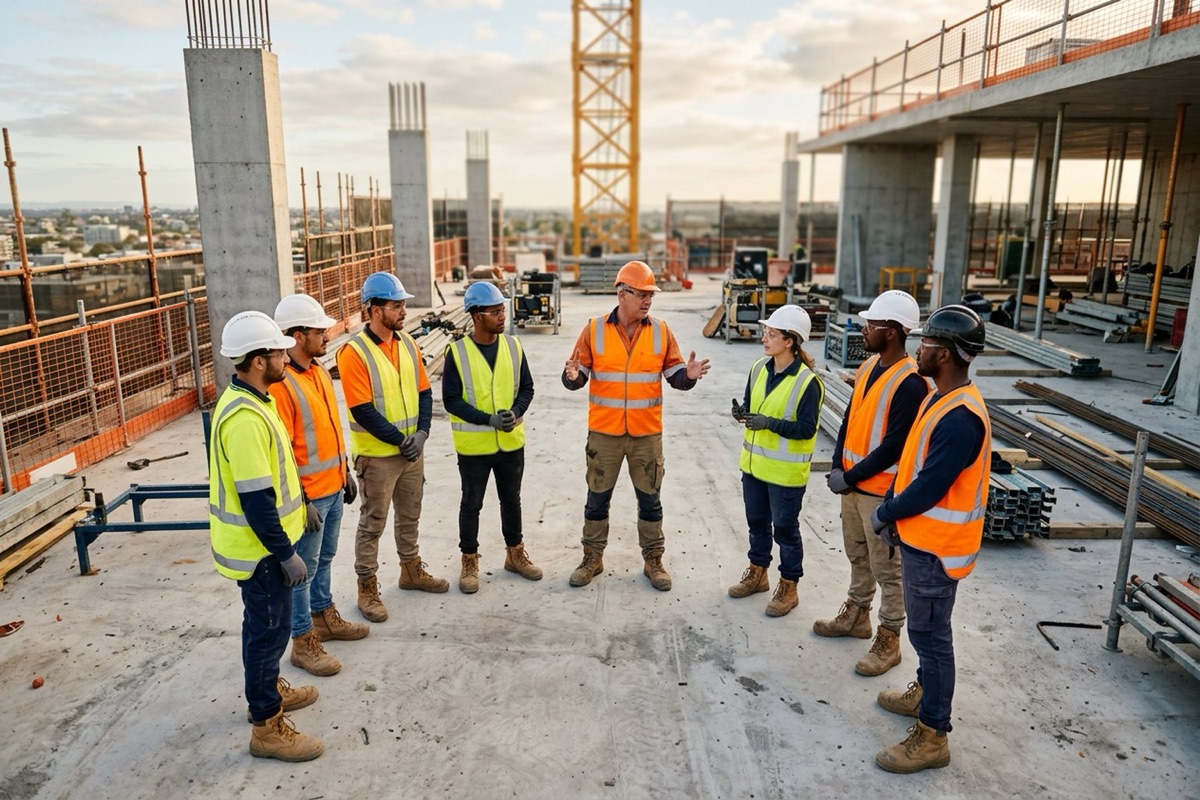
Toolbox talks are a practical place to normalise the topic. Our guide on running a toolbox talk covers how to keep them short, relevant and two-way.
How should we talk about suicide on site?
How suicide is discussed matters, especially after a death that has affected the crew. Mindframe, the national program for safe communication about suicide and mental ill-health, recommends:
- Use accurate language. Say “died by suicide” or “took their own life”, not “committed suicide” or “successful suicide”.
- Leave out method and location. Descriptions of how or where someone died have been linked to imitation, so keep them out of toolbox talks, messages and noticeboards.
- Avoid sensational terms. Say “higher rates” rather than “epidemic”.
- Always include help. Every message about suicide should end with where to get support.
After a suicide, contact your EAP, and consider calling the MATES helpline, to arrange support for the crew. Check in with close workmates individually, and give people time and flexibility rather than expecting work as normal straight away.
Mental health checklist for supervisors and employers
- Identify hazards. Include job demands, hours, insecurity, travel and behaviour in your risk assessment.
- Consult workers. Ask crews and health and safety representatives what is causing pressure.
- Control the work. Review programs, rosters and overtime before relying on resilience training.
- Publish the numbers. Display helplines and EAP details on site and in inductions.
- Train people. Give supervisors and volunteers training to notice, ask and connect.
- Protect apprentices. Pair young workers with a trusted mentor and stamp out initiation-style bullying.
- Use safe language. Follow Mindframe guidance whenever suicide is discussed.
- Plan for the worst. Know who you will call and what you will do if a worker dies by suicide.
- Review regularly. Revisit controls when programs, crews or conditions change.
Build a mentally healthy site
CPD-accredited online courses on mental health awareness, wellbeing, resilience and supervising young workers, each with an assessment and a certificate.
- Mental Health Awareness in the Workplace View course →
- Wellbeing at Work View course →
- Building Personal and Team Resilience at Work View course →
- Supervising and Communicating with Young Workers View course →
- Preventing and Responding to Workplace Bullying View course →
- Managing Alcohol and Other Drugs in the Workplace View course →
Frequently asked questions
Are construction workers more likely to die by suicide?
Yes. University of Melbourne research for MATES in Construction found the suicide rate for male construction workers over 2001 to 2021 was 25.7 per 100,000, almost double the 14.3 per 100,000 for male workers in other industries. The gap has narrowed over time but remains significant.
Is mental health covered by WHS law?
Yes. Duties to ensure health and safety include psychological health. The model WHS Regulations add specific psychosocial provisions in regulations 55A to 55D, and Victoria has the OHS (Psychological Health) Regulations 2025, which commenced on 1 December 2025.
What is a psychosocial hazard?
It is a hazard arising from the design or management of work, the work environment, plant, or workplace interactions or behaviours that may cause psychological harm. In construction, examples include excessive hours, job insecurity, time away from home, bullying and exposure to traumatic events.
Does asking someone about suicide make it worse?
Asking directly and calmly is one of the most useful things you can do. It shows you care and gives the person permission to talk. If they say yes, stay with them and connect them to help, such as a 24/7 helpline or emergency services.
What is the MATES in Construction helpline number?
The MATES in Construction helpline is 1300 642 111 and operates 24 hours a day, 7 days a week. Lifeline on 13 11 14 and the Suicide Call Back Service on 1300 659 467 are also available around the clock.
Do supervisors need to be mental health experts?
No. A supervisor's role is to notice changes, ask, listen and connect the person to support such as a GP, the employee assistance program or a helpline. The employer's role is to manage the work-related hazards that contribute to poor mental health.
Sources and further reading
- University of Melbourne for MATES in Construction — Suicide in the construction industry 2001-2021, Volume VII (September 2025)
- Queensland Legislation — Work Health and Safety (Psychosocial Risks) Amendment Regulation 2022 (ss 55A-55D)
- SafeWork NSW — What duty holders must do to comply (psychosocial risks, clause 55D)
- Premier of Victoria — New regulations start today to protect workers (OHS (Psychological Health) Regulations 2025, 1 December 2025)
- MATES in Construction — About: training, case management and 24/7 helpline
- Mindframe — Language: communicating about suicide
- Lifeline — I'm worried about someone
- R U OK? — How to ask
- NSW Health — Get help now (national helplines)