Whoever manages or controls powered mobile plant must manage the risks of it overturning, things falling on the operator, the operator being ejected, collisions with people or things, and pressurised fluid failures — and must ensure the plant does not collide with pedestrians or other plant. In practice that means separating people from plant with exclusion zones, barriers, spotters and a traffic management plan, fitting warning devices, and using competent operators.
Forklifts, most cranes, hoists, concrete placing booms and boom lifts of 11 metres or more need a high risk work licence. On a construction project, the principal contractor must also manage the risks from traffic in the vicinity of the site.
What is powered mobile plant?
The model WHS Regulations define powered mobile plant as plant that has some form of self-propulsion that is ordinarily under the direct control of an operator. On a construction site that includes:
- earthmoving machinery — excavators, backhoes, loaders, skid steers, dozers, graders, rollers and dump trucks;
- industrial lift trucks, such as forklifts;
- mobile cranes and self-propelled elevating work platforms; and
- trucks, concrete agitators and pump trucks while operating on site.
Safe Work Australia describes plant as a major cause of work-related death and injury in Australian workplaces. Under regulation 291, construction work in an area where there is any movement of powered mobile plant is high risk construction work, so it needs a safe work method statement (SWMS).
What do the WHS Regulations require for powered mobile plant?
The duties sit with the person with management or control of the plant — usually the business that owns, hires or operates it on site.
Under regulation 214, they must manage the risks of:
- the plant overturning;
- things falling on the operator;
- the operator being ejected from the plant;
- the plant colliding with any person or thing; and
- mechanical failure of pressurised elements that may release fluids.
Regulation 215 then requires them to:
- provide, maintain and ensure the use of a suitable combination of operator protective devices — such as a roll-over protective structure (ROPS), falling object protective structure (FOPS), operator restraint and seat belt — so far as is reasonably practicable;
- ensure no one but the operator rides on the plant unless they have equivalent protection;
- ensure the plant does not collide with pedestrians or other powered mobile plant; and
- where a collision is possible, fit a warning device that will warn people at risk from the plant’s movement.
Forklifts and other industrial lift trucks have extra rules under regulation 218: suitable lifting attachments for the load, and no passengers unless the truck is designed with a seat that has restraints and sits within the operator’s zone of protection. Under regulation 213, maintenance, inspection and testing must be done by a competent person, following the manufacturer’s recommendations where there are any.
How do you keep people and plant apart?
Safe Work Australia’s traffic management guide for construction work and the plant Code of Practice describe the controls. Work from the most effective down:
- Separate them physically. Provide separate routes for vehicles and pedestrians, with clearly marked walkways and barriers, bollards or fencing between them.
- Set exclusion zones. Mark out areas people must not enter while plant is working — an excavator’s slew radius, a crane’s lift zone, a tipping area — and enforce them.
- Limit vehicle movements. Plan delivery and storage areas so trucks do not cross the site, park worker and visitor vehicles away from work areas, control entry with gates, and schedule work so fewer machines share the same area.
- Design out reversing. Use one-way systems, drive-through loading and turning circles where possible.
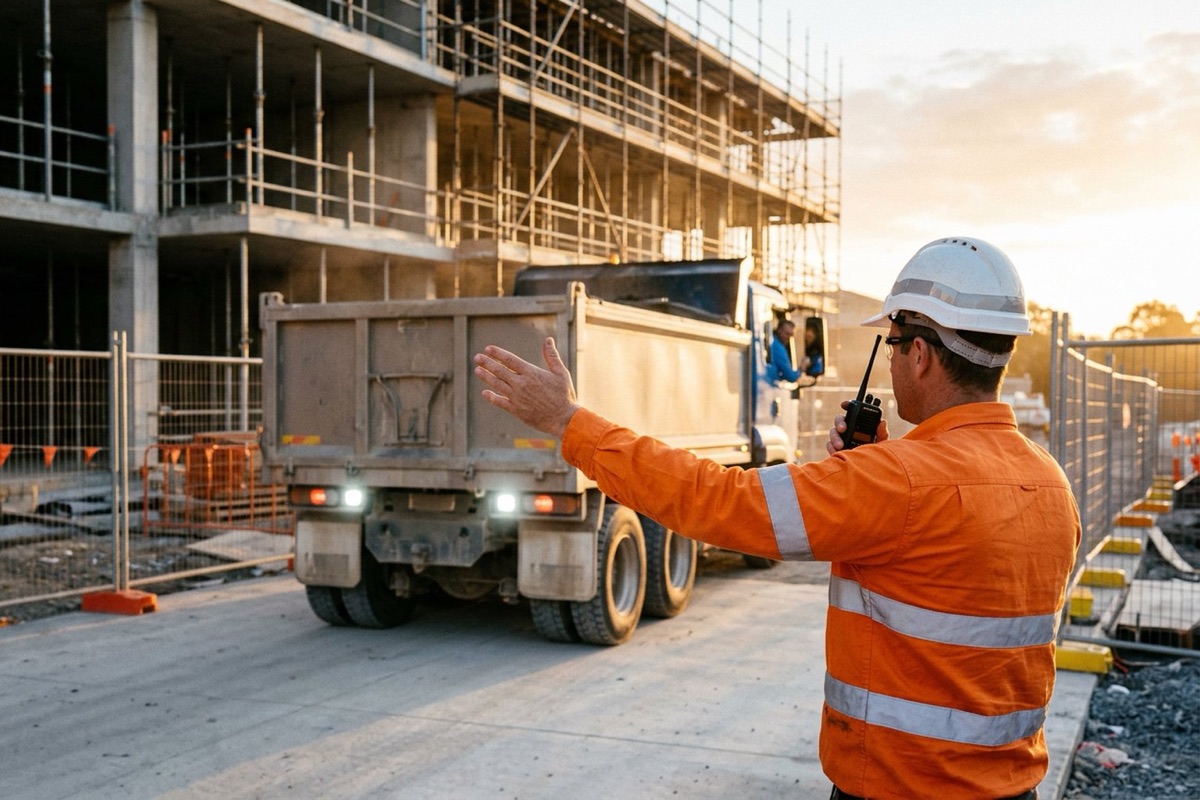
- Use spotters where needed. Where there are blind spots or people nearby, a spotter in direct communication with the operator, such as by two-way radio, helps guide movements.
- Make plant visible and audible. Warning devices, lights, cameras and proximity sensors support — but do not replace — separation.
- Control speed and signage. Set site speed limits and use clear signs and markings.
Our guide to excavation and trenching covers keeping plant back from trench edges.
What should a traffic management plan include?
A traffic management plan sets out how traffic risks will be managed on the site. Safe Work Australia’s guidance says it should include details such as:
- designated travel paths for vehicles and plant;
- pedestrian routes and crossing points;
- designated delivery and loading areas; and
- the traffic control measures for each expected interaction between people and plant, such as exclusion zones, spotters and traffic controllers.
Draw it on a site plan, update it as the site changes — a new floor, a crane relocation, a road closure — and brief it at induction and toolbox talks. The plan supports the SWMS for high risk construction work; it does not replace it.
Which plant needs a high risk work licence?
Under regulation 81 and Schedule 3 of the model WHS Regulations, a high risk work licence is needed to operate:
- forklift trucks and order-picking forklift trucks;
- cranes — tower, self-erecting tower, derrick, portal boom, bridge and gantry, non-slewing mobile cranes over 3 tonnes, slewing mobile cranes, and vehicle loading cranes of 10 metre tonnes or more;
- materials hoists and personnel and materials hoists;
- boom-type elevating work platforms with a boom of 11 metres or more;
- concrete placing booms; and
- reach stackers over 3 tonnes for shipping containers.
Earthmoving machinery such as excavators, loaders, rollers and skid steers is not on the Schedule 3 list, so no high risk work licence is needed to operate it under the model Regulations. Operators must still be competent and trained for the specific machine — a verification of competency (VOC) assessment is one way to show that.
Before directing or allowing a worker to do licensed work, the business must see written evidence of the licence (regulation 85). Trainees working towards a licence may do the work under the supervision of a licensed person (regulation 82).
What is the principal contractor responsible for?
On a construction project, regulation 315 makes the principal contractor manage the risks associated with:
- the storage, movement and disposal of construction materials and waste;
- the storage of plant that is not in use;
- traffic in the vicinity of the workplace that may be affected by the construction work; and
- essential services at the workplace.
So the principal contractor owns the site-wide picture: the traffic management plan, the interface between different subcontractors’ plant, deliveries, site entries and exits, and the effect of the site on the street outside. Each business operating plant still has its own duties under regulations 214 and 215, and must consult and coordinate with the others.
What about work on or next to public roads?
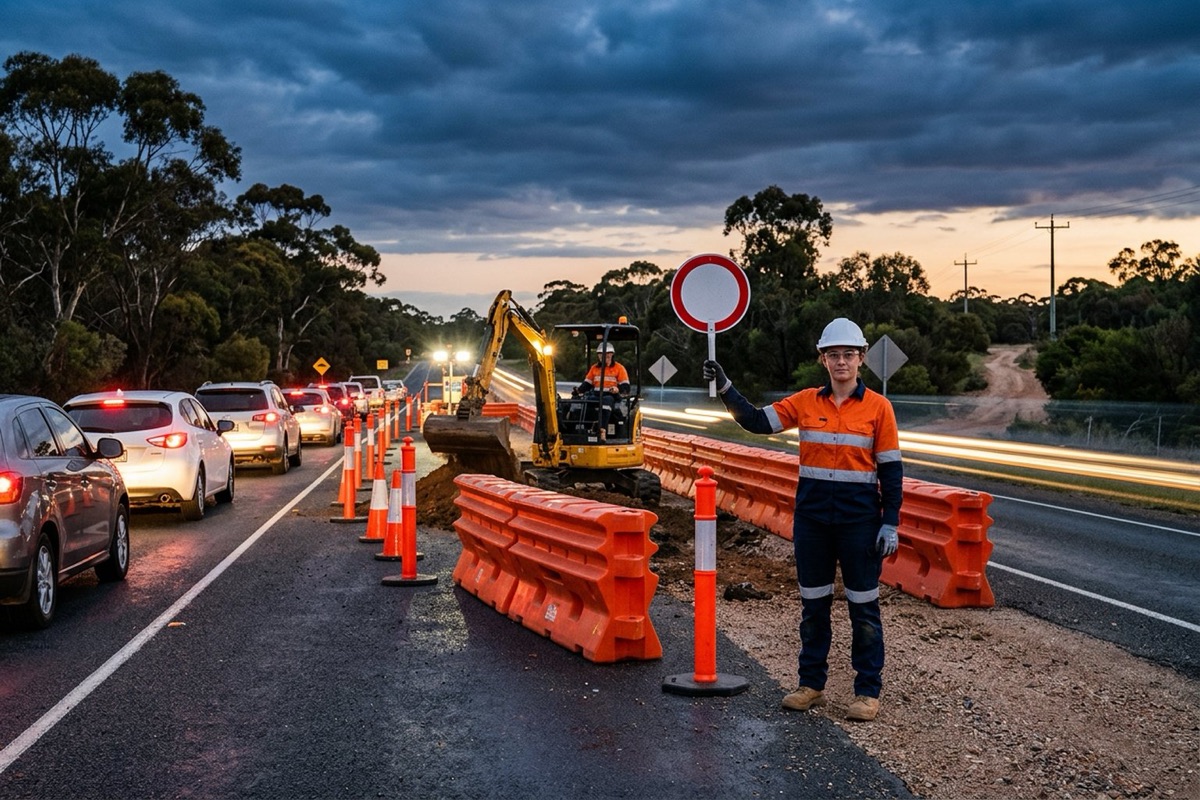
Construction work on, in or adjacent to a road, railway or other traffic corridor in use by traffic other than pedestrians is high risk construction work under regulation 291, so it needs a SWMS.
Work on or affecting a public road also brings in the road authority — the state road agency or the local council. Road authorities set requirements for traffic control at work sites, such as approved traffic guidance schemes, permits to occupy the road, and qualifications for traffic controllers. These differ between states and councils, so contact the relevant road authority early.
In New South Wales, for example, anyone doing traffic control work on or adjacent to a public road must hold a SafeWork NSW traffic control work training card, which covers traffic controllers, implementing traffic control plans and preparing work zone traffic management plans.
How is Victoria different?
Victoria has not adopted the model WHS laws. Plant is regulated under Part 3.5 of the Occupational Health and Safety Regulations 2017. Victoria’s list of high risk construction work in regulation 322 includes work at workplaces where there is any movement of powered mobile plant, and work on or adjacent to roadways or railways used by road or rail traffic — so a SWMS is needed for both.
Victoria’s high risk work licence classes in Schedule 3 are similar to the model list, covering forklifts, order-picking forklifts, cranes, hoists, concrete placing booms and boom-type elevating work platforms with a boom length of 11 metres or more. Work from the Victorian Regulations and WorkSafe Victoria’s guidance on Victorian sites.
Mobile plant and traffic checklist
- Prepare a SWMS for work where powered mobile plant moves, or near roads in use.
- Draw up a traffic management plan showing plant routes, pedestrian routes, loading areas and exclusion zones.
- Physically separate pedestrians from plant with barriers and marked walkways.
- Minimise reversing with one-way routes and turning areas.
- Use spotters with direct communication where blind spots or people are near plant.
- Check operator protective devices and warning devices on every machine.
- Sight high risk work licences and confirm operators are competent for each machine.
- Maintain and inspect plant by a competent person, to the manufacturer’s recommendations.
- Engage the road authority before work affects a public road, and use qualified traffic controllers.
- Review the plan whenever the site layout changes.
Keep people and plant apart
CPD-accredited online courses on mobile plant, traffic management, cranes and lifting, and excavation, each with an assessment and a certificate.
Frequently asked questions
Do you need a licence to operate an excavator?
Not a high risk work licence under the model WHS Regulations, because earthmoving machinery is not listed in Schedule 3. The operator must still be competent and trained for that machine, which can be confirmed with a verification of competency.
Do you need a licence to drive a forklift on site?
Yes. Operating a forklift truck, or an order-picking forklift truck, is high risk work that requires a high risk work licence. The business must see written evidence of the licence before allowing the work.
Who is responsible for traffic management on a construction site?
Every business that manages or controls powered mobile plant must manage its collision risks. On a construction project, the principal contractor must also manage risks from traffic in the vicinity of the workplace, and in practice coordinates the site-wide traffic management plan.
Does work near mobile plant need a SWMS?
Yes. Construction work in an area where there is any movement of powered mobile plant is high risk construction work under the model WHS Regulations and under Victoria's Regulations, so a safe work method statement is required before the work starts.
What is an exclusion zone?
An exclusion zone is an area that people must not enter while a hazard is active, such as the slew radius of an excavator, the area under a crane lift or a truck tipping area. It should be marked out, physically controlled where possible and enforced.
Who can do traffic control on a public road?
Requirements are set by each state and its road authorities. In New South Wales, for example, anyone doing traffic control work on or adjacent to a public road must hold a SafeWork NSW traffic control work training card. Check the rules with the road authority in your state.
Sources and further reading
- Federal Register of Legislation — Work Health and Safety Regulations 2011 (Cth), regs 82, 85, 213–218, 291, 315 and Schedule 3 (model text)
- Safe Work Australia — Model Code of Practice: Managing risks of plant in the workplace
- Safe Work Australia — Traffic management guide: construction work
- Service NSW — Get a traffic control work training card
- Victorian Legislation — Occupational Health and Safety Regulations 2017, reg 322 and Schedule 3