On a building site, stormwater has two sets of rules: how the finished building drains, and how the site stops pollution while it is being built. For the finished building, the NCC’s Deemed-to-Satisfy route is AS/NZS 3500.3 (F1D3 in Volume One, H2D2 in Volume Two), and councils add requirements such as on-site detention and water sensitive urban design (WSUD) features.
During construction, sediment, concrete slurry and other pollutants must be kept out of drains and waterways. State environment laws make that a legal duty, and guidance such as EPA Victoria’s publication 1834 and the NSW “Blue Book” sets out the controls.
Where does stormwater drainage sit in the NCC?
Stormwater drainage is mainly covered in the building volumes of the NCC, not the Plumbing Code:
- Volume One (Class 2 to 9 buildings). F1D3 requires stormwater drainage to be designed and constructed in accordance with AS/NZS 3500.3. Where it does not comply, a Performance Solution is needed. The clause has the same number and wording in NCC 2022 and NCC 2025.
- Volume Two (houses and Class 10 buildings). H2D2 allows drainage to be designed to AS/NZS 3500.3 or, within limits, to Part 3.3 of the ABCB Housing Provisions, which covers roofs in areas with 5-minute rainfall intensities of up to 255 mm per hour, sub-soil areas, and land adjoining and under buildings.
The Performance Requirements set the outcomes. Under H2P1, surface water from a storm with a 5% annual exceedance probability (AEP) that is collected or concentrated by a building or sitework must be disposed of without damage or nuisance to other property, and surface water from a 1% AEP storm must not enter the building. NCC 2025 reworded Volume One’s F1P1 along similar lines, covering both the building and adjoining properties.
NCC 2022’s explanatory information notes that the NCC does not itself require a drainage system to be installed; these provisions apply when one is. Whether one is required, and where it connects, is usually set by the council or drainage authority.
What does AS/NZS 3500.3 cover?
AS/NZS 3500.3 is the stormwater drainage part of the plumbing and drainage standard. NCC 2025 references the 2025 edition; NCC 2022 references the 2021 edition. It covers the design and installation of roof drainage (gutters, downpipes and overflows) and surface and subsoil drainage through to the point of connection with the council or authority system.
For building and plumbing practitioners, the practical points are:
- Design events. Eaves gutters are designed for a 5-minute rainfall intensity at a 5% AEP. The ABCB Housing Provisions add overflow measures sized for a 1% AEP.
- Overflow. Roof drainage needs overflow measures so that water from a 1% AEP storm does not enter the building, which is the outcome H2P1 requires.
- Point of connection. Stormwater must go to an approved point of discharge, which the council or drainage authority sets, and must be kept out of the sewer. Victoria’s VIC E4P2 says so expressly.
In Victoria, roof and surface stormwater drainage is regulated through VIC Parts E3 and E4 of Volume Three, alongside the state’s plumbing laws. Our guide to the Plumbing Code of Australia explains how Volume Three works.
What is on-site detention, and when do councils require it?
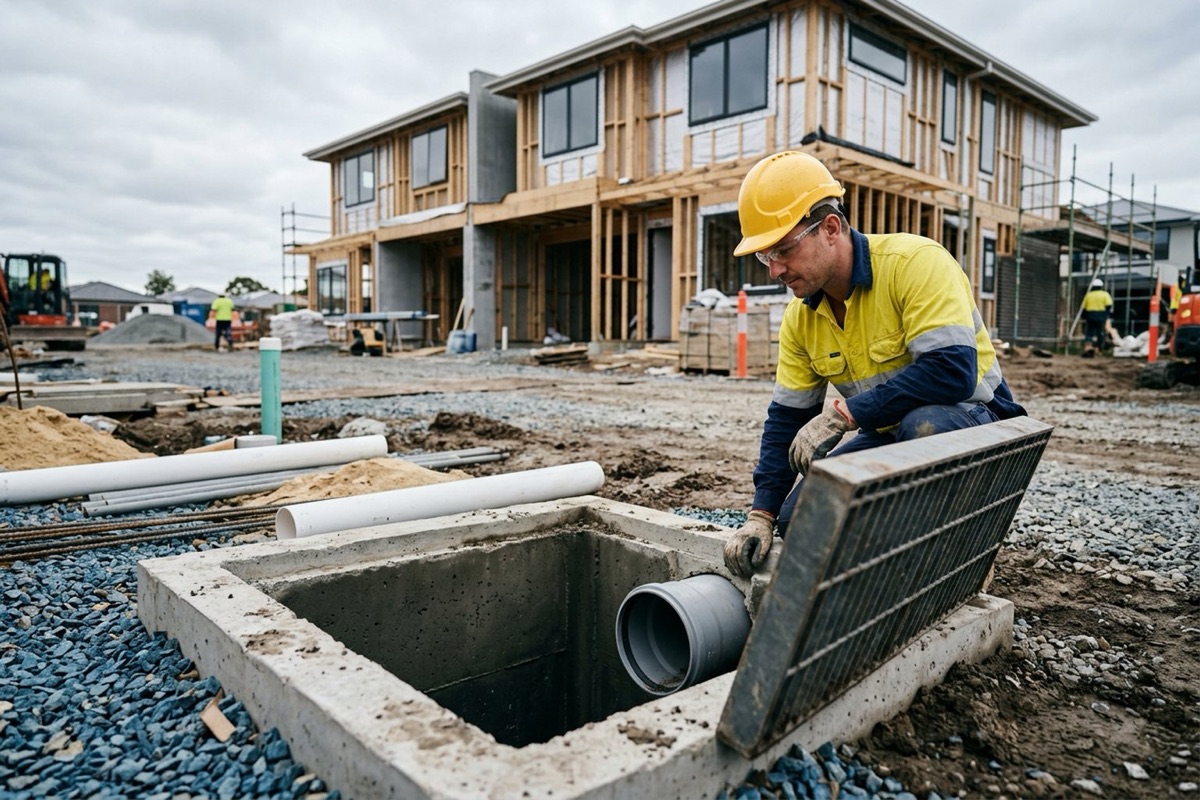
On-site detention (OSD) temporarily stores stormwater on the site and releases it to the drainage system at a controlled rate. Sydney Water’s guide explains the reason: hard surfaces such as roofs and paving increase the volume and speed of run-off, existing drains have limited capacity, and OSD stops new development increasing flooding downstream.
OSD is a council or drainage authority requirement, not an NCC one. Whether it applies, and how big the storage and outlet must be, depends on the location, the site and the type of development. Some councils apply it to multi-dwelling and larger developments and exempt single houses, unless a restriction on the title requires it. Sydney Water’s requirements apply where a property connects to its stormwater assets, alongside council requirements.
OSD tanks, below-ground storage, pits and orifice plates are usually shown on the approved stormwater plans. Building them differently, or substituting a rainwater tank for detention storage, needs the drainage designer’s and council’s agreement because the two do different jobs. Our guide to rainwater tank plumbing rules covers tanks used for water supply.
What is water sensitive urban design?
Water sensitive urban design is an approach that treats stormwater as a resource and manages its quantity and quality close to where it falls, instead of piping it straight to a creek. Typical WSUD elements on building sites include:
- Rainwater tanks. Capture roof water for reuse and reduce run-off volume.
- Raingardens and bioretention. Planted, layered soil beds that filter run-off and remove fine sediment and nutrients.
- Swales. Shallow grassed or vegetated channels that slow and filter water as it flows.
- Permeable paving. Paving that lets water soak through to a gravel base, reducing run-off.
- Infiltration trenches. Gravel-filled trenches that let water soak into suitable soils.
WSUD is usually required through planning rules and council policies. In Victoria, Clause 53.18 of the planning provisions, introduced by Amendment VC154, extends stormwater management requirements to commercial and industrial subdivisions and developments, public use developments and residential multi-dwelling developments. In New South Wales, BASIX’s water section assesses alternative water sources such as rainwater, and councils can set WSUD controls in their development control plans.
Infiltration needs care near footings. Water soaking into reactive clay next to a slab can cause movement, so infiltration devices should follow the engineer’s setbacks. Our guide to site classification and footings explains why soil moisture matters.
What erosion and sediment controls does a building site need?
Exposed soil, stockpiles and vehicle movements generate sediment that washes into drains and waterways with the first rain. The two key state guidance documents are:
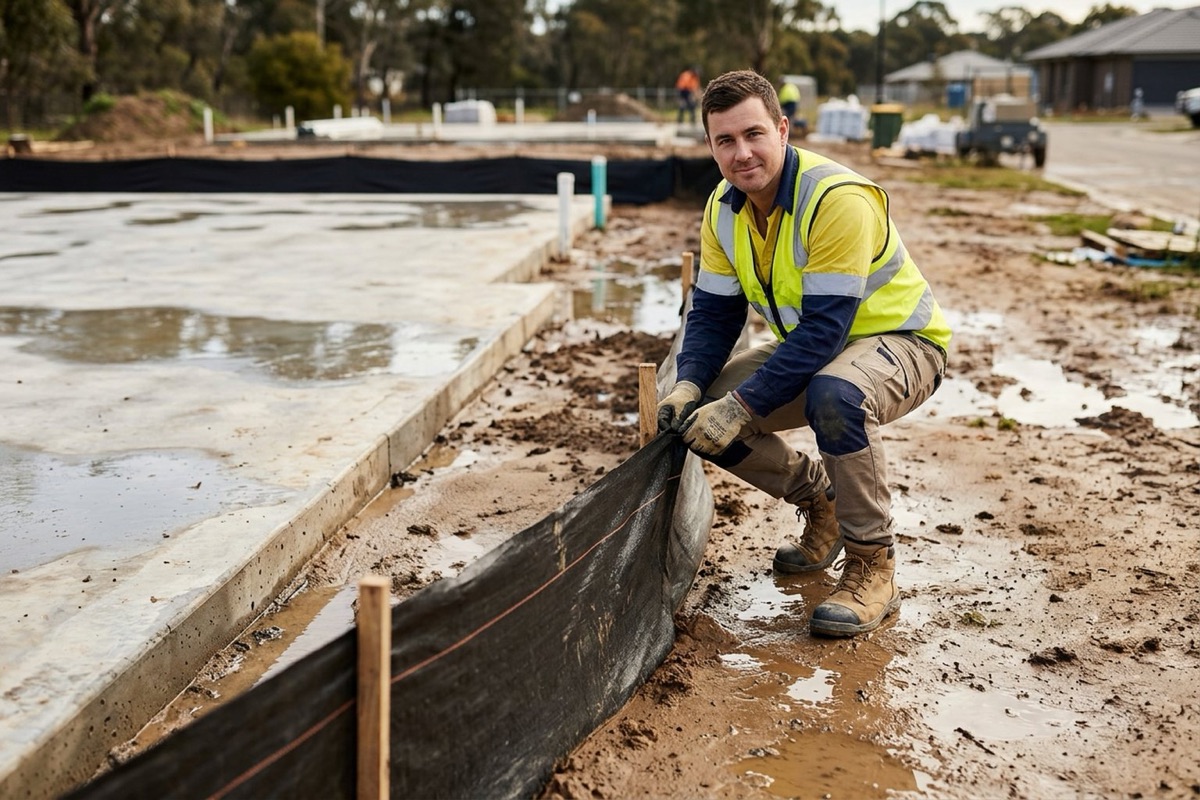
- Victoria. EPA Victoria’s Civil construction, building and demolition guide (publication 1834), updated in September 2025, replaced older guidance including Reducing stormwater pollution from construction sites. It recommends preparing an erosion and sediment management plan before work starts.
- New South Wales. Managing Urban Stormwater: Soils and Construction, Volume 1 (Landcom, 4th edition, 2004), known as the Blue Book, is the standard reference for councils and industry on erosion and sediment control.
The controls EPA Victoria describes include:
- Divert clean water. Divert clean stormwater around the site where possible.
- Sediment fences. Install sediment fences around stockpiles and downslope of disturbed areas, and remove sediment when it is halfway up the fence.
- Stabilised access. Stabilise site entry and exit points and restrict vehicles to defined routes. Use rumble grids or wheel washes so trucks do not track soil onto roads, keeping them clear of drainage lines.
- Protect inlets. Use screens, filter traps and silt socks to reduce sediment entering pits and kerb inlets.
- Concrete slurry. Contain and remove concrete slurry so it does not enter stormwater or waterways.
- Dewatering. Treat water pumped from excavations to remove sediment before discharge.
- Maintain controls. Inspect and maintain controls regularly, especially after rain.
Who is legally responsible for stormwater pollution from a site?
Each state and territory has its own environment protection law and regulator, and those laws generally restrict polluting waters, including through the stormwater system. They can reach builders, subcontractors and site operators, but the duties and offences differ between jurisdictions.
Victoria shows how this works. At the centre of the Environment Protection Act 2017 is the general environmental duty, which requires anyone engaging in an activity that may give rise to risks of harm to human health or the environment from pollution or waste to minimise those risks so far as reasonably practicable. EPA Victoria says the duty applies to all Victorians, so builders and trades need to assess and manage the risks from their activities proactively, not just respond after a pollution event. The Act adds a duty to notify EPA of pollution incidents that cause or threaten material environmental harm, and a duty to clean up and restore an affected area, which applies regardless of fault.
In practice, responsibility follows control. The principal contractor usually controls the site’s erosion and sediment plan, while each trade is responsible for its own activities, such as washing out concrete trucks, cutting pavers or emptying paint buckets. None of those should go near a stormwater pit.
Stormwater and WSUD checklist for building sites
- Read the approval. Note the stormwater plan, point of discharge, OSD and WSUD conditions.
- Confirm the standard. Design drainage to AS/NZS 3500.3, or the Housing Provisions within their limits.
- Plan erosion control. Prepare an erosion and sediment control plan before any soil is disturbed.
- Install controls first. Put in sediment fences, stabilised access and inlet protection before earthworks.
- Manage wash-out. Set up a contained area for concrete, render and paint wash water.
- Inspect after rain. Check and repair controls after every significant rain event.
- Build OSD as designed. Install detention storage, pits and orifices exactly as approved.
- Hand over. Give the owner maintenance details for OSD, raingardens, permeable paving and tanks.
Manage stormwater on site with confidence
CPD-accredited online courses on stormwater management, water sensitive urban design, roof drainage and rainwater harvesting, each with an assessment and a certificate.
- Stormwater Management and Water Sensitive Urban Design View course →
- Roof Drainage Basics View course →
- Rainwater Harvesting for Buildings: An Introduction View course →
- Advanced Rainwater Harvesting System Design View course →
- The Plumbing Code of Australia: NCC Volume Three View course →
- Decoding Plumbing Legislation in Australia View course →
Frequently asked questions
Which NCC clause covers stormwater drainage?
For Class 2 to 9 buildings, F1D3 in NCC Volume One requires stormwater drainage to comply with AS/NZS 3500.3. For houses, H2D2 in Volume Two allows AS/NZS 3500.3 or, within limits, Part 3.3 of the ABCB Housing Provisions. The numbers are the same in NCC 2022 and NCC 2025.
Is stormwater part of the Plumbing Code of Australia?
Mostly not. The national Plumbing Code does not contain a stormwater drainage Part, so drainage is covered by F1D3 and H2D2 in the building volumes. Victoria is an exception, adding stormwater roof and surface drainage Parts to its Volume Three.
What is the difference between OSD and a rainwater tank?
A rainwater tank stores water for reuse. On-site detention temporarily holds stormwater and releases it slowly to protect the drainage system from flooding. They do different jobs, so one cannot replace the other without the council's agreement.
What is a WSUD raingarden?
A raingarden is a planted bed with layers of filter media that collects run-off from roofs or paving. Water filters through the soil and plants, which remove sediment and nutrients, before it soaks away or drains to the stormwater system.
What is the Blue Book?
The Blue Book is Managing Urban Stormwater: Soils and Construction, Volume 1, published by Landcom in 2004. It is the main NSW reference on erosion and sediment control for building and land development sites.
Can I wash concrete tools into the stormwater drain?
No. Concrete slurry is a pollutant, and EPA Victoria's guidance says it must be contained and removed so it does not enter stormwater networks or waterways. Use a contained wash-out area and dispose of the waste lawfully.
Sources and further reading
- ABCB — NCC 2025 Volume One, Part F1 Water management (F1P1, F1D3)
- ABCB — NCC 2022 Volume One, Part F1 Surface water management, rising damp and external waterproofing (F1D3)
- ABCB — NCC 2025 Volume Two, Part H2 Damp and weatherproofing (H2P1, H2D2)
- ABCB — NCC 2022 Volume Two, Part H2 Damp and weatherproofing (H2P1, H2D2)
- ABCB — NCC 2025 Volume Three, VIC Part E3 Stormwater roof drainage systems
- ABCB — NCC 2025 Volume Three, VIC Part E4 Stormwater surface drainage systems
- ABCB — NCC 2025 Volume Two, WA Part H10 Changes to AS/NZS 3500.3:2021
- EPA Victoria — Civil construction, building and demolition guide (publication 1834)
- NSW Environment and Heritage — Managing Urban Stormwater: Soils and Construction, Volume 1 (the Blue Book)
- Sydney Water — On-site stormwater detention guide
- Department of Transport and Planning (Vic) — Amendment VC154 Stormwater management (Clause 53.18)