Under the NCC, a new house or Class 10 building needs a termite management system where subterranean termites are a known risk and a primary building element is susceptible to attack. Elements made entirely of steel, concrete, masonry, fibre cement, or timber that is naturally termite resistant or preservative treated to AS 3660.1, are treated as not subject to attack.
Where a system is needed, it must suit the building element under Table 3.4.2 of the Housing Provisions, comply with AS 3660.1 or pass the AS 3660.3 tests, and be recorded on a durable notice. Queensland and the Northern Territory add stricter rules, and the system only works if owners keep it inspected and unbridged.
When does the NCC require termite risk management?
For houses and Class 10 buildings, NCC 2022 Volume Two lists “termite actions” among the actions a building must resist under Performance Requirement H1P1. The Deemed-to-Satisfy route is H1D3(3): compliance with Part 3.4 of the ABCB Housing Provisions satisfies H1P1 for termite risk management.
Under clause 3.4.1 of the Housing Provisions, Part 3.4 applies where both of these are true:
- Termite risk. The Class 1 or 10 building is constructed in an area where subterranean termites are known to present a potential risk of attack.
- Susceptible elements. A primary building element is considered susceptible to termite attack.
The NCC’s explanatory information notes that termites are not considered a risk in Tasmania and are a lesser risk in parts of Victoria, and that the appropriate authority, usually the local council, may hold records of termite activity and advise whether termite risk management is needed.
Which materials are not subject to termite attack?
Clause 3.4.1(2) treats a primary building element made entirely of, or a combination of, the following materials as not subject to termite attack:
- Metals. Steel, aluminium or other metals.
- Concrete.
- Masonry.
- Fibre-reinforced cement.
- Naturally resistant timber. Timber that is naturally termite resistant in accordance with Appendix C of AS 3660.1.
- Treated timber. Timber that is preservative treated in accordance with Appendix D of AS 3660.1.
Two points from the NCC’s explanatory information are easy to miss. First, where only some primary building elements are susceptible, only those elements need a termite management system. Second, although masonry is not subject to attack, termites can still gain entry through mortar and other joints.
In the Northern Territory, naturally termite resistant timber only qualifies in areas where Mastotermes darwiniensis, the giant northern termite, is not prevalent. Our guide to timber framing and deck durability covers timber durability classes and treatment more broadly.
What does AS 3660 cover?
AS 3660 is the Australian Standard series for termite management. The parts relevant to new work are:
- AS 3660.1-2014, New building work. The standard the NCC calls up for termite management systems in new buildings, including the appendices that define naturally resistant and preservative treated timber.
- AS 3660.2, In and around existing buildings and structures. Guidance for managing termites in buildings already built, often used for inspections and treatments after handover.
- AS 3660.3-2014, Assessment criteria for termite management systems. The test methods for proving a system works. Clause 3.4.2 allows a system that has passed the tests in Section 5 of AS 3660.3 as an alternative to compliance with AS 3660.1.
The NCC’s explanatory information adds that a chemical system tested to AS 3660.3 must then be installed exactly as tested for the results to remain valid. The installation of any system will not stop termite activity on the site; its purpose is to deter termites from entering the building by a concealed route, so that any activity becomes visible.
What termite management systems are acceptable?
Clause 3.4.2 requires a termite management system to be selected appropriate to Table 3.4.2, comply with AS 3660.1 or pass the AS 3660.3 tests, have a durable notice, and, where a chemical is used, use a chemical on the appropriate authority’s pesticides register. The Australian Pesticides and Veterinary Medicines Authority (APVMA) coordinates that register.
Table 3.4.2 sets out the options by building element:
- Slab perimeter or external wall perimeter. Slab edge exposure, sheet material, granular material or chemical.
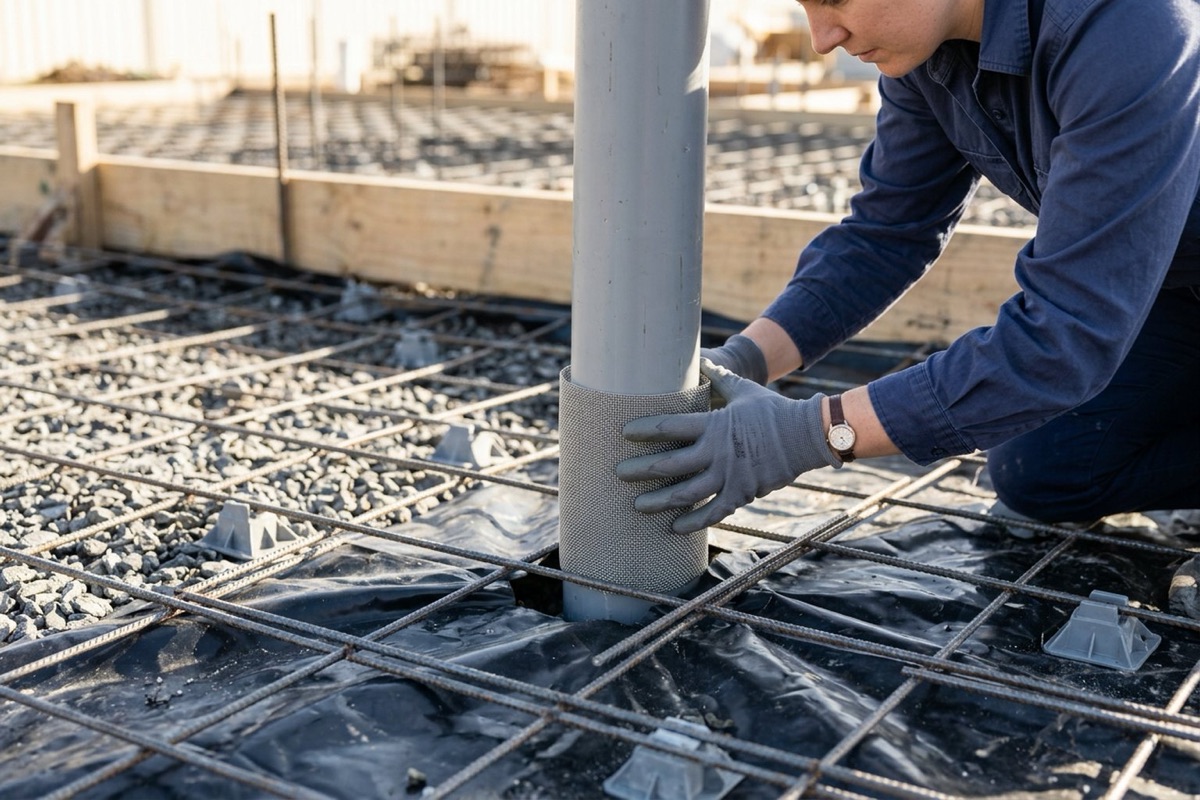
- Penetrations, control joints and the area beneath a slab. Sheet material, granular material or chemical.
- Suspended floors. Sheet material, granular material or chemical.
- Attachments to buildings. A termite management system to the attachment, or an inspection zone between the attachment and the building.
Attachments include downpipes, service pipes, steps, verandahs, porches, ramps, carports, trellises, decks, hot water systems and air-conditioners. Where a slab-on-ground is not designed and constructed in accordance with AS 2870 or AS 3600, the entire area beneath the slab must be treated.
The table works in components. A slab built to AS 2870 can be one component, but service penetrations and control joints need their own protection, and the perimeter needs another. Together they make the full system. Products range from stainless steel mesh and graded stone to chemicals, but the system must match the footing type. Our guide to site classification and footings explains how AS 2870 slabs are designed.
What extra rules apply in Queensland and the Northern Territory?
Both jurisdictions vary the national provisions.
Queensland. QLD H1P3 requires a termite management measure for a non-temporary Class 1 building to have a design life of at least 50 years, unless it is easily and readily accessible for replenishment or replacement and capable of being replenished or replaced. For other buildings the measure needs the lesser of 50 years or the building’s specified design life. The measure must also be accessible for installation, maintenance and inspection, and protected against being damaged, bridged or breached. Queensland replaces Table 3.4.2 with its own table, and where a chemical is used as an external perimeter system it must be installed by trenching, treating and backfilling with treated material, then covered by a concrete strip at least 50 mm thick and 300 mm wide from the external wall.
The NCC’s explanatory information gives an example: a hand-sprayed chemical under a slab laid directly on the ground may not satisfy QLD H1P3 if the chemical does not have a 50-year design life, because the area cannot be reached for replenishment. A reticulation system that can be topped up may satisfy it. In Queensland, chemical termite work falls under the QBCC termite management (chemical) licence class, and anyone supervising or performing it must also hold a Queensland Pest Management Licence. Physical systems fall under a separate QBCC termite management (physical) class. Other states license pest management work differently, so check local requirements.
Northern Territory. Where Mastotermes darwiniensis is prevalent, the NT variation requires additional termite risk management measures, and a chemical external perimeter system for this species must be trenched, treated, backfilled and covered by the same 50 mm by 300 mm concrete strip.
What about apartments and commercial buildings?
For Class 2 to 9 buildings, NCC 2022 Volume One deals with termites in B1D4. Where a primary building element is subject to attack by subterranean termites, B1D4 calls up AS 3660.1 and lists the same materials as not subject to attack. It also requires the same durable notice. The NT variation to B1D4 adds additional protection measures where Mastotermes darwiniensis is prevalent.
What must the durable notice say?
Clause 3.4.3 requires a durable notice to be permanently fixed to the building in a prominent location, such as a meter box, indicating:
- The system. The termite management system used.
- The date. The date the system was installed.
- Chemical life. Where a chemical is used, its life expectancy as listed on the pesticides register label.
- Inspections. The installer’s or manufacturer’s recommendations for the scope and frequency of future inspections for termite activity.
The NCC’s explanatory information says the notice should be clearly written on a material that will not deteriorate or fade, so future owners can read it. A missing or incomplete notice leaves the owner with no record of what protects the house or when it needs attention. Our guide to building defects covers how defects like this are identified and resolved.
How should termite systems be inspected and maintained?
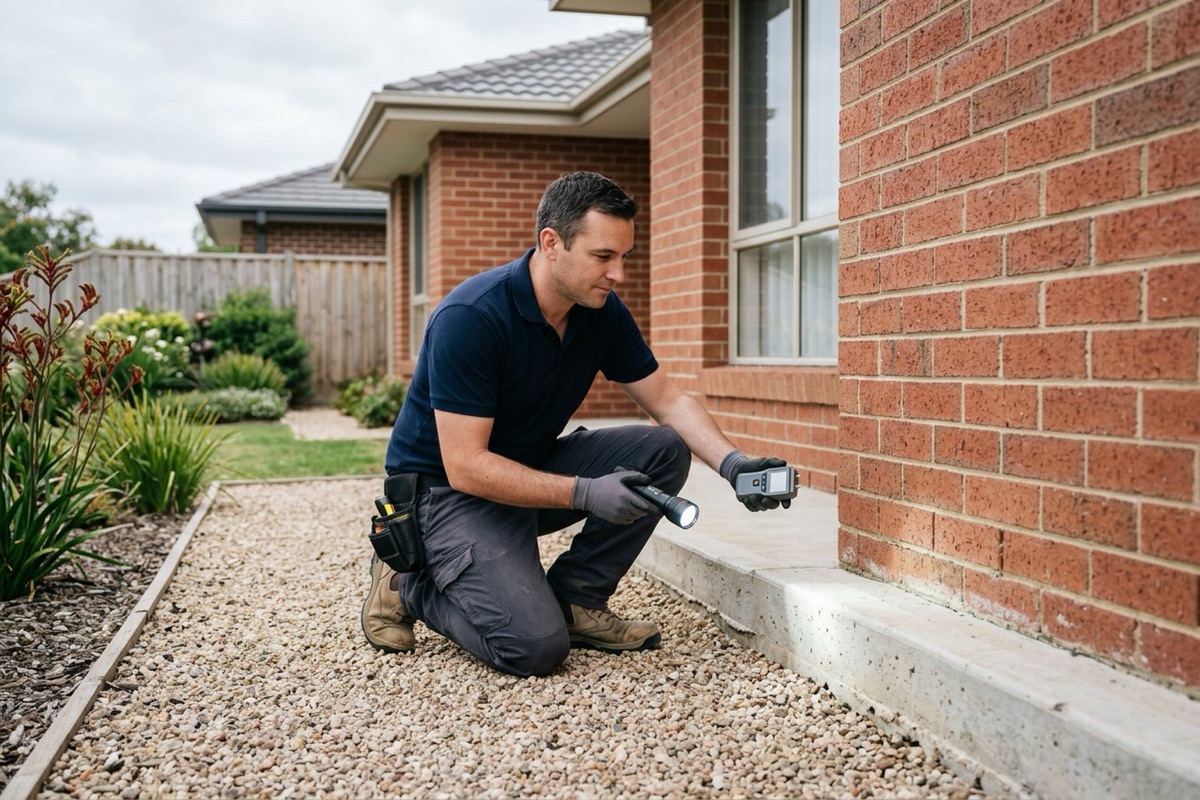
The NCC’s explanatory information is clear that a system’s effectiveness relies on regular maintenance and competent inspection, not just correct installation. The QBCC’s advice to Queensland owners is to inspect the system regularly themselves and have a licensed pest controller inspect and report every year, or more often in high hazard areas, and to meet the system’s maintenance requirements, such as chemical top-ups, as stated on the notice.
After handover, the main threat is bridging or concealment, where something gives termites a hidden path over or around the barrier or hides the evidence:
- Gardens and mulch. Garden beds or mulch built up over or above the level of the barrier.
- Paving and paths. New paths, patios or turf laid against the slab edge, hiding the exposed edge.
- Attachments. Pergolas, decks, steps or hot water units added without their own protection or inspection zone.
- Stored materials. Timber, firewood or rubbish stacked against the building.
- Damp conditions. Plumbing leaks and poor drainage that keep soil damp next to the building, which can attract termites.
When renovating, check how the work affects the existing termite management system before you start.
Termite management checklist for builders
- Confirm the risk. Check with the council whether the site is in a termite risk area.
- Identify susceptible elements. List every primary building element that is not made of an exempt material.
- Match the system. Select options from Table 3.4.2, or the Queensland table, for each element and footing type.
- Protect penetrations. Treat every service penetration and control joint before the pour.
- Check the chemical. Confirm any chemical is on the APVMA register and installed by a licensed person.
- Meet local rules. Apply the Queensland 50-year design life and NT Mastotermes provisions where relevant.
- Fix the notice. Install a durable notice with system, date, chemical life and inspection advice.
- Keep it visible. Leave slab edge exposure and inspection zones clear at handover.
- Brief the owner. Explain inspection frequency and how to avoid bridging the system.
Get termite management right first time
CPD-accredited online courses on termite management, timber framing, footings and building defects, each with an assessment and a certificate.
- Termite Management in Construction View course →
- Residential Timber Framing and Trusses View course →
- Site Classification and Footings for Residential Construction View course →
- Concrete Flooring and Treatments View course →
- Timber Decks and Balconies: Design and Construction View course →
- Building Defects: Prevention, Identification and Rectification View course →
Frequently asked questions
Do all new homes need termite protection?
No. Under Part 3.4 of the Housing Provisions, a termite management system is needed only where subterranean termites are a known risk and a primary building element is susceptible to attack. The NCC notes termites are not considered a risk in Tasmania and are a lesser risk in parts of Victoria.
Which edition of AS 3660.1 does the NCC reference?
Both NCC 2022 and NCC 2025 reference AS 3660.1-2014, Termite management Part 1: New building work, incorporating Amendment 1. Check the referenced documents schedule for the edition in force when you build.
Is a steel frame house exempt from termite management?
A primary building element made entirely of steel or other metals is considered not subject to termite attack. Only susceptible elements need a system, so check every primary element, including any timber, before deciding none is required.
What is a durable termite notice?
It is a permanent notice fixed in a prominent place such as the meter box. It records the system used, the installation date, the chemical life expectancy if a chemical is used, and the recommended scope and frequency of future inspections.
How often should a termite system be inspected?
Follow the recommendations on the durable notice. The QBCC advises Queensland owners to have a licensed pest controller inspect and report every year, or more often in high hazard areas, and to carry out any required maintenance such as chemical top-ups.
What are the extra termite rules in Queensland?
Queensland requires a termite management measure for a non-temporary house to have a design life of at least 50 years unless it can be readily replenished or replaced. Chemical perimeter systems must be trenched and covered with a concrete strip at least 50 mm thick and 300 mm wide.
Sources and further reading
- ABCB — NCC 2022 ABCB Housing Provisions, Part 3.4 Termite risk management (3.4.1 to 3.4.3, Table 3.4.2, QLD and NT variations)
- ABCB — NCC 2022 Volume Two, Part H1 Structure (H1P1, QLD H1P3, H1D3)
- ABCB — NCC 2022 Volume One, Part B1 Structural provisions (B1D4)
- ABCB — NCC 2025 ABCB Housing Provisions, Part 3.4 Termite risk management
- ABCB — NCC 2022 Housing Provisions referenced documents (AS 3660.1-2014, AS 3660.3-2014)
- Standards Australia — AS 3660.1:2014 Termite management, Part 1: New building work
- QBCC — Protect against termites
- QBCC — Termite management (chemical) licence