Concrete cracks because it is strong in compression but weak in tension, and it shrinks as it loses water. Early cracks come from plastic shrinkage and settlement while the concrete is still soft; later cracks come from drying shrinkage, temperature change, ground movement, overload and, most destructively, corrosion of the reinforcement.
Durability is designed in through AS 3600:2018, which sets concrete quality and cover according to the exposure classification of each surface, and built in on site through compaction and curing. For houses, the NCC Housing Provisions add simple rules: specified covers to the reinforcement and slab surfaces moist cured for 7 days.
Why does concrete crack at all?
Concrete resists squashing very well but resists pulling apart poorly. AS 3600:2018 goes as far as assuming, when calculating the bending strength of beams, slabs and columns, that the concrete has no tensile strength at all. Reinforcement carries the tension.
Any time concrete wants to shorten, bend or move and something stops it, tensile stress builds up. When that stress exceeds the concrete’s limited tensile capacity, it cracks. The common triggers are:
- Shrinkage as water leaves the concrete, both while it is plastic and over the months after it hardens.
- Temperature changes, including the heat of the cement reacting in thick pours.
- Restraint from footings, columns, walls, or friction with the ground.
- Ground movement under slabs and footings, especially on reactive clay.
- Load beyond what the member was designed for.
- Corrosion of the reinforcement, which expands and bursts the concrete.
Cracks are not automatically defects. Well-designed reinforced concrete is expected to crack in a controlled way: the reinforcement keeps the cracks fine and joints put them where they do no harm. The questions are how wide the cracks are, where they are, whether they are still moving and whether they let water reach the steel.
What are plastic shrinkage and plastic settlement cracks?
These happen in the first few hours, before the concrete has set.
Plastic shrinkage cracks form when water evaporates from the surface faster than bleed water replaces it. Hot, dry and windy days are the classic conditions. The cracks are often short, roughly parallel and fairly wide at the surface, and they can appear while the finishers are still on the slab.
Plastic settlement cracks form as fresh concrete settles under its own weight and is held up by something rigid, such as top reinforcement or a change in depth. The cracks often mirror the reinforcement pattern below. Poor compaction and very wet mixes make them worse.
Both are prevented on site rather than in design: protect the surface from wind and sun, use evaporation control measures where needed, compact properly, and start curing as soon as finishing allows.
What causes drying shrinkage and thermal cracking?
Once hardened, concrete keeps losing moisture for months and shortens as it does. If a slab or wall is restrained, that shortening produces cracks, often running across the shortest dimension or from re-entrant corners.
Designers manage drying shrinkage with reinforcement and joints. AS 3600:2018 requires the design of slabs on ground to consider, among other things, techniques to control and minimise cracking and shrinkage warping. Its movement joint provisions require joints to control movement, control cracking at design locations, or separate members, without impairing strength or serviceability.
Those joints only work if they are built. Building Commission NSW’s Building Defects Library lists slabs on ground without the saw-cut or isolation joints shown on the approved plans, and movement joints in suspended slabs not built as designed, as recurring defects. It also cautions that not every slab needs saw cuts, so the approved plans are the reference.
Thermal cracking matters most in thick pours, where the core heats up as the cement reacts and the surface cools first. Large pours and transfer slabs need a designed approach to mix, pour sequence and protection.
When do cracks signal a structural problem?
Some crack patterns point to something more serious than shrinkage:
- Settlement or heave. Diagonal or stepped cracks, sticking doors and uneven floors suggest the footing or the ground under it has moved. Our guide to site classification and footings explains how reactive soils cause this.
- Overload. Wide cracks at mid-span on the underside of a slab or beam, or near supports, can mean the member is carrying more than it was designed for.
- Cut reinforcement. The Building Defects Library lists reinforcement cut or damaged during work, often when coring or chasing without scanning first. Because the concrete is assumed to carry no tension, cutting bars can compromise the member.
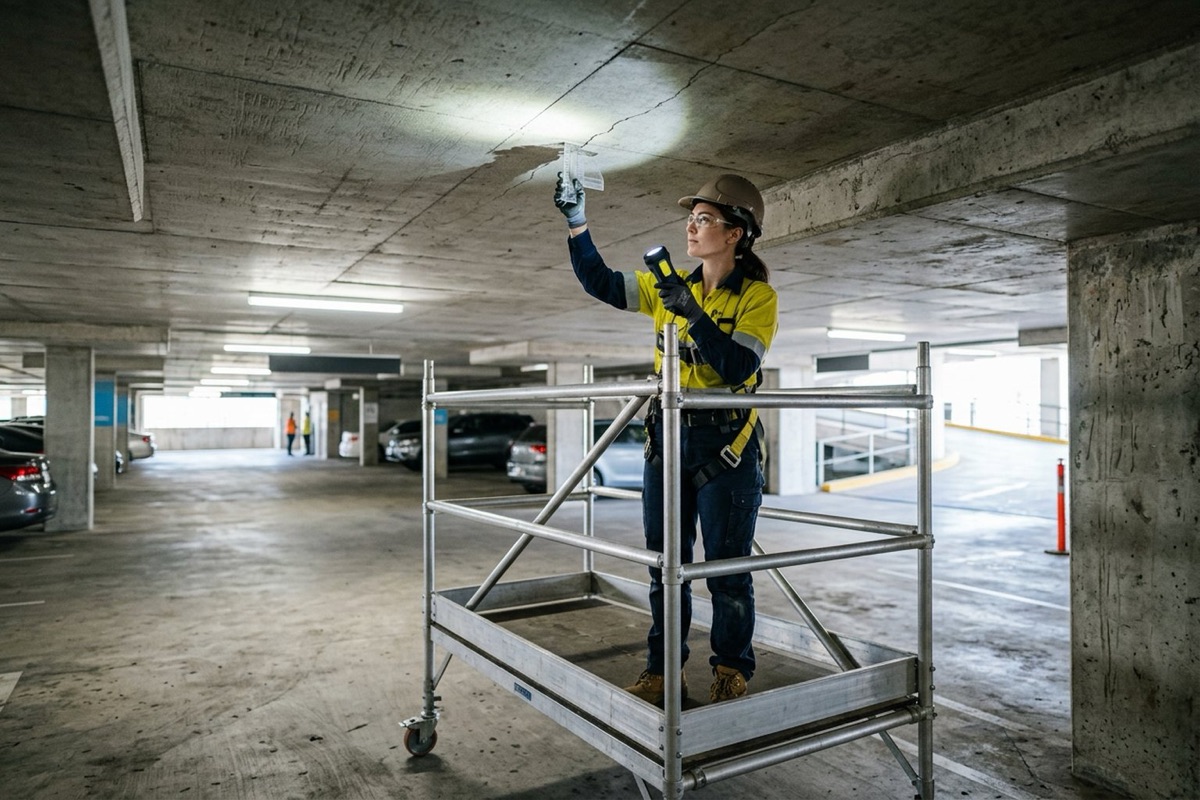
- Corrosion. Cracks running along the line of a bar, rust staining and drummy or spalling concrete all suggest the steel is corroding.
Any of these warrants assessment by a structural engineer rather than a patch and paint.
How does reinforcement corrosion destroy concrete?
Concrete normally protects steel chemically: its high alkalinity forms a passive film on the bars. Two processes break that protection down over time.
- Carbonation. Carbon dioxide from the air slowly reacts with the cement paste, lowering its alkalinity from the surface inwards. When the carbonated zone reaches the steel, the bars can start to corrode.
- Chlorides. Salt from seawater, sea spray, de-icing salts or contaminated materials penetrates the concrete. Once enough chloride reaches the steel, corrosion can begin even in alkaline concrete.
Rust occupies more volume than the steel it replaces, so corroding bars crack and spall the cover concrete. Those cracks let in more water and salt, and deterioration accelerates. This is why leaking balconies and podiums so often end with concrete repair as well as new waterproofing. See our guide to why balconies leak.
The two defences are the same in every case: enough cover of dense, well-compacted and properly cured concrete between the steel and the outside world.
What are exposure classifications and cover in AS 3600?
AS 3600:2018 Concrete structures is the standard the NCC calls up for concrete design (B1D4 of NCC 2022 Volume One). Its current version incorporates Amendment 1 (2018) and Amendment 2 (2021). Its durability provisions, in Section 4, work in three steps:
- Classify the exposure of each surface. The classifications run from A1 and A2 (benign), through B1 and B2, to C1 and C2 (most aggressive), plus U for conditions the table does not cover. In marine settings, for example, B2 covers coastal locations within 1 km of the coastline, C1 the spray zone and C2 the tidal and splash zone. Aggressive soils have their own classification tables.
- Specify the concrete quality that the exposure classification requires, including minimum strength and curing.
- Specify the cover. The required cover depends on the exposure classification and the concrete strength. Fire resistance can separately govern the axis distance to the reinforcement under Section 5.
The tabulated values in AS 3600 are based on a design life of about 50 years. Structures with longer design lives, such as bridges, use other standards or engineered durability assessments. The C exposure classification was split into C1 and C2 in the 2009 edition.
Why does curing matter so much?
Curing keeps moisture in the concrete so the cement keeps hydrating. Poorly cured surfaces are weaker, more porous and more prone to cracking, and that porous outer layer is exactly the cover zone that protects the steel.
The requirements are explicit:
- AS 3600:2018 requires freshly cast concrete to be protected from rain, running water, freezing and drying before hardening, and from freezing or drying during the initial curing period. The Building Defects Library lists concrete placed in rain without protection as a structural defect.
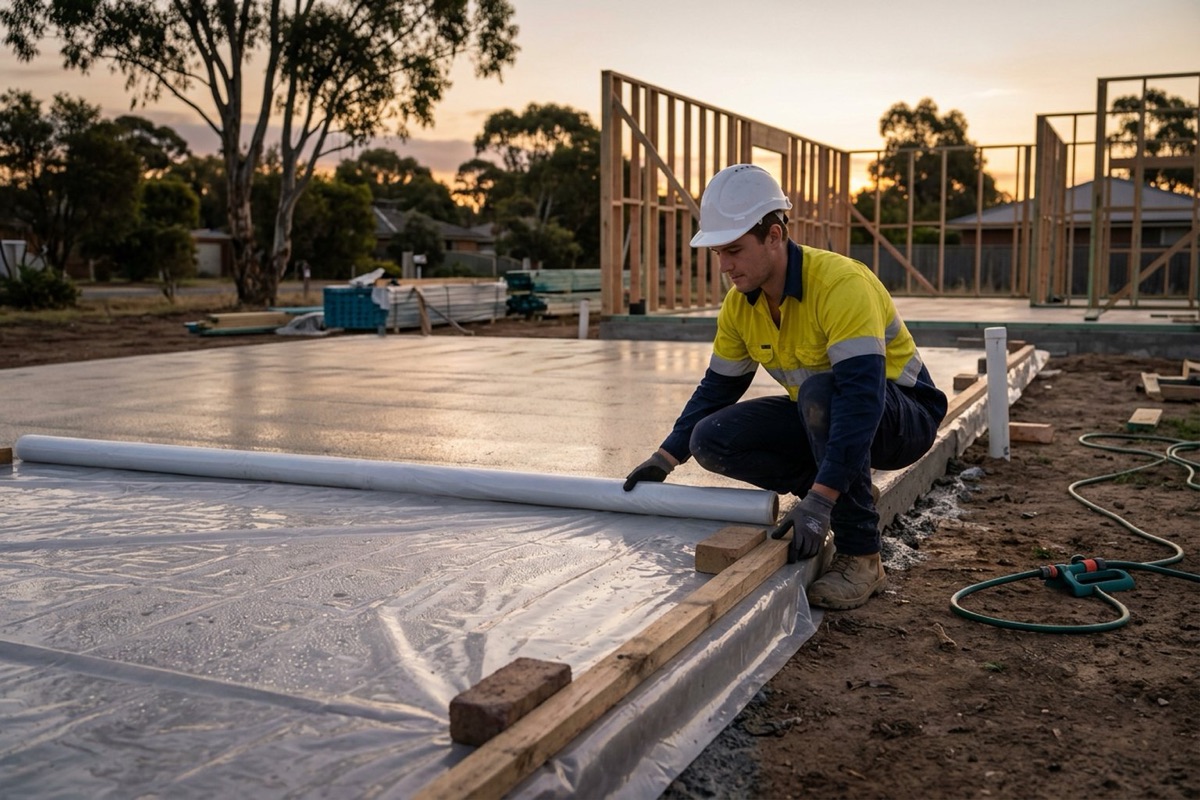
- NCC 2022 Housing Provisions 4.2.10 requires concrete in slabs to be adequately compacted, and slab surfaces, including edges, to be moist cured for 7 days.
- Compaction is part of the same picture. AS 3600 requires concrete to completely fill the formwork, expel entrapped air and closely surround all reinforcement. Honeycombing and exposed reinforcement are among the most common structural defects in the library.
Curing methods include ponding or sprinkling, wet hessian, plastic sheeting and curing compounds compatible with the floor finish. Whatever the method, it must start promptly and continue for the full period.
What crack widths are acceptable in a house slab?
For houses, AS 2870-2011 Residential slabs and footings includes an appendix classifying damage to walls and to concrete floors caused by foundation movement. Builders, inspectors and tribunals use these categories, alongside each state’s standards and tolerances, to judge whether cracking is within normal limits.
As a practical guide, Queensland’s regulator, the QBCC, treats hairline cracks under 2 mm wide in concrete floors as acceptable in its home maintenance guide, and cracks wider than 2 mm as not acceptable and a sign of a possible subsidence problem. Wall cracking has its own scale, covered in our guide to building defects.
Width is only part of the story. Record the location, length and width with a crack-width gauge and dated photos, then re-measure over the seasons. A crack that keeps growing is telling you something a single measurement cannot.
Concrete durability checklist
- Confirm the exposure classification for every surface, including coastal and aggressive soil conditions.
- Specify strength and cover to match the exposure classification and fire requirements.
- Detail joints and build saw-cut, isolation and movement joints exactly as the drawings show.
- Chair the reinforcement so cover is achieved and maintained during the pour.
- Inspect before pouring at a hold point: reinforcement, cover, cleanliness and embedded items.
- Protect the pour from rain, wind and sun, and do not pour in rain without a plan.
- Compact thoroughly to avoid honeycombing and voids around the steel.
- Cure for the full period the specification and the NCC require, including slab edges.
- Scan before coring or cutting so reinforcement is not damaged.
Design and build concrete that lasts
CPD-accredited online courses on concrete durability, robust concrete design, slabs and footings, and building defects, each with an assessment and a certificate.
- Durability of Concrete Structures View course →
- Designing Robust Concrete Structures: An Introduction View course →
- Concrete Flooring and Treatments View course →
- Site Classification and Footings for Residential Construction View course →
- Building Defects: Prevention, Identification and Rectification View course →
Frequently asked questions
Is it normal for a new concrete slab to crack?
Some fine cracking is normal because concrete shrinks as it dries. Hairline cracks are usually not structural. Wide cracks, cracks with displacement, or cracks that keep growing should be assessed.
What is the difference between plastic shrinkage and drying shrinkage cracks?
Plastic shrinkage cracks form within hours, while the concrete is still soft, when surface water evaporates too fast. Drying shrinkage cracks form over weeks and months as hardened concrete loses moisture and shortens against restraint.
What does exposure classification mean in AS 3600?
It is the rating of how aggressive the environment is for each concrete surface, from A1 and A2 for benign conditions to C1 and C2 for marine spray and tidal zones, plus U for unusual conditions. The classification sets the required concrete quality and cover.
How long should a concrete slab be cured?
For houses under the NCC 2022 Housing Provisions, slab surfaces including edges must be moist cured for 7 days. Other structures should follow AS 3600 and the project specification.
What concrete cover does a house slab need?
Under NCC 2022 Housing Provisions 4.2.11, cover is at least 40 mm to unprotected ground, 30 mm to a membrane in contact with the ground, 20 mm to an internal surface and 40 mm to external exposure.
Why does rust staining on concrete matter?
Rust staining or cracks along the line of a bar suggest the reinforcement is corroding. Corrosion expands the steel, cracks and spalls the concrete and weakens the member, so it should be investigated by an engineer.
Sources and further reading
- ABCB — NCC 2022 Volume One, Part B1 Structural provisions (B1D4)
- ABCB — NCC 2022 Housing Provisions, Part 4.2 Footings, slabs and associated elements
- Standards Australia — AS 3600:2018 Concrete structures
- Standards Australia — AS 3600:2018 Amd 2:2021
- Building Commission NSW — Building Defects Library (v1.1, June 2025), structural defects
- Concrete Institute of Australia, Concrete 2021 — Concrete cover: the what, where and when
- QBCC — Your essential guide to home maintenance