Most waterproofing defects come from a handful of details: membranes not terminated into drains or overflows, poor falls that leave water ponding, inadequate upturns at sliding doors and wet area thresholds, and poorly prepared substrates. Building Commission NSW’s Building Defects Library lists exactly these, and its strata surveys rank waterproofing as the most prevalent serious defect in newer apartment buildings.
Liability usually sits with the builder first, under the contract and the statutory warranties that state laws imply into residential building work. In NSW a waterproofing defect can be a major defect with a 6-year warranty period (2 years for other defects), and in Victoria the warranties apply for up to 10 years after the occupancy permit or certificate of final inspection.
Why are waterproofing defects so common and so costly?
Waterproofing is a thin layer doing a critical job, and it is almost always hidden. A membrane is laid, then tiled over, screeded over or backfilled within days. If it is breached, misdetailed or poorly bonded, nobody sees it until water appears somewhere else: a stained ceiling below, swollen skirting, efflorescence on a slab soffit, mould behind a wardrobe or corroded reinforcement.
By then the fix rarely involves just the membrane. Tiles, screeds, balustrade fixings, linings and sometimes structure must come out, often in an occupied building. That is why waterproofing failures generate disputes out of proportion to the cost of the membrane itself.
The NSW evidence is clear. In research by Building Commission NSW with Strata Community Association NSW, waterproofing defects were the most prevalent serious defect in the 2023 survey and again in the 2025 survey of strata schemes registered between July 2018 and June 2024 (22 per cent). The fall is encouraging, but the two surveys covered different groups of buildings, and waterproofing still tops the list.
What are the most common waterproofing defects?
Building Commission NSW’s Building Defects Library (v1.1, June 2025, based on NCC 2022) sets out common defects in Class 2, 3 and 9c buildings. Its waterproofing section lists:
- Membrane not terminated into a puddle flange draining an external roof or balcony.
- Membrane not terminated into an overflow.
- Retained water, ponding or inadequate falls on a roof or balcony.
- Inadequate surface preparation on an external surface or roof.
- Inadequate termination of the membrane at a sliding door.
- Ponding or inadequate falls in the general bathroom area and in the shower area.
- No waterstop angle at a doorway to a wet area.
- Puddle flange for an internal membrane not recessed into the substrate.
- Incorrect fillet size at the wall to floor junction.
Across houses and apartments, the same failures turn up by location:
- Wet areas: membranes stopping short at the shower or floor perimeter, unsealed penetrations for taps and pipes, missing bond breakers at junctions, and tiling over a membrane before it has cured.
- Balconies and roof decks: inadequate set-down or upturn at door sills, drains set too high to collect water, missing overflows and balustrade posts fixed through the membrane. Our guide to why balconies leak goes into these.
- Planter boxes: membranes damaged by roots or backfill, blocked drainage cells and joints running beneath the planter.
- Below-ground walls and basements: membranes damaged during backfilling, poor detailing at construction joints and penetrations, and the wrong system for the groundwater conditions.
- Window and door junctions: missing or reversed sill flashings and gaps between frame and membrane, which let water bypass the waterproofing entirely.
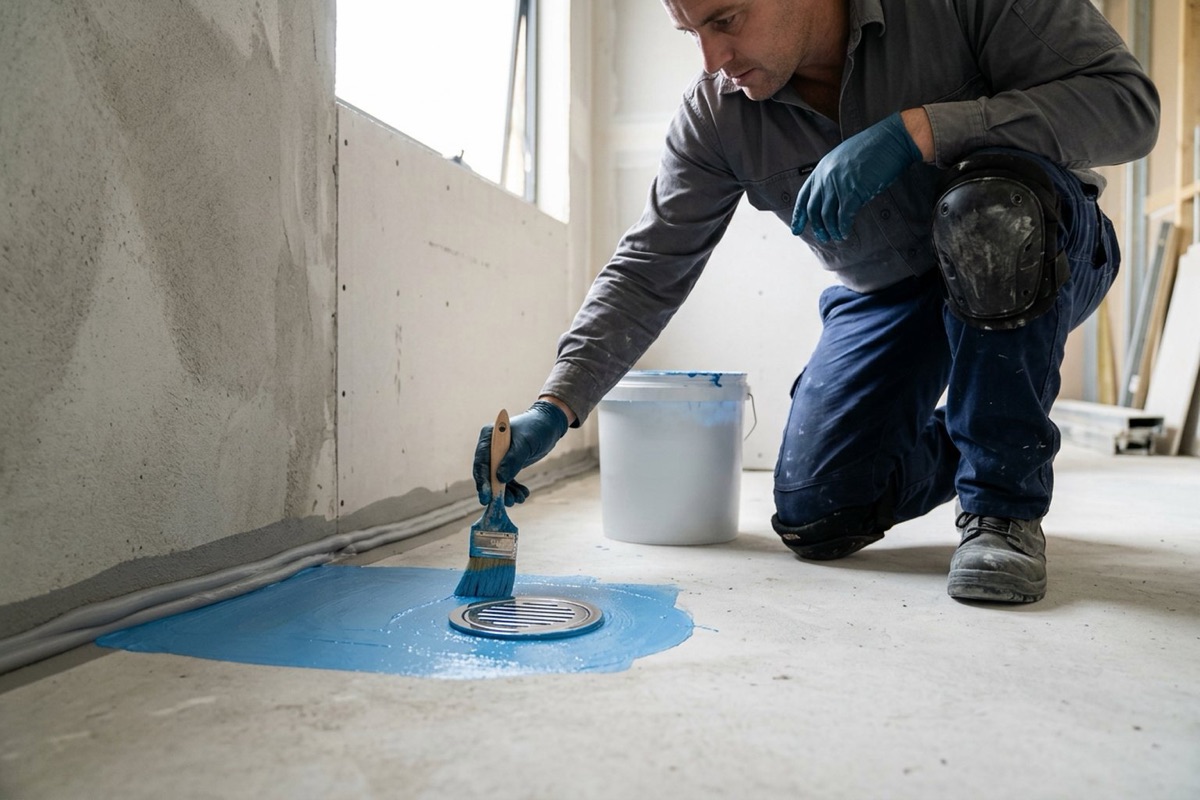
Why do they happen?
The root causes repeat across projects:
- Design gaps. Drawings that show “waterproof membrane” with no detail at drains, thresholds, upturns or junctions leave the waterproofer to improvise.
- Sequencing and trade interfaces. Plumbers, tilers, glaziers, balustrade installers and waterproofers all work on the same few square metres. Each later trade can damage or penetrate the membrane.
- Levels set wrong. If the slab or screed is not set with adequate falls and set-downs, no membrane will compensate.
- Substrate and curing. Membranes applied to wet, dusty or uneven surfaces, or covered before curing, fail to bond.
- Product mismatch. Using a membrane outside its tested application, or mixing incompatible products in one system.
- No hold point. The membrane is covered before anyone inspects or flood tests it.
What do the NCC and Australian Standards require?
The requirements depend on the building and the location of the waterproofing. The clause numbers below are from NCC 2022.
- Wet areas in houses (Class 1). Performance Requirement H4P1 in Volume Two is met by the Deemed-to-Satisfy route through the ABCB Housing Provisions. There are two options: Part 10.2 in full (10.2.1 to 10.2.32), or clauses 10.2.1 to 10.2.6 and 10.2.12 combined with AS 3740:2021 Waterproofing of domestic wet areas. The ABCB notes that the 2021 edition is the one referenced in NCC 2022. Our guide to waterproofing wet areas covers the detail.
- Roofs, balconies, podiums and similar horizontal surfaces (Volume One). F1D5 requires a waterproofing membrane of materials complying with AS 4654.1 and designed and installed in accordance with AS 4654.2. Standards Australia lists AS 4654.2-2012 as the current edition, marked as pending revision.
- Exposed joints (Volume One). F1D4, new in NCC 2022, requires exposed joints in the drainage surface of a roof, balcony, podium or similar surface to be protected in accordance with Section 2.9 of AS 4654.2, and not located beneath or running through a planter box, water feature or similar part of the building.
Who is liable for a waterproofing defect?
Liability usually runs along the contract chain, with statute layered on top:
- The builder is usually the owner’s first point of claim. For residential work, state laws imply statutory warranties, which typically cover work done with due care and skill, in accordance with the plans and the law, and with suitable materials. The builder carries these even when a subcontractor did the waterproofing.
- The waterproofer and other subcontractors are generally liable to the builder under their subcontracts, not directly to the owner.
- Designers can be liable for defective details. In NSW, the Design and Building Practitioners Act 2020 imposes a duty on a person who carries out construction work to exercise reasonable care to avoid economic loss caused by defects, owed to each owner and subsequent owner of the land, and that duty cannot be delegated.
- Manufacturers and suppliers may be liable where a product itself failed or was misrepresented, but most failures trace back to design or installation.
How long the exposure lasts depends on the state:
- New South Wales: the Home Building Act 1989 sets a statutory warranty period of 6 years for a major defect and 2 years for other defects, from completion of the work. Waterproofing is a “major element”, but a defect is only a major defect if it causes, or is likely to cause, consequences such as the building being unusable for its intended purpose. A leaking shower may therefore fall into the 2-year category. Where a breach becomes apparent in the last 6 months of the period, there is an extra 6 months to commence proceedings.
- Victoria: Consumer Affairs Victoria states that the statutory building warranties apply for up to 10 years after the occupancy permit or certificate of final inspection was issued, even if the property is sold several times.
- Other states and territories set their own warranty periods and claim deadlines. Check with the regulator where the work was done.
Home warranty insurance sits alongside these warranties. In NSW, for example, icare describes it as last-resort cover for incomplete or defective work where the builder has become insolvent, died, disappeared or had their licence suspended for failing to comply with a tribunal or court money order. Our guide to home warranty insurance explains how it works.
What does NSW do differently?
NSW has made waterproofing a regulatory priority, especially in apartments:
- Licensing. You need a contractor licence for residential waterproofing work valued at more than $5,000, and waterproofing has its own licence category with specified Certificate III qualifications.
- Regulated design. The Design and Building Practitioners Act 2020 treats waterproofing as a defined building element, bringing it within the design and compliance declaration scheme for the buildings the Act covers.
- Enforcement. Building Commission NSW publishes the Building Defects Library and, where major defects are confirmed through inspection, may issue a rectification order describing the required work and deadlines.
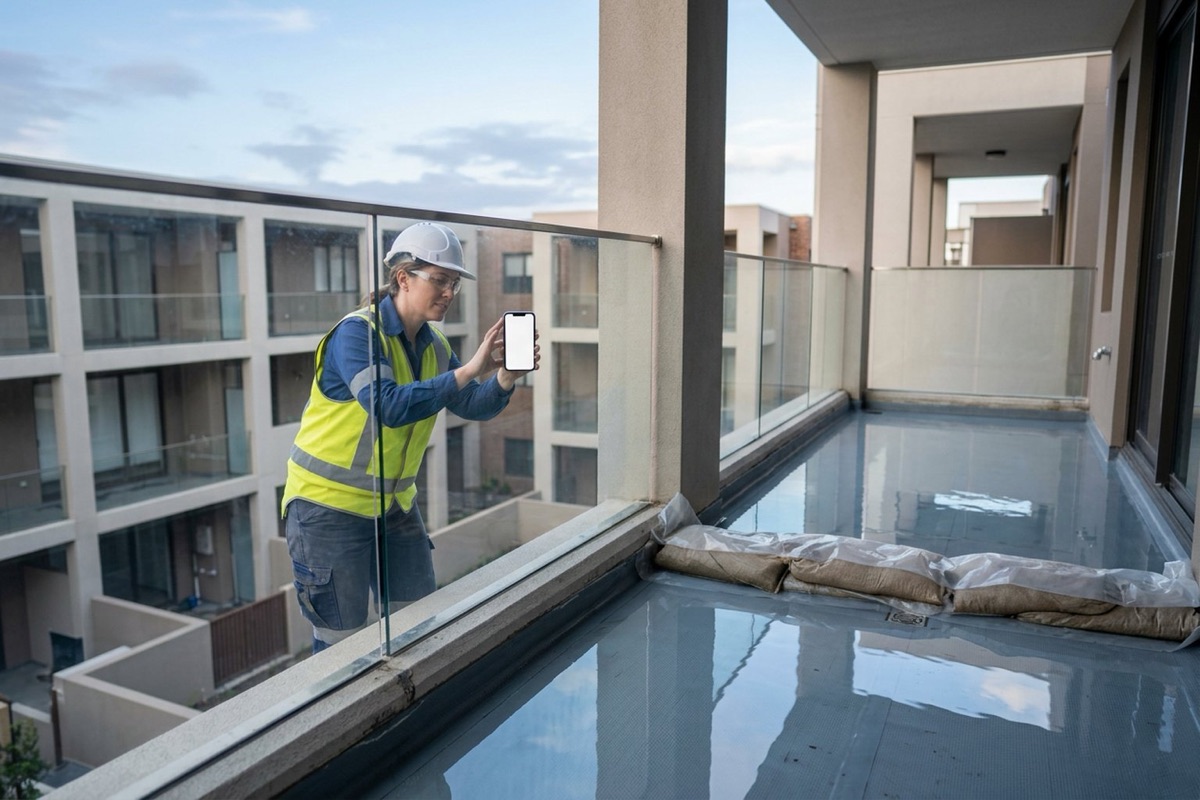
How should defects be inspected and evidenced?
Disputes are won or lost on evidence, and most of it can only be gathered before the membrane is covered:
- Hold points. Inspect substrate, falls, puddle flanges and upturns before the membrane goes on, and again before tiling or screeding.
- Flood testing. Where the specification or standard calls for it, flood test wet areas and balconies and record the duration and result.
- Photographs. Take dated photos of every drain, threshold, penetration and junction, with enough context to locate them later.
- Product records. Keep data sheets, the system specification and any manufacturer installation requirements.
- Certificates. Keep the waterproofer’s installation certificate and licence details.
For an existing defect, investigate before demolishing: moisture mapping, thermal imaging and targeted water testing can isolate the source and avoid replacing work that was never at fault. Our guide to building defects in Australia covers the wider process.
Waterproofing defect prevention checklist
- Detail every junction on the drawings: drains, overflows, thresholds, upturns, penetrations and movement joints.
- Confirm the NCC edition and the edition of AS 3740 or AS 4654 that applies.
- Set falls and set-downs in the structure or screed before waterproofing starts.
- Use a licensed waterproofer and a complete, compatible membrane system.
- Keep joints out from under planters and protect exposed joints as AS 4654.2 requires.
- Inspect at hold points and flood test before covering.
- Control later trades so balustrades, fixings and services do not puncture the membrane.
- Hand over the records: photos, test results, product data and certificates.
Stop waterproofing defects before they start
CPD-accredited online courses on wet area, balcony, external and below-ground waterproofing and on building defects, each with an assessment and a certificate.
- Building Defects: Prevention, Identification and Rectification View course →
- Waterproofing Internal Wet Areas View course →
- Diagnosing and Fixing Leaking Balconies View course →
- External Above-Ground Waterproofing View course →
- Below-Ground Waterproofing View course →
- Joint Sealant Design and Application View course →
- External Wall Weatherproofing Design View course →
Frequently asked questions
What is the most common waterproofing defect?
In Building Commission NSW research on newer apartment buildings, waterproofing is the most prevalent serious defect overall. Within it, the Building Defects Library highlights membranes not terminated into puddle flanges or overflows, inadequate falls and poor termination at sliding doors.
Which Australian Standard covers wet area waterproofing?
AS 3740:2021 Waterproofing of domestic wet areas, which is the edition referenced in NCC 2022. Houses can also comply with the full Part 10.2 of the ABCB Housing Provisions instead.
Which standard applies to balcony waterproofing?
For roofs, balconies, podiums and similar surfaces under NCC 2022 Volume One, F1D5 requires membrane materials complying with AS 4654.1 and design and installation in accordance with AS 4654.2.
How long is a builder liable for a leaking shower in NSW?
Under the NSW Home Building Act, the statutory warranty period is 6 years for a major defect and 2 years for other defects. A leaking shower is often treated as a non-major defect unless it causes serious consequences such as making the building unusable for its intended purpose.
How long do building warranties last in Victoria?
Consumer Affairs Victoria states that the statutory building warranties apply for up to 10 years after the occupancy permit or certificate of final inspection was issued, including for later owners.
Is the waterproofer or the builder liable?
The owner usually claims against the builder, who is bound by the contract and the statutory warranties. The builder may then recover from the waterproofer under the subcontract. Designers can also be liable for defective details.
Sources and further reading
- ABCB — NCC 2022 Volume One, Part F1 Surface water management, rising damp and external waterproofing (F1D4, F1D5)
- ABCB — NCC 2022 Housing Provisions, Part 10.2 Wet area waterproofing
- ABCB — NCC Navigator: Waterproofing in houses
- Standards Australia — AS 3740:2021 Waterproofing of domestic wet areas
- Standards Australia — AS 4654.2-2012 Waterproofing membranes for external above-ground use, Part 2: Design and installation
- Building Commission NSW — Building Defects Library (v1.1, June 2025)
- Building Commission NSW — Research on serious building defects in NSW strata communities
- Building Commission NSW — How Building Commission NSW deals with building defect complaints
- NSW Government — Waterproofing work licences
- Consumer Affairs Victoria — Building problems after property settlement
- icare NSW — What is icare HBCF and why do I need it?
- NSW Legislation — Design and Building Practitioners Act 2020