In Australia, the external walls of buildings required to be Type A or Type B construction must be non-combustible under the National Construction Code (NCC), including the facade covering, framing and insulation. Combustible cladding, particularly aluminium composite panels (ACP) with a polyethylene core and rendered expanded polystyrene (EPS), was widely used despite that rule, and fires showed how quickly it can carry flame up a building.
Victoria and New South Wales have since banned high-risk ACP on new multi-storey buildings, Queensland requires owners of certain buildings to assess their cladding, and state programs have funded or managed remediation. Any new external wall on a Type A or B building needs evidence that every component is non-combustible, or a properly verified Performance Solution.
Why did combustible cladding become a national issue?
Two fires turned cladding from a technical question into a national one.
- Lacrosse, Melbourne, 25 November 2014. A fire on a balcony of the 23-storey Lacrosse apartment building in Docklands spread rapidly up the facade. According to the Victorian Cladding Taskforce, the cause was a cigarette that had not been extinguished, disposed of in a plastic container, and there were no casualties.
- Grenfell Tower, London, 14 June 2017. A fire in a 24-storey residential block spread across the building’s cladding and caused 72 deaths. It is outside Australia’s regulatory system, but it changed how governments here treated the issue.
Within weeks of Grenfell, the Victorian Government established the Victorian Cladding Taskforce on 3 July 2017 to investigate non-compliant external wall cladding across the state. On 6 October 2017, the then Building Ministers’ Forum agreed that Ministers would use their available laws and powers to prevent the use of ACP with a polyethylene core on most types of multi-storey buildings.
The NCC already required non-combustible external walls on these buildings, so the problem was largely one of compliance: product selection, evidence, certification and enforcement.
What does the NCC require for external walls?
The starting point is the building’s Type of construction. Under C2D2 and Table C2D2 of NCC Volume One, Type A applies to buildings with a rise in storeys of four or more, and to Class 2, 3 and 9 buildings of three storeys; Type B applies to Class 2, 3 and 9 buildings of two storeys and Class 5 to 8 buildings of three storeys. Classification matters here, and our guide to NCC building classifications explains how it is decided.
Then C2D10(1) applies. In a building required to be Type A or B construction, external walls and common walls, including all components incorporated in them including the facade covering, framing and insulation, must be non-combustible.
C2D10 sets out exceptions for minor components, including gaskets, sealants, caulking, glass, damp-proof courses, paint and similar coatings, isolated packers and fixings, and limited thermal breaks, joint trims and fillers. These exceptions are narrow. They do not allow a combustible cladding panel or combustible insulation to be used in the wall.
C2D14 adds a related limit on ancillary elements: they must not be fixed to, installed on or supported by an external wall required to be non-combustible unless they are non-combustible or fall within a listed exception, such as gutters, downpipes, flashings, light fittings and certain signs.
What does "non-combustible" mean, and what is the AS 1530.1 test?
The NCC defines a non-combustible material as one not deemed combustible as determined by AS 1530.1, the combustibility test for materials. A form of construction is non-combustible only if it is built wholly of materials that are not deemed combustible.
NCC 2025 refines that definition: the determination is to be made by an Accredited Testing Laboratory, with a note that this need not apply until the next edition of the NCC is adopted.
The NCC also deems some materials acceptable without testing. C2D10(5) lists materials that, when composed entirely of themselves, are non-combustible, including concrete, steel, masonry, aluminium, autoclaved aerated concrete, terracotta, ceramic and natural stone. C2D10(6) allows plasterboard, fibre-reinforced cement sheeting, fibrous-plaster sheet and some thin pre-finished metal sheeting and sarking to be used wherever a non-combustible material is required.
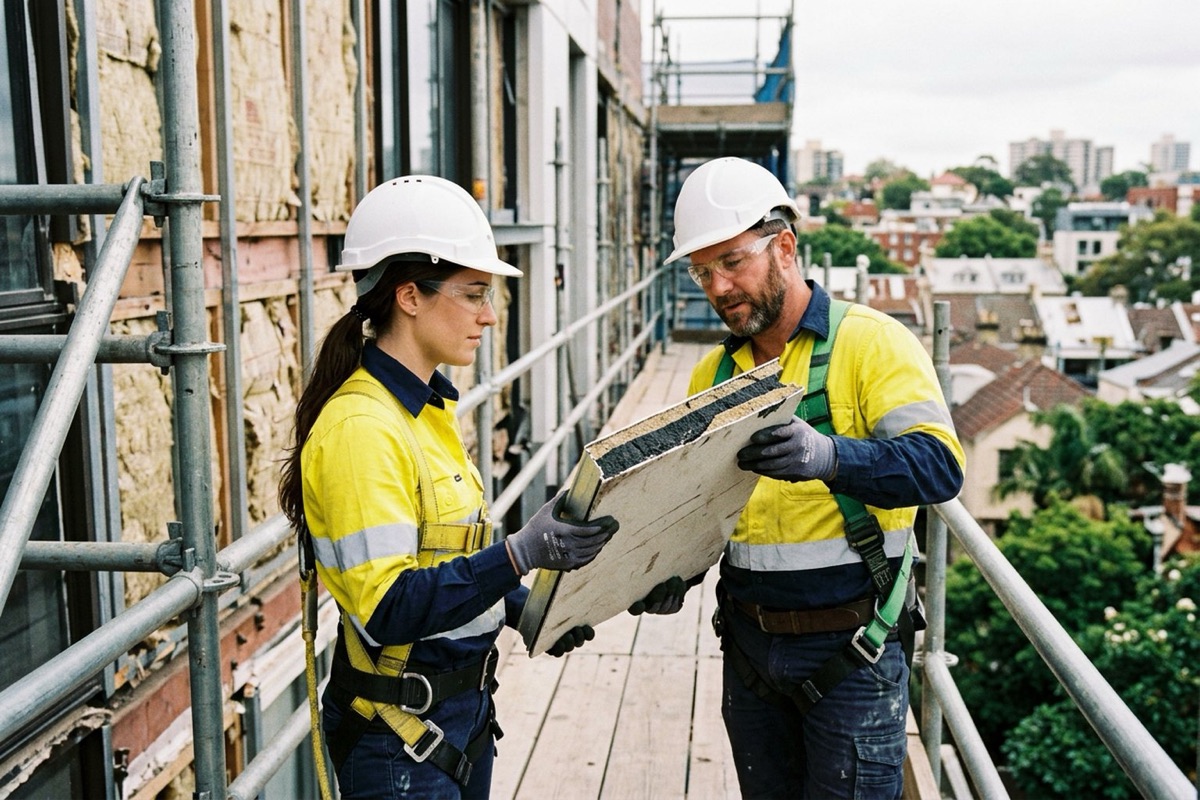
Bonded laminated materials, which include composite panels, can be used only if every lamina, including any core, is non-combustible, the adhesive layers are within strict thickness limits, and the product as a whole achieves a Spread-of-Flame Index of 0 and a Smoke-Developed Index not more than 3. An aluminium skin over a combustible core does not meet that test.
Can a combustible external wall comply through a Performance Solution?
It can, but the bar is high. The relevant Performance Requirement is C1P2, which deals with spread of fire. NCC Volume One provides a Verification Method, C1V3, for fire spread via external walls.
C1V3 is met when, among other things, the external wall system has been tested to AS 5113 and achieved the EW classification, cavity barriers have been included in the test where the wall has a cavity, and, in a Type A building, the building is sprinkler-protected throughout to Specification 17, with sprinkler protection to balconies and further requirements for taller buildings.
Any Performance Solution for an external wall needs a full, documented case agreed with the building surveyor or certifier. The ABCB’s advisory note on fire performance of external walls and cladding explains how the DTS Provisions apply and is a useful starting point.
Which states have banned combustible cladding?
The rules differ, so name the state before you specify a product.
- New South Wales. A building product use ban under the Building Products (Safety) Act 2017 took effect on 15 August 2018. It bans ACP with a core of more than 30 per cent polyethylene by mass in any external cladding, external wall, external insulation, facade or rendered finish on Type A buildings (Class 2, 3 and 9 of three or more storeys, Class 5 to 8 of four or more) and Type B buildings (Class 2, 3 and 9 of two or more storeys, Class 5 to 8 of three or more). Products that pass AS 1530.1 or AS 5113 testing and are installed as tested are excepted. Penalties are up to $1.1 million for corporations and $220,000 for individuals.
- Victoria. From 1 February 2021, a Ministerial declaration under the Building Act 1993 prohibits ACP with a core of less than 93 per cent inert mineral filler by mass in external cladding as part of a wall system, and EPS in external insulation and finish (rendered) wall systems, on buildings of Type A or B construction. The Victorian Government’s announcement describes this as covering apartment buildings, hotels and aged care with two or more storeys, and offices, shops, warehouses, factories and car parks with three or more storeys. It does not apply retrospectively to cladding already installed or approved before 1 February 2021.
- Queensland. Rather than a product ban, Queensland requires owners of certain existing buildings to identify combustible cladding through the Safer Buildings program (below), and places duties on everyone in the building product supply chain.
The NCC itself now defines a combustible cladding product as ACP with a core of less than 93 per cent inert mineral filler by mass in external cladding as part of a wall system, and EPS products used in an external insulation and finish (rendered) wall system.
What remediation programs exist for existing buildings?
Each state has taken its own approach.
- Victoria — Cladding Safety Victoria. Announced in July 2019 and established as a statutory authority on 1 December 2020, Cladding Safety Victoria delivered the Cladding Rectification Program for residential apartment and publicly owned buildings. The Parliament of Victoria reports more than 1,600 buildings rectified, representing about 83,000 homes. The Cladding Safety Victoria Repeal Bill 2026 abolishes it as a standalone agency and transfers its remaining functions to the Building and Plumbing Commission.
- New South Wales — Project Remediate. A voluntary program, now run by the Building Commission NSW, offering 10-year interest-free loans to remove high-risk combustible cladding from eligible Class 2 residential apartment buildings. Registrations have closed.
- Queensland — Safer Buildings. Owners of privately owned Class 2 to 9 buildings of Type A or B construction, with a building development approval given after 1 January 1994 but before 1 October 2018 for building work to build the building or alter its cladding, must complete a combustible cladding checklist. The deadline to complete it without penalty closed on 3 May 2021, but the obligation remains.
For owners outside these programs, remediation is usually driven by orders from a council or the state regulator, followed by a building permit for replacement cladding that must meet the NCC in force at the time.
Who is responsible for building products?
A compliant design can still end in a non-compliant building if products are swapped, so responsibility now runs through the supply chain.
- Queensland has the most explicit regime. Under Part 6AA of the Queensland Building and Construction Commission Act 1991, everyone who designs, manufactures, imports, supplies or installs a building product is in the chain of responsibility. The QBCC states that a suspected non-conforming building product must be reported as soon as practicable and no later than two days after becoming aware of it.
- New South Wales can ban unsafe building products under the Building Products (Safety) Act 2017, as it did for ACP.
- Victoria can prohibit high-risk cladding products by Ministerial declaration under the Building Act 1993.
In every state, specify the wall system precisely, require evidence for every component, and accept no substitute without equal evidence and the certifier’s agreement.
External wall compliance checklist
- Confirm the Type of construction. Check the classification and rise in storeys against Table C2D2.
- List every wall component. Include cladding, framing, insulation, sarking, cavity barriers and fixings.
- Hold evidence for each. Obtain AS 1530.1 test results, deemed non-combustible status or other evidence of suitability.
- Check the state ban. Confirm the product is not prohibited in your state for that building.
- Control substitutions. Require written approval and equal evidence before any product change.
- Check ancillary elements. Confirm signs, awnings and attachments comply with C2D14.
- Document Performance Solutions. Base any external wall Performance Solution on AS 5113 testing and an agreed brief.
- Keep the records. Hand the owner the full external wall evidence pack.
Understand cladding risk and remediation
CPD-accredited online courses on external wall fire safety, non-combustible construction and cladding remediation, each with an assessment and a certificate.
- Cladding: Fire Safety and Remediation View course →
- Combustible Cladding Remediation in Practice View course →
- Non-Combustible External Walls: Materials and Evidence of Compliance View course →
- The Behaviour of Fire in Buildings View course →
- Fire Safety Upgrades and Reforms View course →
- Passive Fire Protection and Fire-Stopping View course →
Frequently asked questions
Is combustible cladding illegal in Australia?
The NCC requires the external walls of Type A and Type B buildings, including cladding, to be non-combustible unless a Performance Solution is approved. Victoria and New South Wales also ban specific high-risk aluminium composite panels on certain buildings.
What is aluminium composite panel cladding?
It is a panel made of two thin aluminium skins bonded to a core. Cores with a high polyethylene content are combustible, while cores with a high inert mineral content are far less so. The core, not the aluminium skin, decides how the panel behaves in a fire.
What test shows a material is non-combustible?
The NCC uses AS 1530.1, the combustibility test for materials. A material that is not deemed combustible under that test is non-combustible. The NCC also lists materials such as concrete, steel and masonry that are deemed non-combustible.
Did the NCC change after the Lacrosse fire?
The requirement for non-combustible external walls already existed. The main responses were state product bans, audits, remediation programs and stronger product responsibility laws, alongside NCC provisions that spell out external wall components and a Verification Method using AS 5113.
Who pays for cladding remediation?
It depends on the state and the building. Victoria funded rectification of eligible buildings through Cladding Safety Victoria, NSW offers interest-free loans through Project Remediate for eligible apartment buildings, and in other cases owners generally fund the work and may pursue those responsible.
Does the cladding ban apply to houses?
No. The Victorian and NSW bans apply to multi-storey buildings of Type A or Type B construction, and the NCC non-combustible external wall requirement applies to those types of construction, not to Class 1 houses.
Sources and further reading
- ABCB — NCC 2022 Volume One, Part C2 Fire resistance and stability (C2D2, C2D10, C2D14)
- ABCB — NCC 2022 Volume One, Part C1 Fire resistance (C1P2, C1V3)
- ABCB — NCC 2025 Volume One, Schedule 1 Definitions (non-combustible, combustible cladding product)
- ABCB — Advisory note: Fire performance of external walls and cladding
- Victorian Government — Victorian Cladding Taskforce, Report from the Co-Chairs (July 2019)
- Premier of Victoria — Banning dangerous cladding and keeping Victorians safe (1 February 2021)
- Parliament of Victoria — Moves to wind up cladding safety body (Cladding Safety Victoria Repeal Bill 2026)
- NSW Government — Aluminium composite panel ban
- NSW Government — Replace flammable cladding through Project Remediate
- Queensland Government — Safer Buildings
- QBCC — Non-conforming building products are everyone's responsibility