The defects found most often in new Australian buildings are waterproofing failures, fire safety defects, structural and concrete faults, and building enclosure problems such as missing flashings, weepholes and combustible cladding. In Building Commission NSW’s 2025 survey of newer strata apartment buildings, 53% had serious defects, with waterproofing the most prevalent (22%) and fire safety systems second (16%).
Most defects are not exotic. They are known details done badly, covered up before anyone checks them, or changed on site without the designer. The cheapest fix is prevention: clear documentation, inspections at hold points before work is hidden, and records that prove what was built.
What counts as a building defect?
In everyday terms, a building defect is work that does not meet the contract, the approved plans, the National Construction Code (NCC) or the referenced Australian Standards, or that is not done in a proper and workmanlike manner. Defects range from cosmetic, such as a hairline crack in plaster, to serious, such as a fire wall that stops short of the slab.
The law treats the most serious defects differently. In NSW, home building legislation separates major defects from other defects, with longer warranty periods for major defects. NSW apartment regulation also groups building work into building elements, and the Building Defects Library published by Building Commission NSW is organised around five of them:
- Waterproofing. Membranes, falls, drainage and terminations.
- Fire safety. Compartment walls, penetrations, fire doors, exits and hydrants.
- Structure. Concrete, reinforcement, masonry and joints.
- Building enclosure. Cladding, flashings, damp-proof courses and weepholes.
- Services. Ventilation and ductwork.
That grouping is a useful way to think about defects on any project, because it covers the elements where failure is most expensive or most dangerous.
What are the most common building defects in Australia?
The best public evidence comes from NSW. Building Commission NSW, in partnership with Strata Community Association NSW, surveyed Class 2 strata schemes of four or more storeys registered between July 2018 and June 2024. The 2025 survey had 520 completed responses and found:
- 53% of buildings had serious defects, consistent with the 2023 research.
- Waterproofing was the most prevalent serious defect, reported in 22% of buildings.
- Fire safety systems were the second most common, at 16%.
- Newer buildings did better: serious defects were less common in buildings registered in 2022 to 2024 than in those registered in 2018 to 2021.
The survey covers apartments in one state, so treat it as an indicator rather than a national rate. It matches what regulators find on site, though. The Building Defects Library lists the defects that NSW auditors found recurring in Class 2, 3 and 9c buildings: they occur often, can be recognised without specialist testing, and cost far more to fix after occupation than during construction.
Its waterproofing entries include membranes not terminated into puddle flanges or overflows, ponding from inadequate falls, and poor terminations at sliding doors. Our guide to common waterproofing defects covers these in detail. Its fire safety entries include compartment walls that do not reach the floor or roof above, service penetrations that do not match a tested system, fire doors that do not self-close and latch, and non-compliant services in fire-isolated exits.
Which structural and concrete defects come up most often?
Structural defects are less common than waterproofing faults, but they carry the highest stakes. The Building Defects Library’s structural section lists:
- Unsupported masonry. Unreinforced masonry over an opening without a lintel.
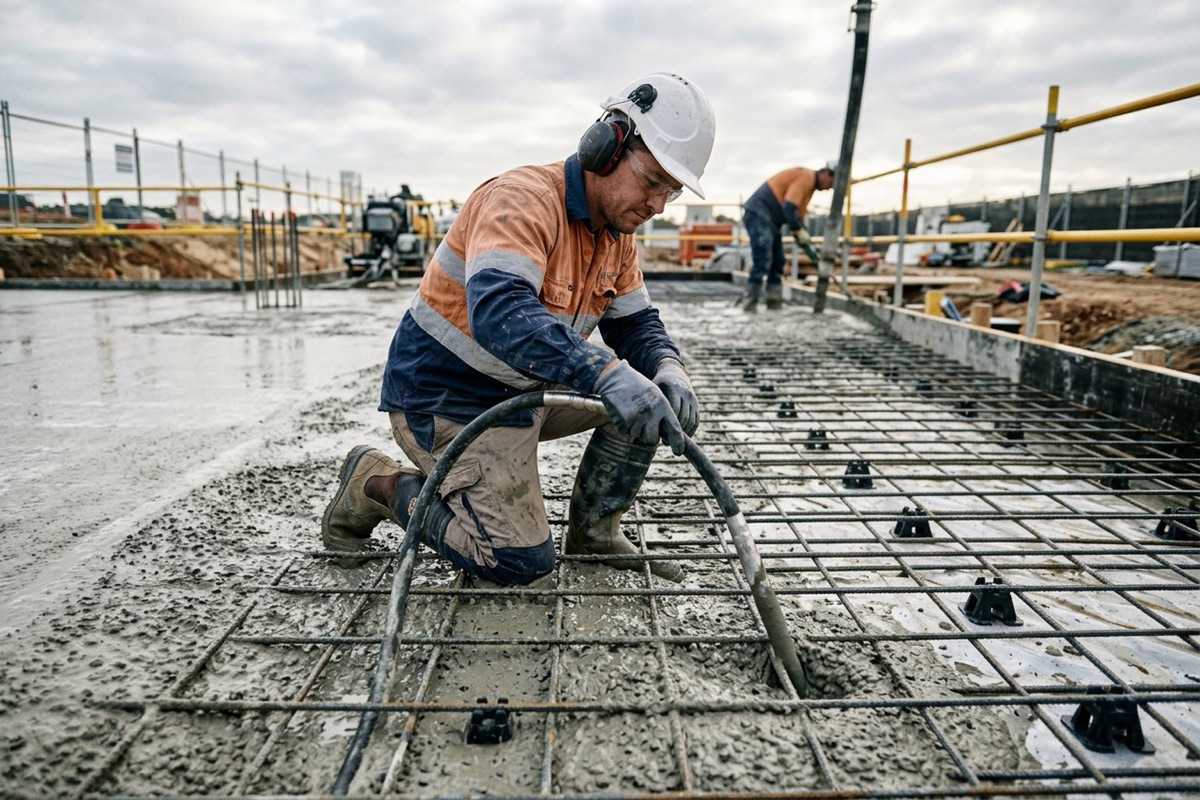
- Poor concrete placement. Inadequate cover, exposed reinforcement and honeycombing.
- Weather damage. Concrete placed in rain without protection.
- Cut reinforcement. Required bars cut or damaged, often when coring or chasing without scanning first.
- Joint errors. Movement joints in suspended slabs, or saw-cut and isolation joints in slabs on ground, not built as the approved plans show.
- Contamination. Debris and other material entrained in the concrete.
Most of these trace back to site practice rather than design. The library quotes AS 3600:2018, which requires concrete to be placed and compacted so that it completely fills the formwork and closely surrounds all reinforcement, and to be protected from rain, running water, freezing and drying before it hardens. Our guide to why concrete cracks explains cover, curing and exposure classification.
What goes wrong with cladding, roofing and the building envelope?
The building enclosure keeps water out of the structure, and its defects often show up years later as damp, rot or corrosion inside the walls. The Building Defects Library’s enclosure section highlights:
- Damp-proof courses that do not project from the face of the brickwork.
- Weepholes that are missing, too far apart, or below the floor level.
- Windows and doors installed without adequate flashings.
- Flashings that do not project far enough to shed water clear of the masonry.
- Combustible cladding used where the NCC does not permit it.
Combustible cladding is both an enclosure and a fire safety issue, and it has driven major remediation programs in several states. Our guide to combustible cladding in Australia explains the current rules.
Roof leaks are a frequent complaint on houses. Queensland’s building regulator, the QBCC, notes in its home maintenance guide that some roof leaks are due to defective building work, but that many are caused by a lack of maintenance and cleaning. That distinction matters when deciding who is responsible.
When is cracking a defect?
Not every crack is a defect. Concrete shrinks as it dries and clay soils swell and shrink with the seasons, so some cracking in walls and slabs is expected. CSIRO’s homeowner guide, Foundation Maintenance and Footing Performance, reproduces the wall damage classification from Table C1 of AS 2870-2011:
| Damage category | Approximate crack width | Typical damage | |—|—|—| | 0 – Negligible | Under 0.1 mm | Hairline cracks | | 1 – Very slight | Under 1 mm | Fine cracks that do not need repair | | 2 – Slight | Under 5 mm | Noticeable but easily filled; doors and windows stick slightly | | 3 – Moderate | 5–15 mm, or several cracks of 3 mm or more in one group | Repairable, possibly with some wall replaced; doors and windows stick | | 4 – Severe | 15–25 mm, depending on number of cracks | Extensive repair; frames distort, walls lean or bulge |
Whether a crack is a defect depends on its width, pattern, cause and the standards and tolerances that apply in your state. The cause matters most: cracking from an undersized footing is the builder’s problem, while cracking from a leaking pipe or overwatered garden next to the slab may be the owner’s.
Why do building defects happen?
Regulators and researchers rarely point to a single cause. Most defects come from a few recurring patterns:
- Incomplete design. Drawings that do not detail junctions, falls, flashings or penetrations leave trades to improvise.
- Hidden work. Membranes, reinforcement, fire-stopping and wall framing are covered within days, often before anyone checks them.
- Trade interfaces. One trade breaches another’s work, such as a plumber cutting a fire-rated wall or a balustrade installer drilling through a membrane.
- Substitution. Products swapped for cheaper alternatives without checking they match the design or tested system.
- Program pressure. Concrete poured in poor weather, curing cut short, or slabs loaded too early.
- Poor records. Work that may be compliant but cannot be proved, because there are no photos, test reports or certificates.
Building Commission NSW notes that the defects in its library are cheaper and easier to fix during construction, with the cost of rectification rising sharply once a building is occupied. That is the core argument for prevention.
What are regulators doing about defects?
NSW has made the biggest regulatory changes, mainly for apartment buildings:
- Building Commission NSW launched on 1 December 2023 to bring building regulation, licensing and enforcement under one body.
- Proactive audits. Since September 2020, the regulator has audited Class 2, 3 and 9c buildings during construction rather than relying on complaints.
- Residential Apartment Buildings Act 2020. Gives the regulator powers to stop work, require developers to fix serious defects and act before occupation.
- Design and Building Practitioners Act 2020. Created a statutory duty of care to avoid economic loss caused by defects, plus practitioner registration and compliance declarations, with Class 2 buildings its original focus.
- Rectification orders. Where serious defects are confirmed through inspection, Building Commission NSW may issue an order describing the work required and the deadline.
Other states rely mainly on licensing, complaints processes and statutory warranties. In Victoria, the Building and Plumbing Commission replaced the Victorian Building Authority on 1 July 2025, and Consumer Affairs Victoria states that the statutory warranties on domestic building work apply for up to 10 years after the occupancy permit or certificate of final inspection. In NSW, statutory warranties run for 6 years for major defects and 2 years for other defects. Our guide to statutory warranties and home warranty insurance covers each state.
How do inspections and quality systems prevent defects?
The single most effective control is checking work before it is covered. That happens at two levels.
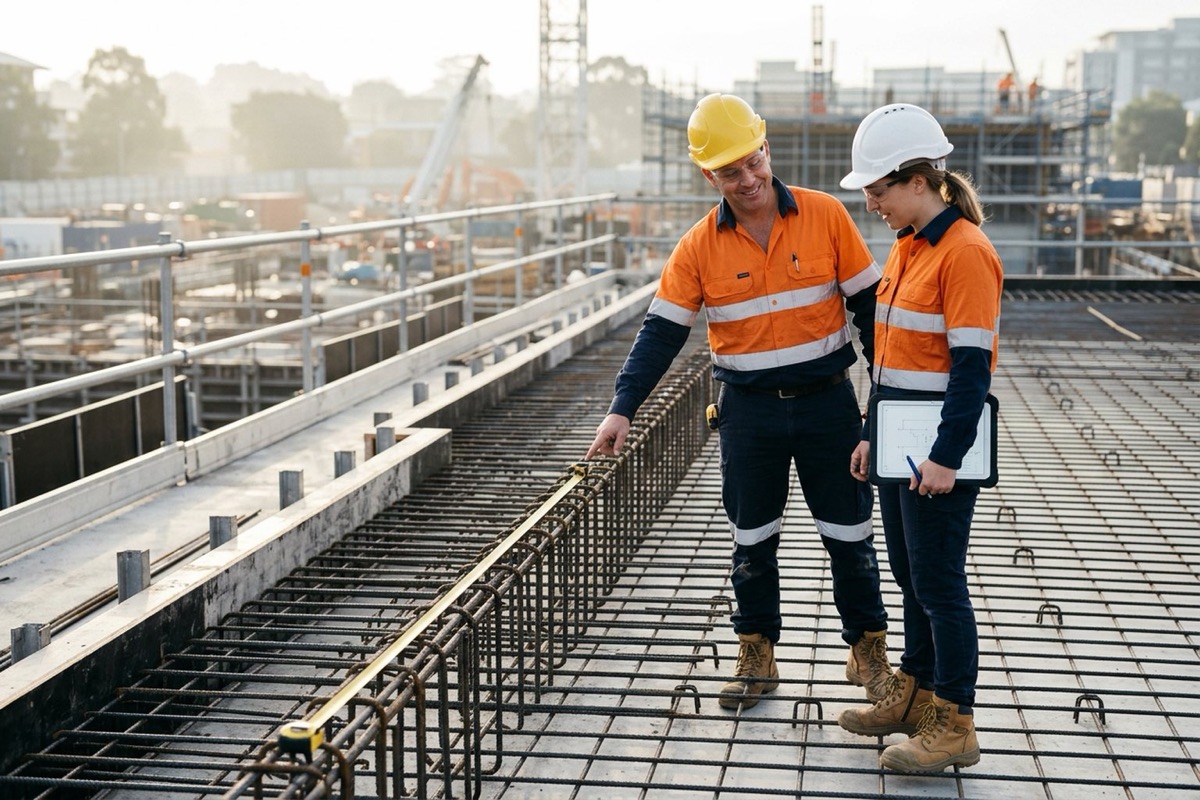
Statutory inspections. Building surveyors and certifiers inspect at set stages. In NSW, the critical stage inspections for houses include after excavation for footings, before pouring in-situ reinforced concrete, before covering the framework, before covering waterproofing in wet areas, before covering stormwater connections and after completion. Other states set their own mandatory inspection or notification stages. These inspections are spot checks, not quality control.
Inspection and test plans (ITPs). An ITP is the builder’s own quality system for each activity. It lists what will be checked, the acceptance criteria, who checks it and what record is kept. Good ITPs include:
- Hold points. Work stops until a nominated person signs off, such as reinforcement before a pour or a membrane before tiling.
- Witness points. The engineer, certifier or client is invited to attend.
- Acceptance criteria. Taken from the drawings, the NCC and the referenced standards, not from memory.
- Records. Dated photos, test results, delivery dockets and sign-offs tied to a location.
A defect found at a hold point costs minutes. The same defect found after handover can mean demolition, an occupied building and a dispute.
Building defect prevention checklist
- Detail every junction. Falls, flashings, penetrations, terminations and movement joints on the drawings.
- Confirm the NCC edition and the editions of the standards that apply to the project.
- Write ITPs with hold points for footings, reinforcement, waterproofing, fire-stopping and framing.
- Inspect before covering. Never close up work that has not been checked and recorded.
- Control substitutions. Any product change goes back to the designer, and to the certifier where it affects compliance.
- Coordinate trades so later work does not breach membranes, fire walls or flashings.
- Protect and cure concrete as the specification requires, and do not pour in rain without protection.
- Hand over records and maintenance advice so owners know how to look after drainage, sealants and finishes.
Build it right the first time
CPD-accredited online courses on building defects, concrete durability, footings, timber framing and masonry, each with an assessment and a certificate.
- Building Defects: Prevention, Identification and Rectification View course →
- Durability of Concrete Structures View course →
- Site Classification and Footings for Residential Construction View course →
- Residential Timber Framing and Trusses View course →
- Timber Decks and Balconies: Design and Construction View course →
- Masonry Design and Detailing View course →
Frequently asked questions
What is the most common building defect in Australia?
In Building Commission NSW's 2025 survey of newer strata apartment buildings, waterproofing was the most prevalent serious defect, reported in 22% of buildings. Fire safety system defects were second at 16%.
What is the Building Defects Library?
It is a free reference published by Building Commission NSW listing defects that auditors found recurring in Class 2, 3 and 9c buildings. Version 1.1 was published in June 2025 and is based on NCC 2022. It covers waterproofing, fire safety, structure, building enclosure and services.
Are cracks in a new house a defect?
Not always. Hairline and fine cracks are often within normal movement for concrete and masonry. Wider cracks, groups of cracks, sticking doors or distorted frames should be assessed against the standards and tolerances that apply in your state, and the cause investigated.
How long is a builder responsible for defects?
It depends on the state. In NSW, statutory warranties run for 6 years for major defects and 2 years for other defects. In Victoria, the statutory warranties apply for up to 10 years after the occupancy permit or certificate of final inspection.
What is an inspection and test plan?
An inspection and test plan is a quality document that lists each check for an activity, the acceptance criteria, who carries it out and what record is kept. It usually includes hold points where work cannot continue until the check is signed off.
Who can be liable for a building defect?
The builder is usually the first party responsible under the contract and statutory warranties. Designers, subcontractors and certifiers can also be liable depending on the cause. In NSW, the Design and Building Practitioners Act 2020 also creates a statutory duty of care to avoid economic loss caused by defects.
Sources and further reading
- Building Commission NSW — Research on serious building defects in NSW strata communities (2025)
- Building Commission NSW — Building Defects Library (v1.1, June 2025)
- Building Commission NSW — How Building Commission NSW deals with building defect complaints
- NSW Legislation — Design and Building Practitioners Act 2020
- CSIRO — Foundation Maintenance and Footing Performance (Building Technology Resource)
- QBCC — Your essential guide to home maintenance
- Consumer Affairs Victoria — Building problems after property settlement
- Hornsby Shire Council — Critical stage inspections and occupation certificates