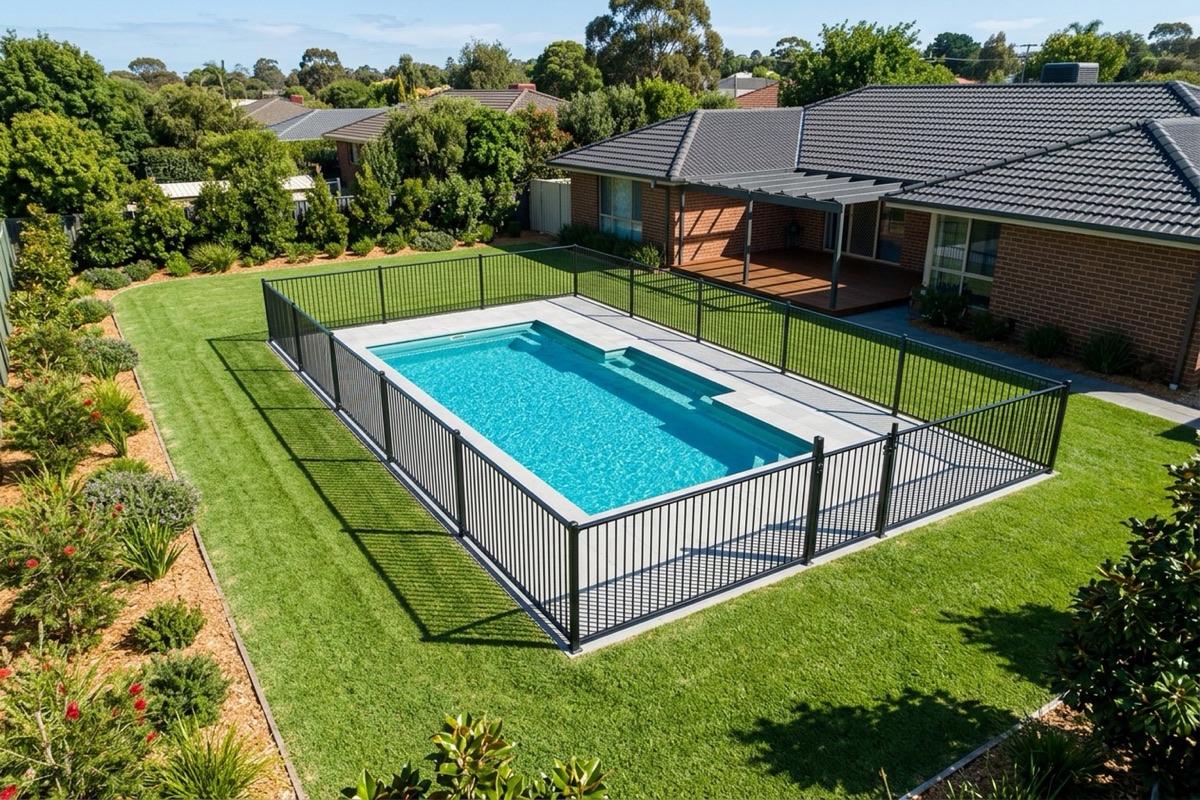
Every swimming pool or spa that can hold more than 300 mm of water needs a child-resistant safety barrier. Under the NCC, the Deemed-to-Satisfy route is H7D2 for houses and G1D2 for apartments and similar buildings, both pointing to AS 1926.1 and AS 1926.2. The core figures are a barrier at least 1200 mm high, no more than 100 mm under it, a clear non-climbable zone, and gates that open away from the pool and close and latch by themselves.
Each state then adds its own regime. NSW runs a pool register with compliance certificates on sale and lease, Queensland requires QBCC registration and pool safety certificates, Victoria requires council registration and a barrier certificate every four years, and WA local governments inspect barriers at intervals of no more than four years.
What counts as a swimming pool for barrier rules?
The NCC’s barrier provisions apply to a swimming pool with a depth of water of more than 300 mm, and the NCC definition of swimming pool includes spas. Portable and inflatable pools are not exempt:
- NSW. The law applies to structures capable of holding water deeper than 300 mm, including portable pools and spa pools, on residential property.
- Queensland. QBCC’s homeowner guide covers pools, spas, portable and inflatable pools capable of holding more than 300 mm of water.
- Victoria. Councils require registration of all pools and spas capable of holding water deeper than 30 cm, including relocatable and inflatable pools, spas and hot tubs.
- Western Australia. All private pools, including spa pools and portable pools, with a water depth of more than 300 mm must have safety barriers. Spa baths are excluded.
The test is capacity, not how much water is in the pool today. Under the NCC, a pool is a Class 10b structure, which our guide to NCC building classifications explains.
What does the NCC require for pool barriers?
The NCC sets a Performance Requirement and points to Australian Standards for the Deemed-to-Satisfy (DTS) Solution.
- Performance Requirement H7P1 (Volume Two). A barrier must be continuous, strong enough to withstand the foreseeable impact of people, restrict young children’s access to the pool and its surrounds, and have gates and doors that close and latch automatically with latches young children cannot readily operate.
- DTS Provision H7D2(1) (Volume Two). For a pool deeper than 300 mm associated with a Class 1 building, H7P1 is satisfied by safety barriers installed in accordance with AS 1926.1 and AS 1926.2.
- DTS Provision G1D2(1) (Volume One). Applies the same approach to a pool deeper than 300 mm associated with a Class 2 or 3 building or a Class 4 part of a building.
- Water recirculation. H7D2(2) and G1D2(2) require pool water recirculation systems to comply with AS 1926.3, to avoid entrapment and injury.
AS 1926.1 sets out how a barrier is designed and built. AS 1926.2 deals with where barriers are located. A barrier that departs from the standards can still comply through a Performance Solution assessed against H7P1.
Which edition of AS 1926.1 applies?
NCC 2022 references AS 1926.1-2012 and AS 1926.2-2007. NCC 2025 references the newer AS 1926.1:2024, still alongside AS 1926.2-2007, and modifies clause 2.3.1 of the 2024 standard, so the two must be read together.
Not every state followed. WA’s Building and Energy division confirmed in May 2026 that a state variation keeps AS 1926.1-2012 for new private swimming pools in WA, so the 2024 edition and its clause 2.3.1 modification do not apply there. WA’s Building Regulations 2012 also modify parts of the 2012 edition.
Existing pools are judged against the standard that applied when they were built. In NSW, for example, the NSW Government lists AS 1926-1986 for pools built before August 2008, AS 1926.1-2007 for pools built from September 2008 to April 2013, and AS 1926.1-2012 for pools built after May 2013. Our guide to NCC 2025 adoption dates has the state-by-state picture.
What are the key barrier dimensions?
AS 1926.1 is paywalled, so these figures come from regulator and council guidance that quotes it: QBCC’s pool safety compliance fact sheet and a NSW council fact sheet based on AS 1926.1-2012.
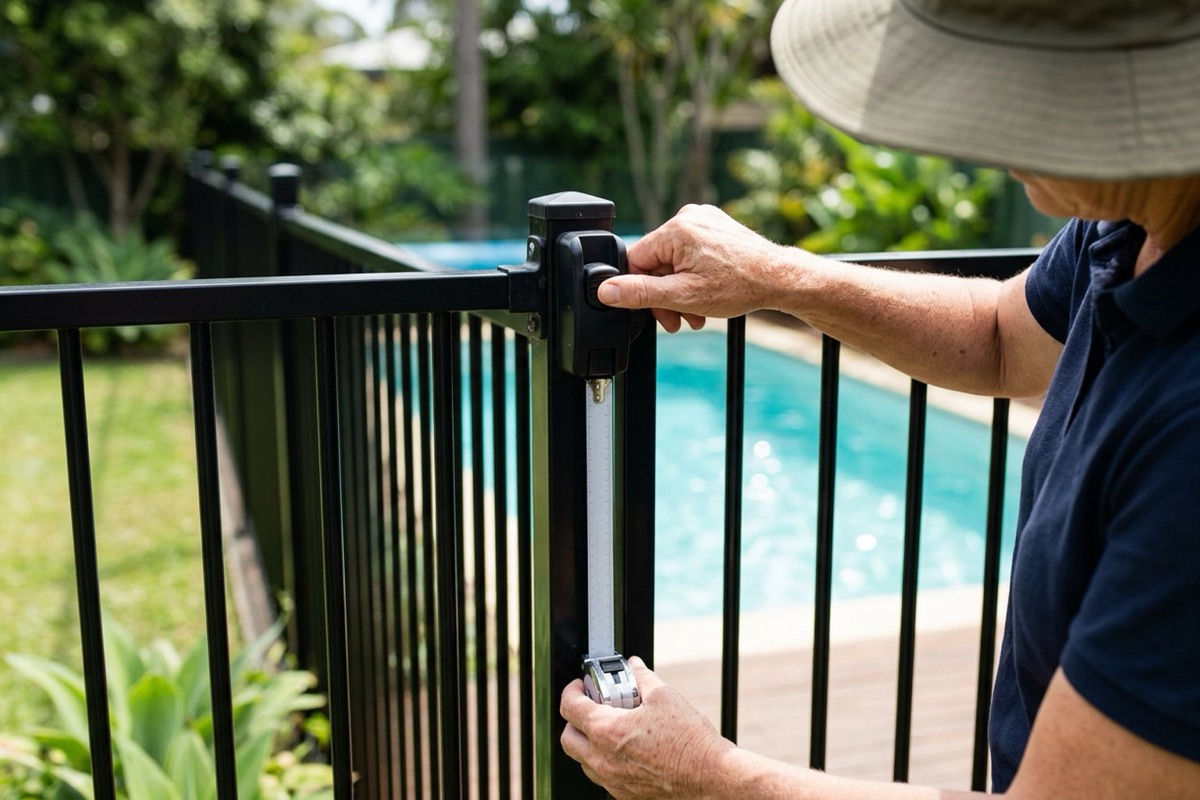
- Height. At least 1200 mm from finished ground level to the top of the barrier, measured on the outside.
- Gap underneath. No more than 100 mm between finished ground level and the bottom of the barrier.
- Vertical gaps. No more than 100 mm between vertical members. In Queensland’s guidance, where horizontal rails are less than 900 mm apart, gaps between verticals must not exceed 10 mm.
- Non-climbable zone. Climbable objects must be kept at least 900 mm from the outside of the barrier, and Queensland’s guidance adds 300 mm on the inside.
- Boundary fences. Where a 900 mm clear zone cannot be kept outside, as on many boundary fences, both guides describe a barrier at least 1800 mm high measured from the pool side, with a 900 mm non-climbable zone at the top on the inside.
Treat these as the common baseline and check the exact clause for your edition before building.
What are the rules for pool gates, doors and windows?
Gates are the most-used part of any barrier and the most likely to fail. Guidance on AS 1926.1 sets out:
- Direction. Gates must swing outwards, away from the pool area.
- Self-closing. The gate must close by itself from any open position, not just from fully open.
- Self-latching. The latch must engage automatically when the gate closes.
- Latch height. The latch release on the outside must be at least 1500 mm above the ground. In NSW guidance, a lower latch is only allowed on the inside of the gate where you must reach over the barrier, with shielding around it.
Doors and windows are tighter still. In both NSW and Queensland, a door from the house generally cannot open directly into the pool area for an outdoor pool. A window that opens into the pool area must be restricted to open no more than 100 mm or protected by a fixed security screen.
How do pool safety rules differ between states?
The NCC covers new work. The ongoing duty to keep a barrier compliant sits in state law.
- New South Wales. Under the Swimming Pools Act 1992, every pool and spa must be registered on the NSW Swimming Pool Register. A contract for sale must include a registration certificate and one of a recent occupation certificate (issued within 3 years), a certificate of compliance, or a certificate of non-compliance. If a non-compliance certificate is attached, the buyer has 90 days after settlement to fix the defects. For a lease, the landlord must give the tenant a certificate of compliance or an occupation certificate; a non-compliance certificate cannot be used. Certificates of compliance last three years, and councils run inspection programs.
- Queensland. Regulated pools must be registered with the QBCC. A pool safety certificate (Form 23), issued only by a QBCC-licensed pool safety inspector, is needed when selling, buying or leasing; it is valid for 1 year for shared pools and 2 years for non-shared pools. Selling without one requires a Notice of No Pool Safety Certificate (Form 36), and the buyer must obtain a certificate within 90 days of settlement.
- Victoria. Under the Building Regulations 2018, pools and spas deeper than 30 cm must be registered with the local council. Owners must have the barrier inspected by a registered building surveyor or building inspector and lodge a certificate of pool and spa barrier compliance with council every four years.
- Western Australia. Local governments must inspect private pool and spa barriers, with a maximum of four years between inspections.
- South Australia, Tasmania, the ACT and the NT. SA, Tasmania and the ACT rely on the NCC provisions, with SA and Tasmania adding their own variations, and the NT regulates pool barriers under its Swimming Pool Safety Act. Registration, inspection and sale rules differ, so check your state or territory regulator before relying on any rule above.
In every state, a certificate shows the barrier passed on the day; the owner must keep it compliant every day after.
What are the most common pool fence failures?
WA’s Building and Energy guidance names gates propped open, faulty latches and gates that do not self-close properly as common ways children gain access. Other frequent failures include:
- Climbable objects. Chairs, pot plants, barbecues, eskies, toys or bins left inside the 900 mm non-climbable zone outside the fence.
- Growing gardens. Shrubs, trees and overhanging branches that grow into the zone or give a foothold.
- Lost height. Garden beds, mulch, pavers or decks raised against the fence that cut the effective height below 1200 mm.
- Gaps. Washed-out soil under panels, broken palings, or a gap at the hinge side of a gate.
- Tired hardware. Sagging gates and latches that no longer catch.
- Windows. A window into the pool area with a removed restrictor or a flyscreen in place of a security screen.
Most are maintenance failures that appear after the certificate is issued, which is why regular self-checks matter.
Pool barrier compliance checklist
- Confirm the pool is regulated. Any pool or spa capable of holding more than 300 mm of water, including portable and inflatable pools.
- Identify the standard. Find the AS 1926.1 edition that applied when the pool was approved.
- Measure the height. At least 1200 mm on the outside, with no raised ground eating into it.
- Check underneath. No more than 100 mm under the barrier along its full length.
- Clear the zone. Nothing climbable within 900 mm of the outside of the fence.
- Test the gate. Release it from several positions; it must close and latch every time without help.
- Check the latch. Release on the outside at least 1500 mm above the ground.
- Check doors and windows. No direct door access, and windows restricted to 100 mm or screened.
- Register the pool. With the NSW Swimming Pool Register, the QBCC or your Victorian council.
- Keep certificates current. Renew before selling, leasing or the next inspection cycle.
Our pillar guide, What is the National Construction Code, explains how the NCC and state laws fit together.
Get pool barriers right first time
CPD-accredited online courses on swimming pool safety, the NCC housing provisions and building inspections, each with an assessment and a certificate.
- Swimming Pool Safety and Compliance View course →
- NCC Volume Two: Housing Provisions for Homes and Outbuildings View course →
- NCC Volume One: Multi-Residential, Commercial and Public Buildings View course →
- NCC 2025: Key Changes and Managing the Transition View course →
- Occupation Certificates and Critical-Stage Inspections View course →
- The Building Surveyor’s Code of Practice View course →
Frequently asked questions
Do inflatable pools need a fence in Australia?
Yes, if they can hold more than 300 mm of water. NSW, Queensland, Victoria and WA all treat portable and inflatable pools above that depth as swimming pools, so they need a compliant barrier and, in some states, registration.
How high does a pool fence have to be?
The barrier must be at least 1200 mm high, measured from finished ground level on the outside. Where a boundary fence forms part of the barrier, NSW council guidance calls for at least 1800 mm measured from the pool side.
Which way must a pool gate open?
Outwards, away from the pool area. The gate must also close by itself from any open position and latch automatically, with the latch release on the outside at least 1500 mm above the ground.
What is the non-climbable zone?
It is the clear area around the barrier that must have no objects or footholds a child could use to climb. Guidance based on AS 1926.1 requires climbable objects to be at least 900 mm from the outside of the fence.
Which NCC clause covers pool fencing?
For houses, Performance Requirement H7P1 and Deemed-to-Satisfy Provision H7D2 in Volume Two. For Class 2 and 3 buildings and Class 4 parts, G1D2 in Volume One. Both point to AS 1926.1 and AS 1926.2 in NCC 2022 and NCC 2025.
Do I need a pool certificate to sell my house?
In NSW and Queensland, yes. NSW requires a registration certificate plus an occupation, compliance or non-compliance certificate in the contract. Queensland requires a pool safety certificate or a Form 36 notice.
Sources and further reading
- ABCB — NCC 2022 Volume Two, Part H7 Ancillary provisions and additional construction requirements (H7P1, H7D2)
- ABCB — NCC 2025 Volume Two, Part H7 Ancillary provisions and additional construction requirements (H7P1, H7D2)
- ABCB — NCC 2022 Volume One, Part G1 Minor structures and components (G1D2)
- ABCB — NCC 2022 Volume Two, Schedule 2 Referenced documents (AS 1926.1-2012, AS 1926.2-2007)
- ABCB — NCC 2025 Volume Two, Schedule 2 Referenced documents (AS 1926.1:2024)
- WA Building and Energy — Industry Bulletin 175: BCA 2025 State additions and variations, private swimming pools (May 2026)
- WA Government — Swimming pool and spa safety barrier requirements
- NSW Government — Owning a pool or spa: your obligations
- QBCC — Buy, sell or lease a property with a pool
- QBCC — Swimming pool safety laws
- QBCC — Guide to pool safety for homeowners (March 2024)
- QBCC — Pool safety compliance fact sheet (hosted by Paroo Shire Council)
- Goulburn Mulwaree Council (NSW) — Pool fence requirements FAQ
- Maroondah City Council (Vic) — Swimming pool and spa registration and fencing
- Standards Australia — AS 1926.1-2012 Swimming pool safety, Part 1: Safety barriers for swimming pools
- Standards Australia — AS 1926.1:2024 Swimming pool safety, Part 1: Safety barriers for swimming pools