Most construction businesses need three core insurances: public liability for injury and property damage to other people, contract works for loss or damage to the works themselves, and professional indemnity if they give advice or do design. Workers compensation is a separate, state-based scheme that employers must have, and home warranty insurance is another separate cover that protects home owners.
Who takes out each policy usually depends on the contract, not on habit, so the insurance clauses deserve a careful read before you sign. Some licences also depend on cover: in Victoria, Queensland and Tasmania, for example, certain registrations or licence classes require proof of insurance. This guide is general information; talk to a licensed insurance broker and get legal advice about your own situation.
What insurance does a construction business need?
There is no single “builder’s policy” that covers everything. Most businesses end up with a combination of covers, often bundled in a construction package from an insurer or arranged by a broker. The main ones are:
- Public liability. Covers your legal liability if someone else is injured or killed, or their property is damaged, because of your business activities.
- Contract works. Covers physical loss or damage to the works under construction, and usually materials on site, from events such as fire, storm, theft and vandalism.
- Professional indemnity (PI). Covers claims that your professional advice, design or services were negligent and caused someone a financial loss.
- Workers compensation. Compulsory for employers, covering employees who are injured or become ill because of their work.
- Home warranty insurance. Required in most states for residential work above a threshold, and taken out for the home owner’s benefit.
Tools, vehicles and business interruption cover may also be worth considering, depending on your work, contracts and licence.
What does public liability insurance cover?
Business.gov.au describes public liability insurance as cover if someone dies, gets injured or has their property damaged because of your negligence. On a building site, that could be a neighbour’s fence knocked down by an excavator, a member of the public hurt by a falling object, or water damage to the rest of a house during a bathroom renovation.
Public liability generally does not cover your own employees’ injuries, which fall under workers compensation, or the cost of fixing your own defective work. Policies also commonly contain exclusions and conditions relevant to construction, such as limits on certain types of work, height, hot work or underground services, so check the wording against what you actually do.
Head contracts and subcontracts usually set a minimum level of public liability cover, and principals and head contractors often ask for a certificate of currency before you start on site. The Queensland regulator, the QBCC, notes that most contracts require the contractor to have public liability insurance, and that a home owner may also be required under the contract to take out public liability cover before work starts.
What is contract works insurance and who takes it out?
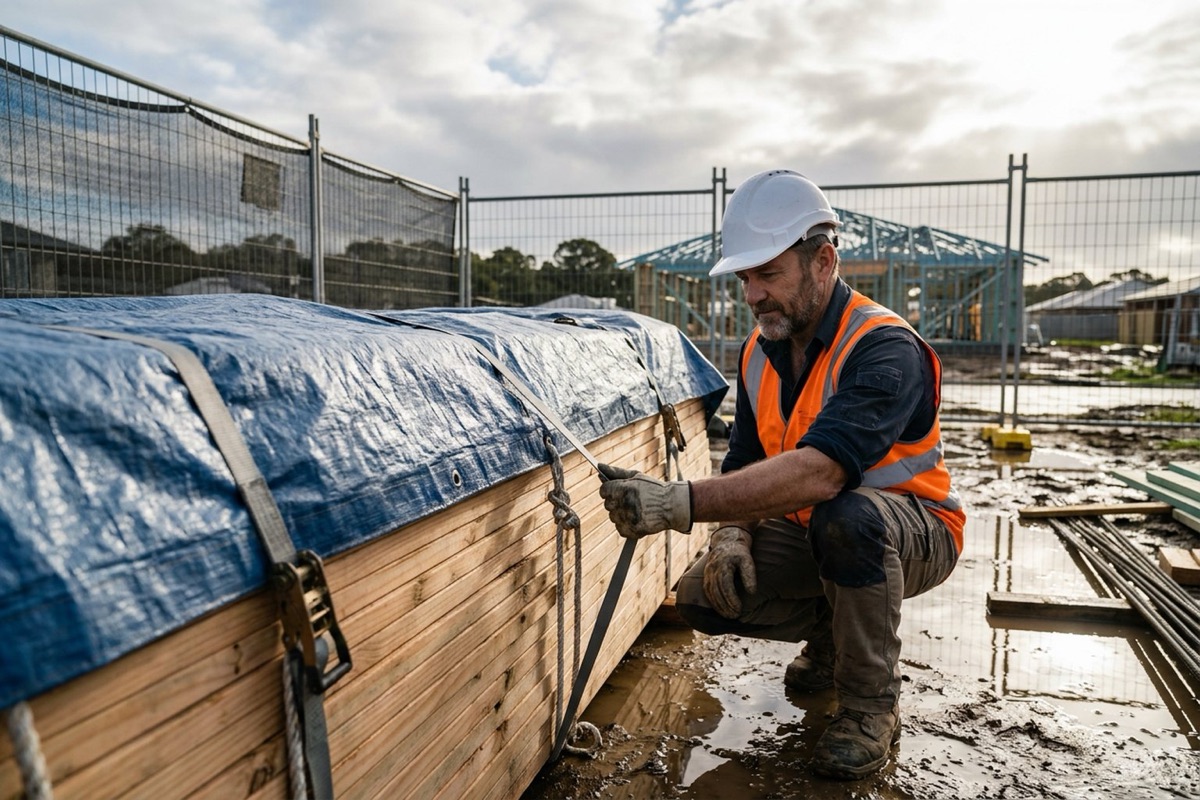
Contract works insurance, also called construction works insurance, protects the project itself. The QBCC describes it as covering the site and materials against theft, vandalism, fire, storm and similar events. If a storm flattens a newly erected frame, or a fire destroys a half-finished house, this is the policy that is meant to pay to rebuild.
Who arranges it depends on the contract:
- Contractor-arranged. On most residential and small commercial jobs, the builder or head contractor takes out contract works cover for the project, often naming the principal as an insured party too.
- Principal-arranged. On larger projects the owner may buy one policy covering itself and all contractors. NSW Treasury Circular TC16-11, for example, requires most NSW Government agencies to insure capital works projects estimated at $10 million or more on a principal arranged insurance basis through icare.
- Subcontractors. Subcontractors are often covered under the head contractor’s or principal’s project policy, but only to the extent the policy says. Check whether you are a named or noted insured, and whether you carry the excess.
Contract works cover should run from the start of work until the works pass to the owner, usually at practical completion. Make sure the sum insured keeps pace with the contract price as variations add value; our guide to building contract basics explains how variations change the contract.
What does professional indemnity insurance cover and who needs it?
Professional indemnity insurance covers claims arising from your professional advice or services. Business.gov.au explains that it covers mistakes, neglect or breaches of contract that result in a loss for your client, and that it is mandatory for some professions.
In construction, PI is most relevant to:
- Designers and engineers, including building designers, architects and structural, civil, mechanical, electrical and fire safety engineers.
- Building surveyors, certifiers and building inspectors.
- Quantity surveyors and project managers.
- Design and construct contractors, who take on design responsibility under the contract even if they subcontract the design.
Public liability policies generally do not cover a pure financial loss caused by a design error, which is the gap PI fills. PI is generally written on a “claims made” basis: the policy that responds is usually the one in force when the claim is made, not the one in force when the work was done. Because building claims can arise years after completion, ask your broker about run-off cover if you stop practising, change structure or close the business.
Do you need insurance to hold a building licence?
In some states and categories, yes. Requirements depend on your licence or registration class and change from time to time, so check with your regulator. Verified examples include:
- Victoria. The Building and Plumbing Commission (BPC) requires evidence that an applicant holds the required insurance, or in some cases is eligible to buy it, before it grants or renews registration. PI insurance is required for categories including building surveyor, building inspector, quantity surveyor and building designer, and for endorsed building engineers. Public liability insurance is required for demolishers and for erectors or supervisors of temporary structures. The detail is set by a Ministerial Order.
- Queensland. The QBCC requires professional indemnity insurance for certain licence classes only, including its building design classes (low rise, medium rise and open) and builder project management services. An exemption may be available where PI is economically unviable for the business.
- Tasmania. Consumer, Building and Occupational Services (CBOS) lists contract works and public liability insurance, with a minimum of $5 million public liability, among its consumer protection requirements for builders.
Home warranty insurance also has a licensing angle in some states, because a builder must be eligible for cover to take on insured residential work. Our guide to home warranty insurance explains each state’s scheme.
How is workers compensation different from other construction insurance?
Workers compensation is not a commercial policy you shop for freely. Safe Work Australia explains that there is a scheme for each state and territory, plus three Commonwealth schemes, each governed by different laws. Employers must generally take out workers compensation insurance under the scheme that applies to their workers, such as icare in NSW, WorkSafe Victoria or WorkCover Queensland. Where workers move between states, check which scheme applies.
Three points catch building businesses out:
- Contractors may count as workers. Each scheme has its own rules on who is a “worker” or “deemed worker”, and a subcontractor engaged mainly for their labour can fall within them. Your premium may need to reflect those payments.
- Sole traders are not covered by their own policy. Business.gov.au notes that sole traders are not covered by workers compensation and should consider personal accident and sickness insurance.
- Principal contractor liability in NSW. Under section 175B of the Workers Compensation Act 1987 (NSW), a principal contractor can be liable for a subcontractor’s unpaid workers compensation premiums unless it holds a written subcontractor’s statement for the relevant period. Our guide to engaging subcontractors covers the paperwork to collect.
Where does home warranty insurance fit?
Home warranty insurance (called different names in each state) is not a cover for the builder. It protects the home owner if the builder dies, disappears or becomes insolvent, and in Queensland and now Victoria it can also respond when a builder will not complete or fix the work. The builder must usually arrange the cover before taking a deposit or starting work on residential jobs above the state threshold.
It does not replace public liability, contract works or PI cover. A builder doing residential work typically needs all of them.
What should you check in the contract's insurance clauses?
The contract decides who insures what, for how much and for how long. Standard forms deal with this in detail. The 1997 edition of AS 4000, for example, has separate clauses on insurance of the works, public liability insurance, insurance of employees, and inspection and provision of policies. Industry forms from HIA and Master Builders have their own insurance clauses for residential work.
Before signing, check:
- Who insures the works, for what sum, and from when until when.
- Minimum public liability and PI limits, and how long PI must be kept after completion.
- Whose names must appear on each policy, and whether cross liability or waiver of subrogation wording is required.
- The excess and who pays it if a claim is made.
- Proof of insurance, including when certificates of currency are due and what happens if you fail to produce them.
- Indemnity clauses, which can make you liable for losses your policy does not cover.
- Subcontractor requirements, so the insurance you require from your subcontractors matches what your head contract requires of you.

Checklist: insurance before you start a job
- List the covers you hold and the limits, excesses and expiry dates of each.
- Read the contract’s insurance and indemnity clauses before you sign, and price any extra cover they require.
- Confirm who arranges contract works cover and make sure the sum insured matches the contract price.
- Check licence requirements with your state regulator for your licence or registration class.
- Arrange home warranty cover for residential work above your state’s threshold before taking a deposit.
- Register for workers compensation in each state where you employ workers, and review it when your labour mix changes.
- Collect certificates of currency from every subcontractor, and NSW subcontractor’s statements where they apply.
- Tell your broker about changes in the type, size or location of your work.
- Keep records of incidents and notify insurers promptly of anything that could become a claim.
Get your insurance right before the job starts
CPD-accredited online courses on construction insurance, contract law and managing risk, each with an assessment and a certificate.
- Construction Insurance: PI, Public Liability and Contract Works View course →
- Basic Contract Law for Building and Construction View course →
- Managing Risk and Reducing Disputes in Construction View course →
- Home Building Law, Statutory Warranties and Home Warranty Insurance View course →
- Contract Administration: Variations, Claims and Extensions of Time View course →
Frequently asked questions
Is public liability insurance compulsory for builders?
Not everywhere as a matter of law, but it is required for some licence types, such as builders in Tasmania and some Victorian registration categories, and most construction contracts require it. In practice, very few builders can win work without it.
What is the difference between public liability and professional indemnity insurance?
Public liability covers injury to people and damage to their property caused by your business. Professional indemnity covers financial loss caused by negligent advice, design or professional services. A design error that costs a client money but injures no one is a PI matter.
Who pays for contract works insurance?
It depends on the contract. On most residential jobs the builder arranges it and builds the cost into the price. On some larger projects the principal arranges one policy for everyone, which is called principal arranged insurance.
Does my public liability policy cover my employees?
No. Injuries to your employees are covered by workers compensation, which is a separate, state-based scheme. Sole traders need to consider personal accident and sickness insurance for themselves.
Do subcontractors need their own insurance?
Usually, yes. Most subcontracts require subcontractors to hold their own public liability and workers compensation cover, and to give certificates of currency. They may also be covered under a head contractor's or principal's contract works policy, but only as that policy states.
Is home warranty insurance the same as contract works insurance?
No. Contract works insurance covers physical damage to the works during construction. Home warranty insurance protects the home owner in defined situations, such as the builder's death, disappearance or insolvency, and in some states when the builder will not complete or fix the work.
Sources and further reading
- business.gov.au — Business insurance (public liability, professional indemnity, workers compensation)
- QBCC — Insurance responsibilities (public liability, contract works, home warranty)
- QBCC — Professional indemnity insurance (licence eligibility requirement)
- Building and Plumbing Commission (Vic) — Builders: insurance for registration
- Building and Plumbing Commission (Vic) — Building Practitioners and Endorsed Building Engineers Insurance Ministerial Order
- CBOS Tasmania — Tasmanian consumer protection requirements
- Safe Work Australia — Workers' compensation
- NSW Treasury — TC16-11 Mandatory principal arranged insurance (PAI) for all major capital works projects