Under the model WHS Regulations, a business must ensure the noise a worker is exposed to at the workplace does not exceed the exposure standard: an eight-hour average (LAeq,8h) of 85 dB(A), or a peak (LC,peak) of 140 dB(C). Workers who frequently need hearing protectors because noise exceeds that standard must be given audiometric testing within 3 months of starting the work and at least every 2 years.
Vibration has no prescribed exposure standard in the model Regulations, but the general duty to manage risks still applies to hand-arm vibration from tools like jackhammers and grinders and whole-body vibration from mobile plant. Separately, state environment protection authorities and councils limit when noisy work can happen near neighbours.
What is the noise exposure standard?
The model WHS Regulations set a two-part exposure standard for noise:
- LAeq,8h of 85 dB(A) — the average noise level over an eight-hour working day; and
- LC,peak of 140 dB(C) — the highest instantaneous level, such as an impact or explosive tool firing.
Exceeding either part breaches the standard. The two limits target different harms. The eight-hour average deals with the slow, cumulative damage from a working life around noisy plant. The peak limit deals with acoustic trauma — a single very loud noise can damage hearing instantly.
The decibel scale is logarithmic. An increase of 3 dB represents a doubling of sound energy, so 88 dB(A) for four hours delivers about the same noise dose as 85 dB(A) for eight. Shifts longer than eight hours count as well: the standard is an eight-hour equivalent, so a twelve-hour shift at the same level gives a higher dose.
SafeWork NSW’s rule of thumb is useful on site: if you have to raise your voice to be heard, the noise level is likely to be 85 dB(A) or more.
What do the WHS Regulations require for noise?
Part 4.1 of the model WHS Regulations deals with noise:
- Regulation 56 defines the exposure standard.
- Regulation 57 requires the business to manage the risk of hearing loss from noise, and to ensure the noise a worker is exposed to does not exceed the exposure standard.
- Regulation 58 requires audiometric testing for workers who frequently need hearing protectors.
- Regulation 59 puts duties on designers, manufacturers, importers and suppliers of plant to minimise noise emissions and provide information about the plant’s noise.
Safe Work Australia’s model Code of Practice: Managing noise and preventing hearing loss at work (updated November 2024) explains how to comply. It also recommends audiometric testing where workers are exposed to ototoxic substances — chemicals that can damage hearing — together with noise above 80 dB(A) LAeq,8h or 135 dB(C) peak.
These requirements apply in every state and territory that has adopted the model laws. Victoria is different — see below, and our guide to which WHS laws apply in your state.
How do you control noise on a construction site?
The WHS hierarchy of control applies: eliminate the noise if reasonably practicable, and otherwise minimise it, working down from the most effective controls. In practice:
- Eliminate or substitute. Choose a quieter method — hydraulic rather than impact piling, a diamond saw or crusher instead of a breaker, bolting instead of riveting — and buy or hire quieter plant. Regulation 59 obliges suppliers to tell you how noisy their plant is; ask for that information before you choose.
- Isolate. Increase the distance between people and the noise source, use enclosures, screens and barriers around compressors and generators, and operate plant remotely where possible.
- Engineering controls. Fit and maintain silencers, mufflers and dampening, and keep plant serviced; worn bearings and loose panels add noise.
- Administrative controls. Schedule noisy work when fewer people are nearby, rotate tasks to cut each person’s exposure time, and keep people out of high-noise zones unless they need to be there.
- Personal protective equipment. Hearing protectors come last, after other controls, and must be suitable for the exposure.
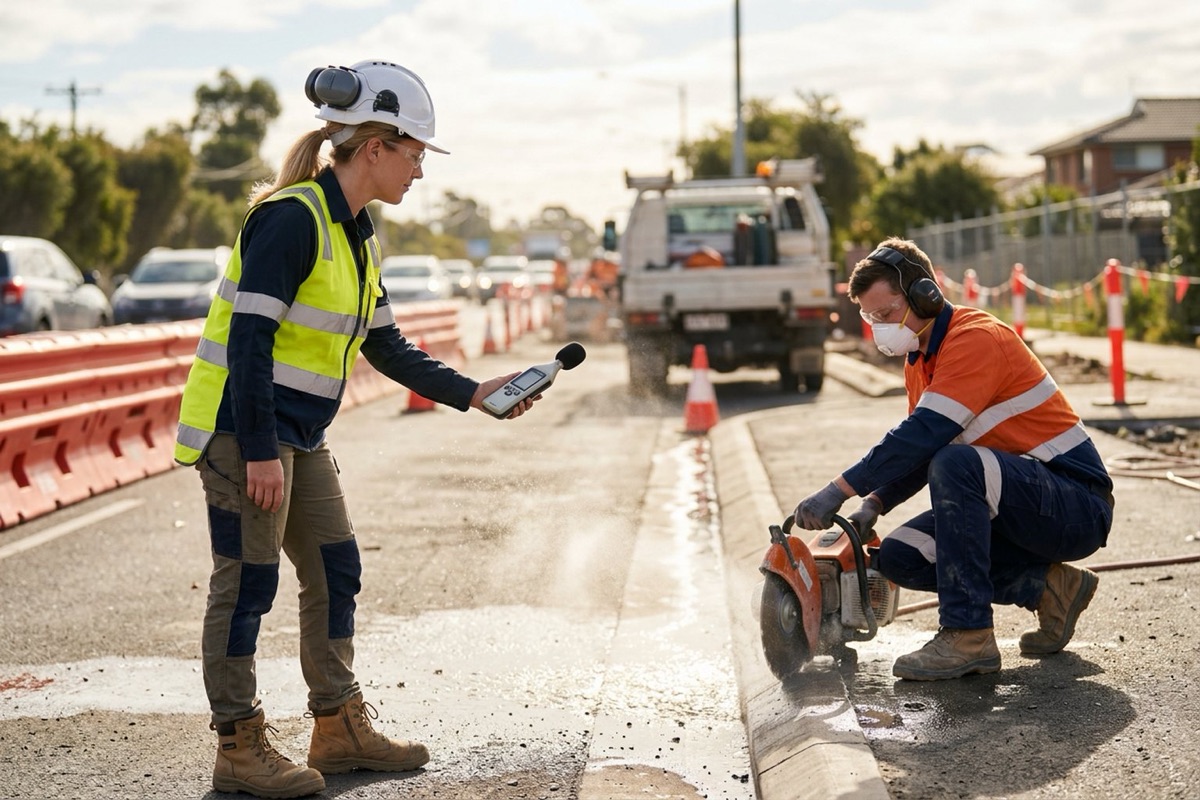
Get a noise assessment where there is any doubt about whether exposure exceeds the standard. It tells you who is at risk, what is causing it and which controls will have the most effect.
When are hearing protectors needed, and which ones?
Where other controls cannot keep exposure below the standard, the business must provide hearing protectors. To work, they have to be:
- selected for the noise — the Code refers to AS/NZS 1269.3 Occupational noise management – Hearing protector program, and suppliers should give attenuation information, including the SLC80 rating and class;
- comfortable and compatible with hard hats, safety glasses and other PPE, or workers will remove them;
- fitted properly and worn for the whole time the worker is in the noise — taking earmuffs off for even a short part of a shift sharply cuts the protection they give over the day; and
- maintained and replaced — worn cushions and stretched headbands leak noise.
Mark hearing protection zones clearly so everyone knows where protectors must be worn. Explain the reasons in a toolbox talk rather than just handing out earplugs.
When must workers have audiometric testing?
Under regulation 58, the business must provide audiometric testing to a worker who is frequently required to use personal hearing protectors to protect them from hearing loss associated with noise that exceeds the exposure standard. The test must be provided:
- within 3 months of the worker starting that work, to establish a baseline; and
- at least every 2 years after that.
WorkSafe WA explains that “frequently” means using hearing protection often or commonly as part of normal work, not occasionally. It also says tests should be carried out by a competent person in line with AS/NZS 1269.4, and that workers should be given copies of their results.
NSW deferred this requirement when it adopted the model laws; it has applied there since 1 January 2024.
What are hand-arm and whole-body vibration?
Hand-arm vibration is transmitted through the hands and arms from hand-held power tools and hand-guided plant: jackhammers and concrete breakers, grinders, hammer drills, chainsaws, compactor plates and impact wrenches. Long-term exposure can cause hand-arm vibration syndrome, including vibration-induced white finger, as well as carpal tunnel syndrome and nerve damage that reduces grip strength and dexterity.
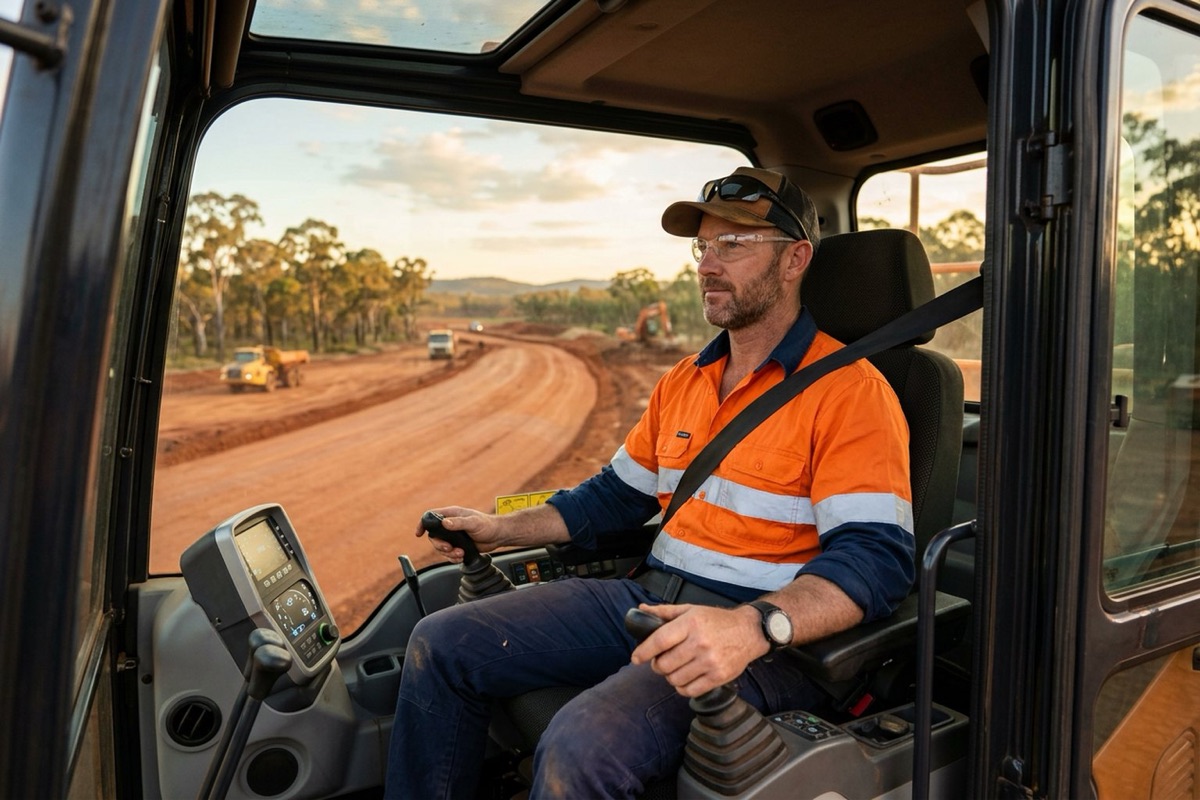
Whole-body vibration is transmitted through the seat or the feet — mainly to operators and drivers of mobile plant such as excavators, rollers, dump trucks and loaders, especially over rough or unsealed ground. Frequent exposure is linked to lower back, neck and shoulder disorders.
Is there an exposure standard for vibration?
No. The model WHS Regulations contain no prescribed exposure standard for hand-arm or whole-body vibration. The general duty to eliminate or minimise risks so far as is reasonably practicable still applies.
Safe Work Australia publishes guides to measuring and assessing workplace exposure to both types. They point to AS ISO 5349.1 and 5349.2 for hand-arm vibration and AS 2670.1 for whole-body vibration, and use European Union action and limit values as benchmarks. SafeWork NSW cites a daily exposure action value of 2.5 m/s² A(8) and a limit value of 5.0 m/s² A(8) for hand-arm vibration, and 0.5 m/s² and 1.15 m/s² A(8) for whole-body vibration — useful reference points, not Australian legal limits.
Practical controls include:
- choosing low-vibration tools and methods, and checking manufacturers’ vibration data before buying or hiring;
- maintaining tools — blunt bits, worn discs and unbalanced parts increase vibration;
- limiting each person’s time on high-vibration tools and rotating tasks;
- fitting suspension seats, maintaining haul roads and controlling speed for plant operators; and
- keeping hands warm and dry in cold weather, and training workers to report tingling, numbness or whitening of the fingers early.
How is Victoria different?
Victoria has not adopted the model WHS laws. Noise is regulated under the Occupational Health and Safety Regulations 2017, with WorkSafe Victoria’s Compliance code: Noise as practical guidance. The core settings are the same — an exposure standard of 85 dB(A) averaged over eight hours and a peak of 140 dB(C) — and where an employer must provide hearing protectors to keep employees below the standard, it must provide audiometric testing within 3 months of the employee starting that work and at least every 2 years. WorkSafe Victoria notes testing must also be provided on a reasonable request by a health and safety representative. Use the Victorian terms: employer and employee rather than PCBU and worker.
What rules apply to noise affecting neighbours?
Workplace noise rules protect workers. Noise that reaches neighbours is regulated separately, by state environment protection authorities, councils and development consent conditions. Examples:
- NSW — the EPA’s Interim Construction Noise Guideline recommends standard hours of 7 am to 6 pm Monday to Friday and 8 am to 1 pm Saturday, with no work on Sundays or public holidays. Development consents commonly set the hours that apply to a particular site.
- Victoria — EPA Victoria’s Civil construction, building and demolition guide sets normal working hours of 7 am to 6 pm Monday to Friday, and on Saturday 7 am to 1 pm for commercial, industrial and major infrastructure work or 9 am to 1 pm for residential construction. EPA Victoria says councils deal with noise complaints about residential building sites.
Work outside these hours usually needs justification, extra controls and consultation with neighbours. Vibration from piling, compaction and demolition can also affect nearby buildings, so check consent conditions before heavy work starts.
Noise and vibration checklist
- Identify noisy and vibrating tasks and the plant involved, and get noise data from suppliers.
- Assess exposure where it may exceed 85 dB(A) LAeq,8h or 140 dB(C) peak.
- Apply the hierarchy: quieter methods and plant first, then isolation and engineering controls.
- Limit exposure time through scheduling and task rotation.
- Provide suitable hearing protectors, mark protection zones and check they are worn.
- Arrange audiometric testing within 3 months and at least every 2 years for workers who frequently need protectors.
- Choose low-vibration tools, maintain them and limit time on them.
- Check site hours against EPA guidance, council rules and consent conditions.
- Consult workers and record what you have done.
Protect hearing and health on site
CPD-accredited online courses on heat, noise and vibration, dust and hazardous substances on construction sites, each with an assessment and a certificate.
Frequently asked questions
What is the legal noise limit on a construction site?
The exposure standard in the WHS Regulations is an eight-hour average of 85 dB(A) and a peak of 140 dB(C). The business must ensure workers are not exposed to noise above either level. Victoria applies the same levels under its own regulations.
How often do workers need a hearing test?
Workers who frequently need hearing protectors because noise exceeds the exposure standard must be tested within 3 months of starting the work, and at least every 2 years after that. More frequent testing may be appropriate for very high exposures.
Are earplugs enough to comply with the noise rules?
Not on their own. Hearing protectors are the last line of defence. The business must first eliminate or reduce noise through quieter methods and plant, isolation and engineering controls, and use hearing protectors for the noise that remains.
Is there a legal limit for vibration exposure in Australia?
No. The model WHS Regulations have no prescribed exposure standard for hand-arm or whole-body vibration. Businesses must still manage the risk, and Safe Work Australia guidance uses European action and limit values as benchmarks.
What is vibration white finger?
It is part of hand-arm vibration syndrome, caused by long-term use of vibrating tools. Blood vessels and nerves in the fingers are damaged, causing whitening, numbness and tingling, especially in the cold. The damage can be permanent, so early reporting matters.
What hours can construction work happen?
It depends on the state, council and any development consent. NSW EPA guidance recommends 7 am to 6 pm on weekdays and 8 am to 1 pm on Saturday. EPA Victoria's normal hours are 7 am to 6 pm on weekdays, with Saturday hours depending on the type of work.
Sources and further reading
- Federal Register of Legislation — Work Health and Safety Regulations 2011 (Cth), Part 4.1 Noise, regs 56–59 (model text)
- Safe Work Australia — Model Code of Practice: Managing noise and preventing hearing loss at work
- Safe Work Australia — Guide to measuring and assessing workplace exposure to hand-arm vibration
- Safe Work Australia — Guide to measuring and assessing whole body vibration
- WorkSafe Victoria — Noise: safety basics
- WorkSafe WA — Audiometric testing requirements
- SafeWork NSW — Hand-arm vibration
- NSW EPA — Interim Construction Noise Guideline
- EPA Victoria — Civil construction, building and demolition guide (publication 1834)