Essential safety measures are the fire and life safety systems and features a building relies on in an emergency — sprinklers, fire alarms and detectors, exit signs, emergency lighting, fire doors, fire-rated walls and the seals around service penetrations — and the building owner is responsible for keeping them working. The duty does not end when the occupancy permit or occupation certificate is issued; it lasts for the life of the building.
Each state sets its own maintenance and reporting rules. Victoria calls them essential safety measures and requires an annual essential safety measures report. NSW calls them fire safety measures and requires an annual fire safety statement. Queensland calls them prescribed fire safety installations and requires an annual occupier statement.
What counts as an essential safety measure?
An essential safety measure is anything provided in a building to keep people safe if there is a fire or other emergency. The terms differ between states, but the lists are broadly the same. Victoria’s Building Regulations 2018 set out the categories in Schedule 8:
- Building fire integrity — fire-resisting building elements, fire doors, smoke doors, fire windows and shutters, and fire protection at service penetrations and construction joints.
- Means of egress — paths of travel to exits, exits and fire-isolated stairs, and the doors along them.
- Signs — exit and direction signs, and signs warning against using lifts in a fire.
- Lighting — emergency lighting.
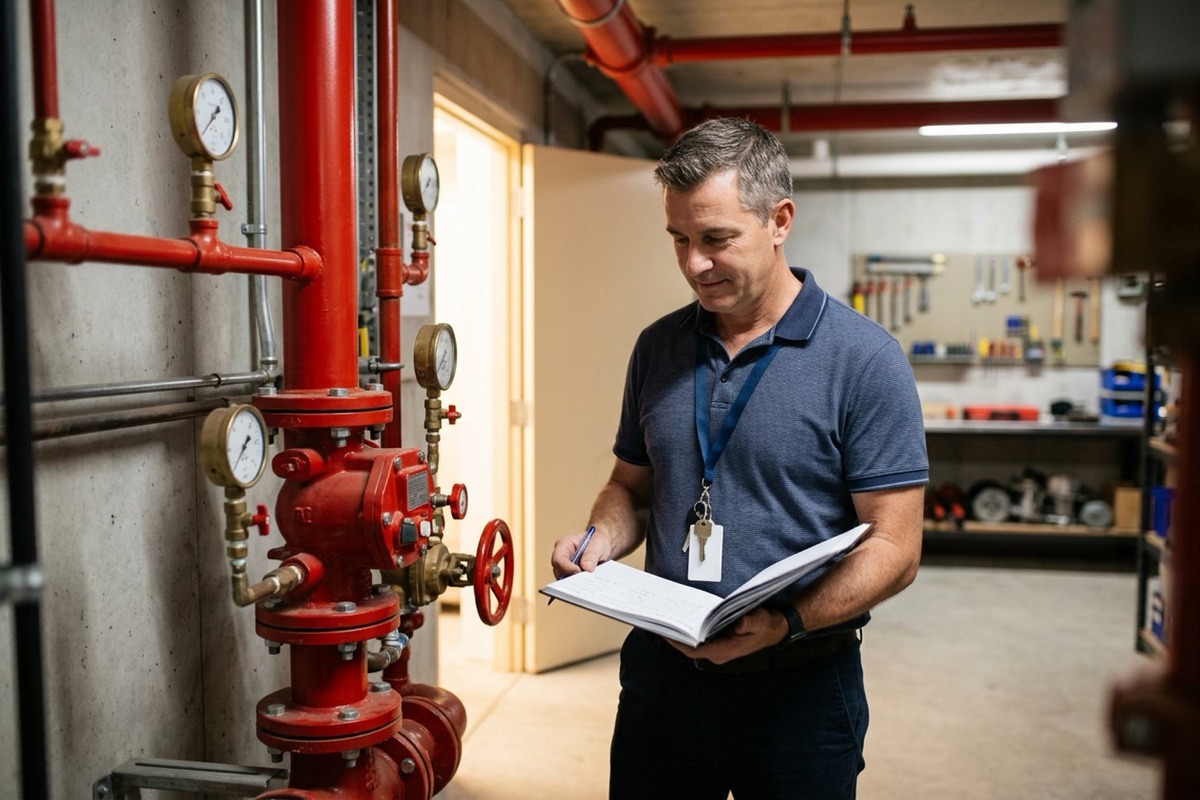
- Fire fighting services and equipment — hydrants, hose reels, sprinklers, portable fire extinguishers and fire control rooms.
- Air-handling systems — smoke control, stair pressurisation and smoke exhaust systems.
- Detection and alarms — automatic fire detection and alarm systems, and emergency warning systems.
Notice how much of the list is passive: walls, floors, doors and seals that do nothing until a fire starts. They are the measures most easily damaged by later building work. A new cable run through a fire-rated wall can undo the wall’s fire resistance in an afternoon — see fire-stopping at service penetrations.
Who is responsible for maintaining them?
In every state, the primary duty sits with the building owner. That can be an individual, a company, or an owners corporation or body corporate in a strata building. Owners usually engage fire protection contractors to do the inspection and testing, but the legal responsibility stays with the owner.
There are two common variations:
- Occupiers. Some regimes put duties on the occupier as well. In Queensland, the maintenance and occupier statement duties fall on the occupier of the building, so in a tenanted building that is usually the tenant. In Victoria, an occupancy permit can make the occupier responsible for maintenance.
- Exits. Keeping exits and paths of travel clear is often a separate duty on whoever occupies the building, day to day.
Most houses are outside these schemes. Victoria’s maintenance rules apply to Class 1b, 2, 3, 5, 6, 7, 8 and 9 buildings, Class 4 parts of buildings and places of public entertainment — not to an ordinary detached house. Smoke alarms in houses are covered by separate state rules.
How does Victoria regulate essential safety measures?
Victoria’s rules are in Part 15 of the Building Regulations 2018. The building surveyor lists each essential safety measure, its required level of performance and the frequency and type of inspection, testing and maintenance in the occupancy permit. Where work needs a building permit but no occupancy permit, the surveyor issues a maintenance determination instead. Under regulation 226, the owner must keep every required measure in a state that enables it to fulfil its purpose.
Each year, the owner must ensure an annual essential safety measures report is prepared within the 28 days before each anniversary of the date the first occupancy permit or maintenance determination requiring an essential safety measure was issued (regulation 223). The report must be in the approved form and signed by the owner, and it must state that the owner has taken all reasonable steps to ensure each measure is operating, has been maintained, and has been inspected, tested and maintained as required. Buildings constructed before 1 July 1994 have a fixed anniversary date of 13 June.
Under regulation 225, the owner must make the reports for the previous 10 years, the maintenance schedules and determinations, and all inspection, testing and maintenance records available at the building within 24 hours of a request from the municipal building surveyor or the chief officer of the fire brigade. The state’s building regulator, now the Building and Plumbing Commission (which replaced the Victorian Building Authority on 1 July 2025), publishes the approved report and determination forms.
How does NSW regulate fire safety measures?
In NSW the rules are in the Environmental Planning and Assessment (Development Certification and Fire Safety) Regulation 2021. A fire safety schedule lists each fire safety measure that applies to the building and the minimum standard of performance it must meet. The owner must maintain each measure to that standard.
The owner must ensure an annual fire safety statement is issued each year and give a copy to the local council and the Commissioner of Fire and Rescue NSW. Councils also require a copy to be displayed prominently in the building. In the statement, the owner declares that an accredited practitioner (fire safety) has assessed each essential fire safety measure as performing to its standard and has inspected the building’s exit systems. Measures the schedule identifies as critical fire safety measures also need supplementary fire safety statements at the shorter intervals the schedule sets.
The roles are deliberately separate: the practitioner assesses the measures, and the owner, or an authorised agent such as a strata manager, makes the declaration. A practitioner who assessed the measures must not sign the owner’s declaration.
From 13 February 2026, essential fire safety measures in all new and existing Class 1b and Class 2 to 9 buildings in NSW must be inspected and tested in accordance with AS 1851-2012.
How does Queensland regulate fire safety installations?
Queensland uses the term prescribed fire safety installations, under the Building Fire Safety Regulation 2008. The occupier must ensure each installation is maintained by an appropriately qualified person and is inspected and tested at the intervals set by Queensland Development Code MP6.1, which applies to Class 1b and Class 2 to 9 buildings, including existing buildings (section 54).
The occupier must also prepare an occupier statement about the maintenance of each prescribed fire safety installation at the intervals required by MP6.1 — in practice, yearly — and give a copy to the commissioner of the Queensland Fire Department within 10 business days of when it was due (section 55A). Business Queensland’s guidance says that in a tenanted building the tenant is responsible, in an owner-occupied building the owner is, and in a vacant building the owner signs the statement.
What about the other states and territories?
The other jurisdictions have their own schemes, with different names and forms. For example:
- South Australia calls them essential safety provisions. Owners of buildings in the required categories give the council an annual certificate of compliance (Form 3) confirming the provisions have been tested and maintained.
- Tasmania calls them essential building services. Under the Building Act 2016, owners must have a maintenance schedule for the building’s essential building services and keep maintenance records available for inspection.
In Western Australia, the ACT and the Northern Territory, check the requirements with the local building regulator or fire authority before relying on any general rule.
What is AS 1851?
AS 1851-2012 Routine service of fire protection systems and equipment is the Australian Standard most often used to set how fire protection systems are inspected, tested, maintained and surveyed, and how often. Its schedules cover systems such as fire detection and alarms, sprinklers, hydrants and hose reels, extinguishers, exit and emergency lighting, and passive fire elements such as fire doors.
How it applies depends on the state:
- In NSW, inspection and testing to AS 1851-2012 has been mandatory for essential fire safety measures in Class 1b and 2 to 9 buildings since 13 February 2026.
- In Victoria, the occupancy permit or maintenance determination sets the maintenance requirements. Where an older determination refers to AS 1851-2005 or an earlier standard, the Building Regulations allow the owner to comply with AS 1851-2012 instead — but once they do, they must keep complying with it, and the annual report must say so.
- In Queensland, the maintenance standard is set through QDC MP6.1.
Australian Standards are revised from time to time. Check which edition your approval documents and state law reference.
What goes wrong with essential safety measures?
The failures are usually ordinary ones:
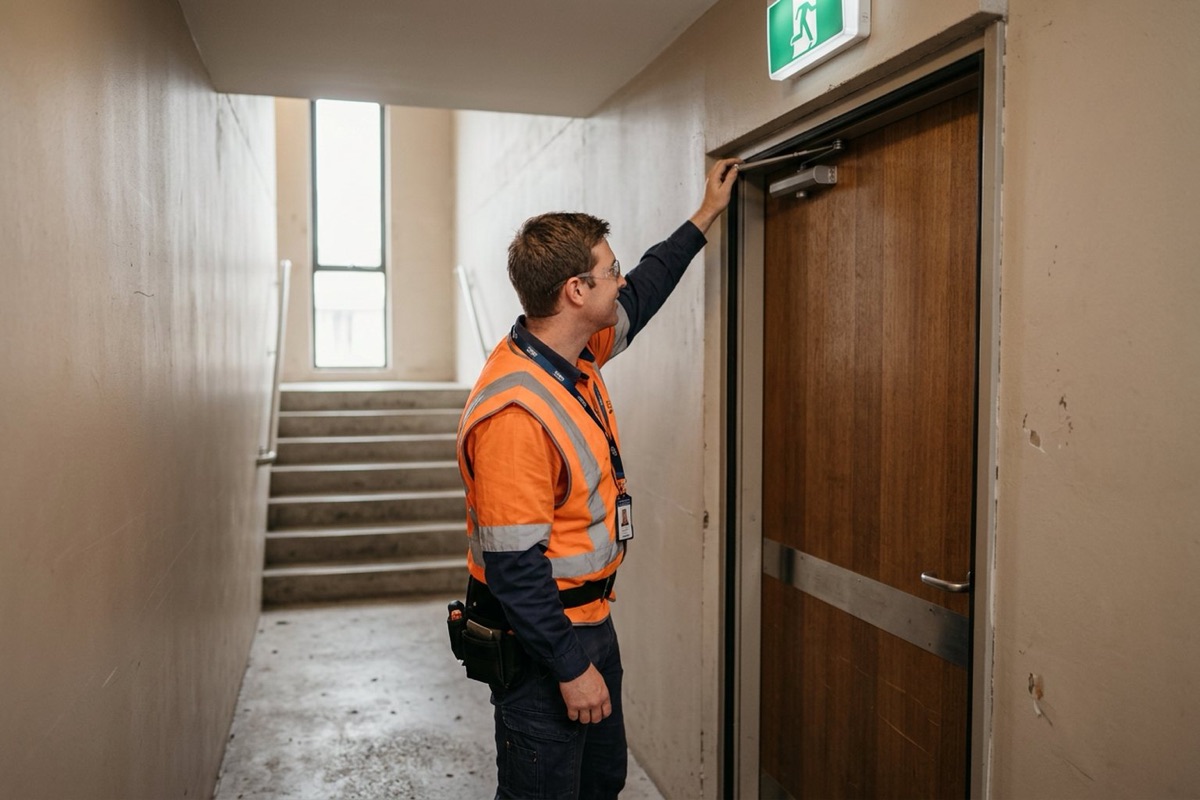
- Fire doors wedged open, or with broken self-closers and latches.
- New penetrations through fire-rated walls and floors, left unsealed or sealed with an untested product.
- Exits blocked by storage, furniture or locked doors.
- Defects found but not fixed, recorded year after year in the same service report.
- Missing records — no logbooks, no copies of past annual reports, no copy of the occupancy permit or fire safety schedule.
- Fit-outs and alterations that change the building without anyone updating the measures, or the paperwork.
Most of these are passive or administrative failures, not system breakdowns — which is why passive fire protection deserves as much attention as the alarm panel.
Essential safety measures checklist
- Find the source document — the occupancy permit, maintenance determination or fire safety schedule that lists the building’s measures.
- Confirm who is responsible — owner, occupier, owners corporation or body corporate — and record it.
- Engage competent contractors, and in NSW confirm that the people assessing the measures are accredited practitioners (fire safety).
- Set the service schedule to the frequencies in the approval documents and the relevant standard.
- Keep the records at the building: logbooks, service reports, repair records and past annual reports or statements.
- Fix defects promptly, and close out each one in writing.
- Lodge or prepare the annual report or statement on time for your state.
- Check every alteration, fit-out and new service penetration for its effect on the measures before work starts.
- Keep exits and paths of travel clear, every day.
Keep every safety measure working
CPD-accredited online courses on essential safety measures, fire safety schedules, passive fire protection and emergency lighting, each with an assessment and a certificate.
- Maintaining Essential Safety Measures in Buildings View course →
- Fire Safety Schedules and Audits View course →
- Exit and Emergency Lighting Compliance View course →
- Passive Fire Protection and Fire-Stopping View course →
- Fire Protection of Service Penetrations View course →
- Emergency Planning and Evacuation for Buildings View course →
Frequently asked questions
What is the difference between essential safety measures and fire safety measures?
They are different names for the same idea. Victoria uses essential safety measures, NSW uses fire safety measures, Queensland uses prescribed fire safety installations and South Australia uses essential safety provisions. Each state's law defines exactly which items are covered.
Who signs the annual essential safety measures report in Victoria?
The owner of the building must sign it. The owner may engage a contractor or agent to help prepare it, but the report must be in the approved form and signed by the owner.
When is the NSW annual fire safety statement due?
It must be issued each year, and a copy given to the local council and the Commissioner of Fire and Rescue NSW. Check your council's records for your building's due date. Supplementary statements for critical fire safety measures may be due more often, at the intervals in the fire safety schedule.
Does AS 1851 apply to my building?
In NSW it is mandatory for essential fire safety measures in Class 1b and Class 2 to 9 buildings from 13 February 2026. Elsewhere, it applies if your approval documents or state rules call it up, which they often do. Check the occupancy permit, maintenance determination or fire safety schedule.
Do houses need essential safety measures reports?
Generally not. The state schemes apply to apartment buildings, commercial, industrial and public buildings and similar classes, not ordinary detached houses. Houses still need working smoke alarms under separate state rules.
Can a tenant be responsible for fire safety maintenance?
Yes, in some cases. In Queensland the duty falls on the occupier, so in a tenanted building that is usually the tenant. In Victoria an occupancy permit can make the occupier responsible. Check the lease and the approval documents.
Sources and further reading
- Victorian Legislation — Building Regulations 2018, Part 15 and Schedule 8 (version in force)
- Building and Plumbing Commission (Victoria) — Essential safety measures
- NSW Department of Planning — Fire safety certification
- NSW Building Commission — Building fire safety requirements under AS 1851-2012
- NSW Legislation — Environmental Planning and Assessment (Development Certification and Fire Safety) Regulation 2021
- Queensland Legislation — Building Fire Safety Regulation 2008, ss 54–55A
- Business Queensland — Fire safety installations in buildings